Lanzhou & the Yellow River
A rail city on a muddy river, with the first iron bridge ever built across the Yellow River and the best noodle breakfast in the country.
 Start your enquiry
Destinations / Gansu
A province 1,600 kilometres long and, in places, eighty wide: a corridor of oases between snow mountains and desert, with a Tibetan south attached to it.
Explore the guide ↓The Hexi corridor · Gansu Province
Gansu is shaped like a corridor because it is one. From Lanzhou in the east to Dunhuang in the west is roughly 1,100 kilometres of road, and for most of that distance the province is a strip of cultivated ground squeezed between the Qilian mountains to the south and the Gobi and the Beishan to the north. The Silk Road went this way because there was nowhere else to go. So does the railway and the motorway.
That geography sets the itinerary. The Hexi corridor is a sequence of oasis towns — Wuwei, Zhangye, Jiuquan, Jiayuguan, Dunhuang — each with a walled centre, a garrison history and an irrigation system fed by Qilian meltwater. Between them the land is gravel plain for an hour at a time. The rule that follows is simple: travel it one way. Flying into Lanzhou and out of Dunhuang (or the reverse) turns a thousand kilometres into a line; doubling back turns it into two days of nothing.
The exception is the south. Gannan prefecture is Tibetan country at 3,000 metres, green in summer, with Labrang monastery at Xiahe and the stone village of Zhagana in Diebu. It belongs to a different Gansu — the one that borders Qinghai and Sichuan — and it is usually a separate trip, or the beginning of one that continues onto the plateau.
Two gateways, one fortress line and a Tibetan south. Read them in the order you would travel.
A rail city on a muddy river, with the first iron bridge ever built across the Yellow River and the best noodle breakfast in the country.
Painted mineral hills, a 35-metre reclining Buddha, and the fort that closed the Ming wall at the narrowest point of the corridor.
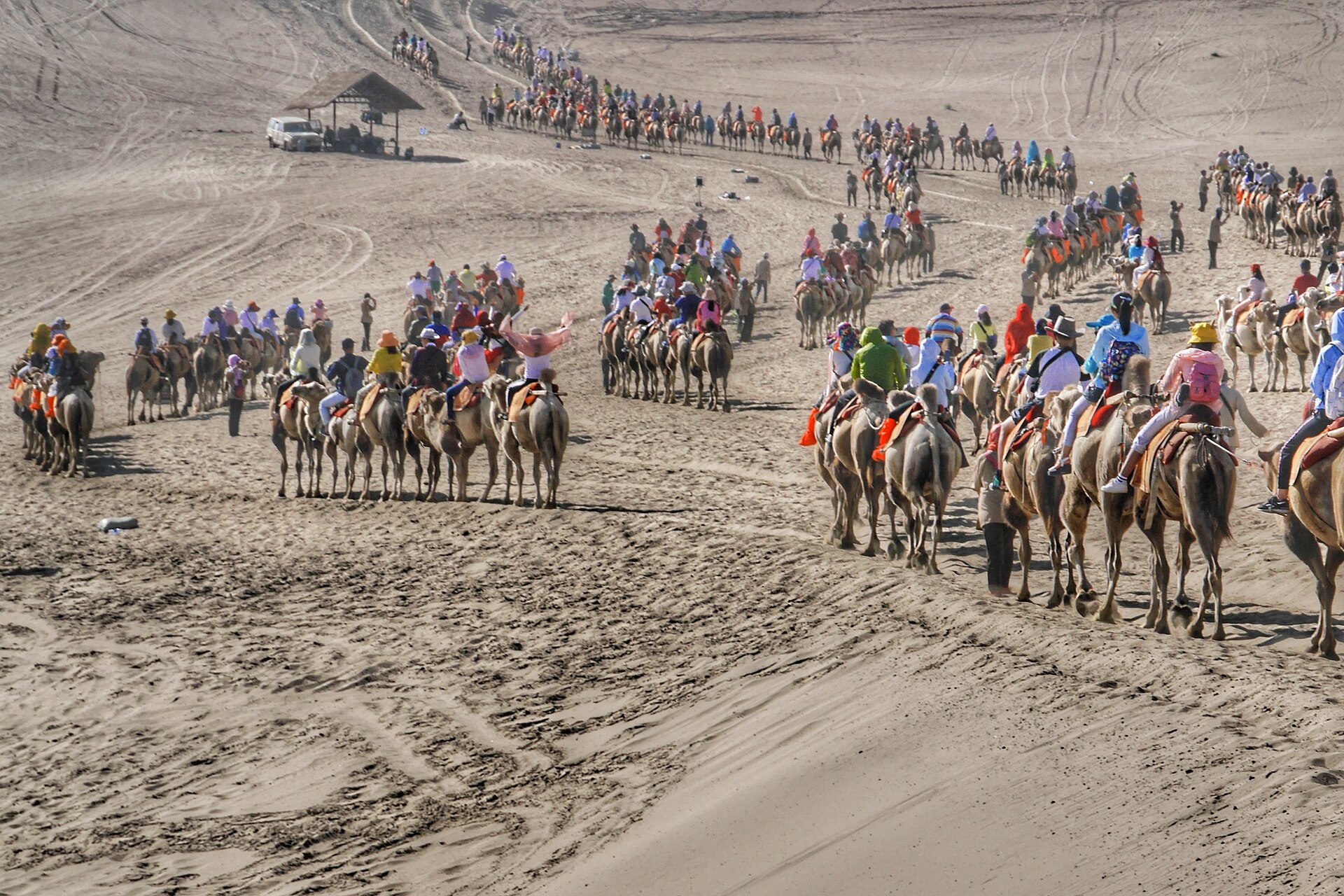
Seven hundred and thirty-five caves of Buddhist painting, a singing dune field beside the town, and two Han-dynasty passes out in the desert.
Labrang monastery and its six-kilometre kora, the grassland at Sangke, and the stone city of Zhagana in the mountains above Diebu.
One long corridor route, one desert camp, and a trek in the Tibetan south.
Zhangye’s danxia and great Buddha, the Jiayuguan fort, the Yulin caves and two full days at Dunhuang. The route the province was built around.
The tallest dunes in China, reached from the corridor’s northern edge, with lakes between them and nobody else camped on them.
The stone city above Diebu, walked rather than driven, with nights in the villages below the rock.
Days, prices, seasons and what combines with what — including the Qinghai and Xinjiang continuations.
What our team has written from Gansu and the desert beyond it.
The booking system, the timed slots, the numbered caves worth asking for and the ones that are never shown.
The physics of booming sand, and the reason Crescent Lake has not been buried yet.
Why the corridor mattered less as a road than as a set of oases that could feed a caravan.
Lakes between 400-metre dunes, and the logistics of camping out there without a support column of vehicles.
The stone city: four villages, two monasteries and a ridge line that photographs better in rain.
How the Gansu window compares with the plateau, Sichuan and Xinjiang.
A May-to-October corridor with sharp edges at both ends.
Warm days, cool nights, open passes and clean light. The dunes and the caves are workable without the summer queue.
Peak domestic season and real heat — Dunhuang regularly passes 35 °C. Mogao tickets sell out days ahead; book the caves before the flights.
The best fortnight of the year: dry air, clear skies, cold mornings and the poplars turning along the irrigation channels.
Cold, empty and cheap. The caves stay open and the dunes are at their best in low winter light, but some eastern routes and mountain roads close.
The Gansu facts that move each year: cave tickets, dune light and the desert season.
Mogao’s booking rules, the light windows at the danxia and the dunes, and the months the desert camps run.
Tell us whether you want the whole line or one end of it. The province rewards the one-way version, and punishes the return leg.
Start my journey brief ↗