The Mogao caves
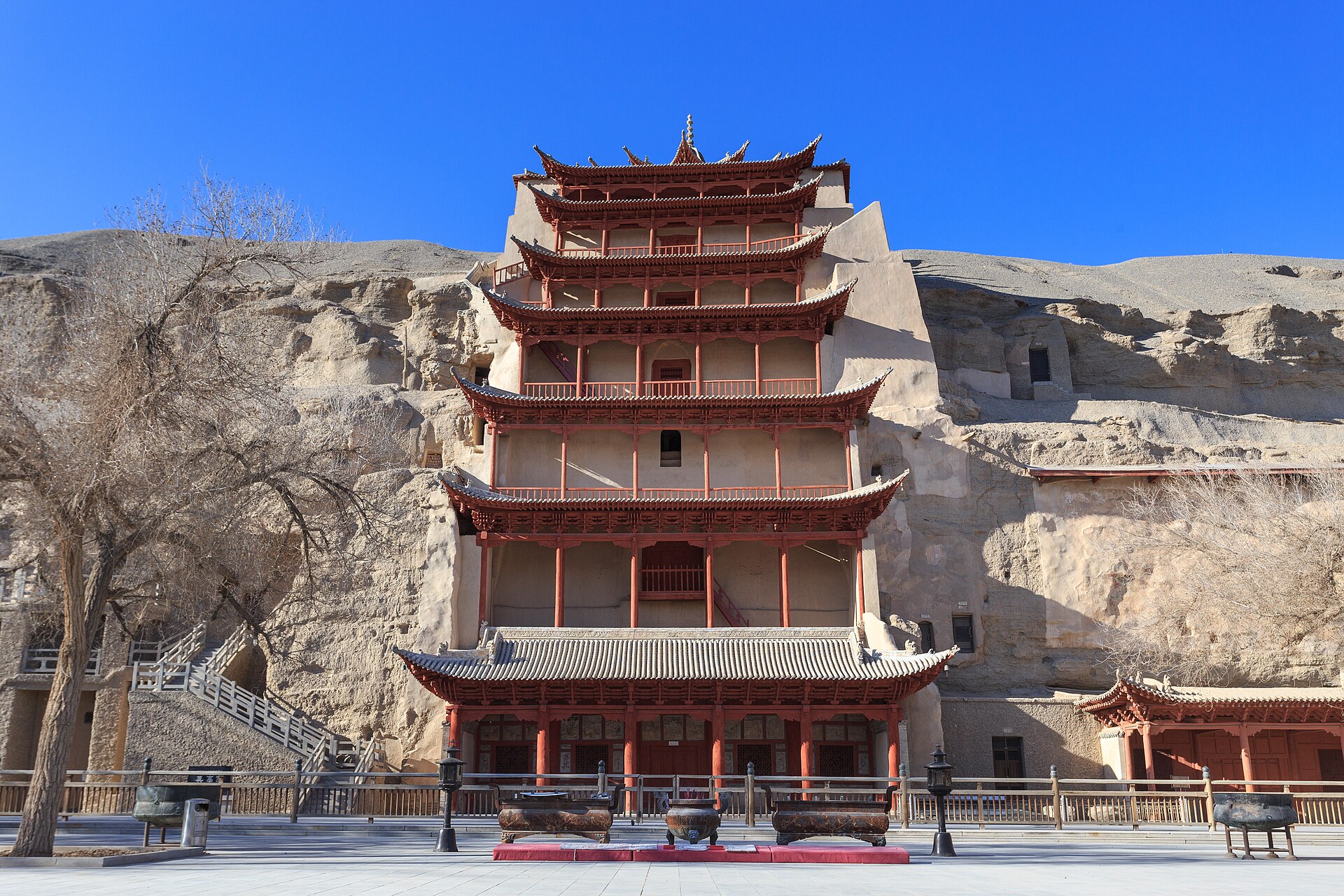
Eight or so general caves on the standard class, rotating to protect the paint; the special-access caves on the higher class. The nine-storey facade is Cave 96, not the oldest and not the best, but it is the one on the poster.
 Start your enquiry
Destinations / Gansu / Dunhuang
Seven hundred and thirty-five caves cut into a river cliff, forty-five thousand square metres of paint, and a dune field that hums when the wind crosses it.
Explore the guide ↓Western Gansu · Dunhuang, 1,100 m
Dunhuang sits in a basin at 1,100 metres, with the Mingsha dunes immediately south of the town and gravel desert on the other three sides. The oasis is fed by the Dang River, which is snowmelt from the Qilian range brought 200 kilometres through a system of channels that has been maintained, in one form or another, since the Han. Everything green here is irrigated; everything else is sand and stone.
The caves are 25 kilometres southeast, in a cliff above a dried riverbed. A monk called Yuezun stopped there in 366 AD, saw the cliff lit by a golden light, and cut the first cave. For the next thousand years patrons — local officials, merchants, the Tibetan empire, the Guiyi circuit, the Western Xia — kept cutting and painting. The result is 735 caves, 492 of them decorated, holding some 45,000 square metres of mural and more than 2,000 painted sculptures: the largest body of Buddhist art anywhere, and the reason Dunhuang is on every Silk Road itinerary ever printed.
The town itself is small, walkable and entirely given over to the trade. That is not a complaint. It has the best dates in China, a night market that runs until midnight, and two Han-dynasty passes out in the desert that are worth a half-day each. Two nights is the minimum; three is the right number.
The caves twice, the dunes at dusk, and the passes.
Eight or so general caves on the standard class, rotating to protect the paint; the special-access caves on the higher class. The nine-storey facade is Cave 96, not the oldest and not the best, but it is the one on the poster.
A dune field 40 kilometres wide with a spring-fed crescent at its foot. Go at six in the evening, walk past the camel loop, and climb the ridge away from the crowd.
A rammed-earth gate standing alone on the gravel, with the remains of a wall running from it. The emptiness is the exhibit.
Wind-cut clay ridges in a protected geopark, best in low light. A long day, and only worth it with a private vehicle and an early start.
A dry year with two hot months in the middle.
Warm days, cold nights and a lot of wind. Clear light and no queues; the sand can sting.
The best balance: long days, warm evenings, the dunes at their most workable, and the summer crowds not yet arrived.
Hot — often above 35 °C in the afternoon — and the busiest. Caves in the morning, sleep in the afternoon, dunes after seven.
The finest fortnight of the year: dry, still, 25 °C days and cold nights. Book the caves well ahead.
A long rail leg, or a flight into the desert.
The overnight train from Lanzhou takes about eight hours; the high-speed line now runs the corridor as far as Dunhuang, which has shortened it considerably. There are also direct flights from Xi’an, Lanzhou and Beijing.
Access is by timed class with a daily cap, and it sells out in season. Book before the flights, and if you can, book two sessions rather than one — the second visit is where the walls start making sense.
Yumen Pass and the Yadan are long drives on empty roads with no services. Carry water, fuel up in town, and do not attempt either in a summer afternoon.
A thousand years of patrons, in one cliff.
Cave 17 held tens of thousands of manuscripts, sealed around the eleventh century and reopened in 1900. Most of the contents left for London, Paris and St Petersburg; the story is told plainly at the site and better in the museum.
The murals are not decoration: they are sutra illustrations, donor portraits and pilgrimage diagrams, painted to be read. A guide who can point out the Jataka tales changes the visit entirely.
Apricot juice, lamb skewers, donkey-meat noodles and a wall of dried fruit. Tourist-facing and still good, which is rarer than it sounds.
Sand, sun and a cold night.
At 1,100 metres Dunhuang is the lowest point of most Gansu routes. It is a relief after the plateau and a good place to sleep properly.
Camera bags, phone ports, boot laces. A dry bag and a lens cloth are worth the space; the dunes at dusk are also the moment the wind gets up.
No photography inside, no touching, no tripods. Humidity from a crowd damages paint faster than sunlight does; the rotation and the caps exist for that reason.
Tell us how much time the caves get. One visit is a tour; two is an education, and the second one is the reason people come back.
Start my journey brief ↗