
Desert / Silk Road: the Hexi corridor
Private silk road journey
Silk Road Journey: 9 Days on the Hexi Corridor, Lanzhou to Dunhuang
Between the Qilian snowline and the northern wastes runs a corridor a thousand kilometres long — the only low road between central China and the oases of Xinjiang. Every caravan, every monk, every army took it. Nine days lets you walk it the way it deserves: not a dash between airports, but a line drawn west, town by town.
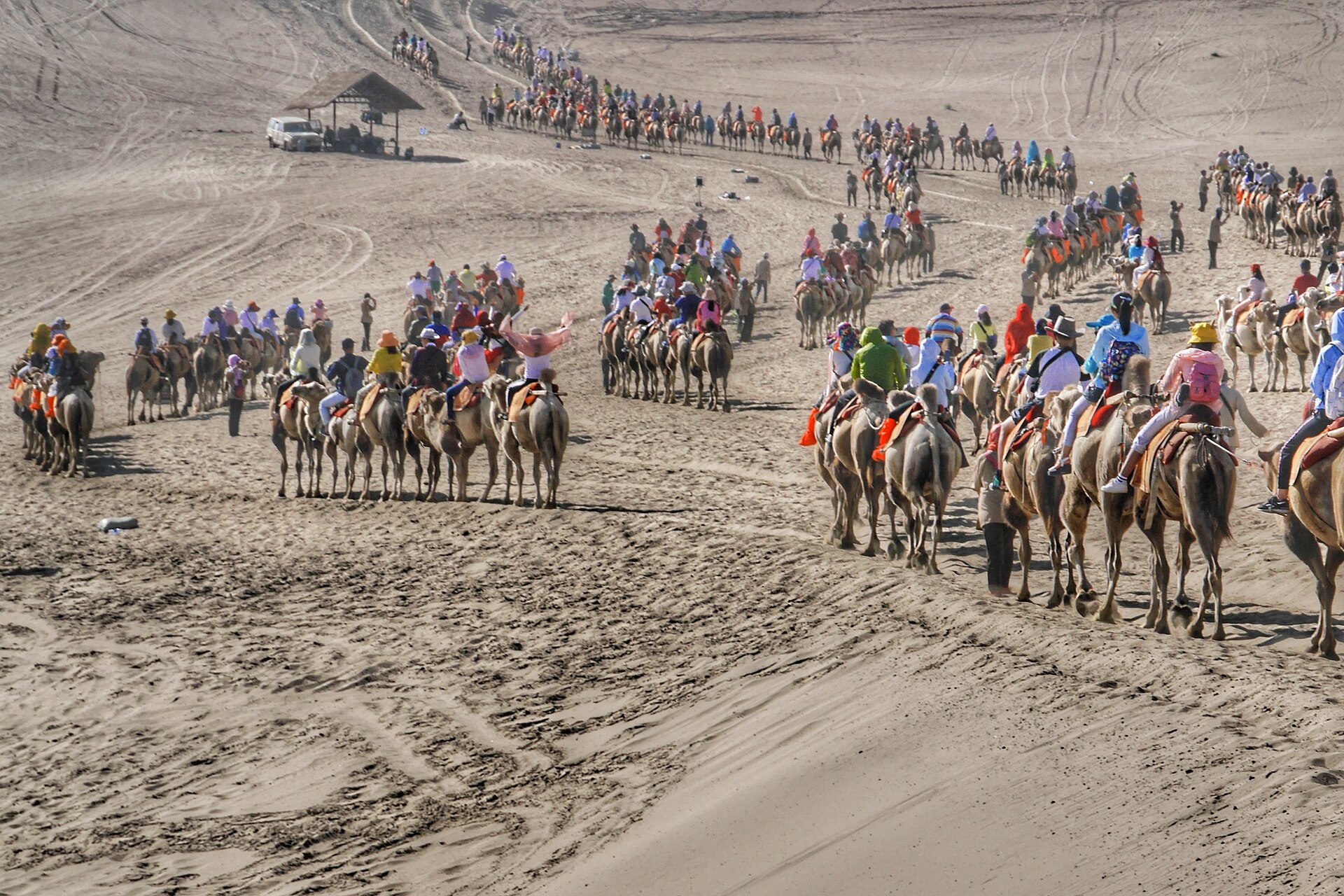
Ask about this itineraryThe Mingsha dunes outside Dunhuang · where the corridor ends and the desert takes over
of road between Lanzhou and Dunhuang, pinned between the Qilian range to the south and the Beishan hills to the north — for two thousand years the only practical way west
caves cut into the Mogao cliff between 366 AD and the Yuan dynasty, 492 of them decorated with some 45,000 square metres of mural
founding year of the Jiayuguan fortress, the Ming dynasty's western gate — completed in 1540 and standing today as the best-preserved frontier fort in China
indoor reclining Buddha at Zhangye's Dafo temple, cast in 1098 — the largest of its kind in China, in a temple that once lodged Marco Polo for a year, by his own account
Why this route
One corridor, one civilisational hinge.
The Hexi corridor is where China met the world. Buddhism came in this way, in the caravans of monks and translators who stopped at cave after cave on the cliff above the Dachuan river. Paper, glass, peaches, and the fiddle-horses of Ferghana went the other direction. The names along the road — Wuwei, Zhangye, Jiuquan, Dunhuang — are Han dynasty garrison names, and the wall and beacon towers that stitch them together are still out there in the gravel.
This journey runs the corridor in order, west to east backwards — you start at Lanzhou and finish at Dunhuang, so that the desert grows around you day by day. We keep the driving humane, put two full days around Dunhuang where it matters, and add the Yulin caves at Guazhou that most rushed itineraries skip.
Route Briefing
A single westward line with three anchors: Zhangye for landform and temple, Jiayuguan for the Ming frontier, Dunhuang for the Buddhist caves and the dunes. High-speed rail covers the eastern half; the western half runs by road through oasis and gobi.
- undefinedundefinedundefined
- undefinedundefinedundefined
- undefinedundefinedundefined
- undefinedundefinedundefined
- undefinedundefinedundefined
- undefinedundefinedundefined
- undefinedundefinedundefined
- undefinedundefinedundefined
- undefinedundefinedundefined
The Journey
Nine days, west by west.
A rhythm of one anchor site per day, with the long drives broken by oasis towns and one flexible day at Zhangye. Cave visits are ticketed and capped — we book the special-access classes at Mogao in advance.
-
Day 01
The Yellow River runs through it
Arrive Lanzhou
Meet in Lanzhou, the corridor's southern gate, a city squeezed between loess cliffs and the Yellow River. Ease in with a walk on the Zhongshan iron bridge — a 1907 German-built span — and the riverside park where locals drink three-gun tea from lidded bowls.
Dinner is the point of Lanzhou: beef noodles, the city's own dish, pulled to order in a dozen thicknesses. A good bowl is judged as 'one clear, two white, three red, four green' — clear broth, white radish, red chilli, green coriander. Your guide will have opinions.
-
Day 02
West on the high-speed line, to a giant reclining Buddha
Lanzhou → Zhangye
Ride the high-speed rail west across the loess plateau into the corridor proper. By afternoon you are in Zhangye, a Han dynasty garrison town whose name means 'extend the arm' — the outstretched arm of the empire.
The Dafo temple holds the great reclining Buddha, 34.5 metres of clay and paint on a timber frame, cast in 1098 under the Western Xia. The pavilion murals behind the altar include a rare set of Journey to the West scenes centuries older than the novel.
-
Day 03
Danxia, gorge, and a flexible afternoon
Zhangye
Out at dawn to the Zhangye danxia — the banded sandstone hills that made this area famous, their reds and golds sharpest in the first two hours of light. We go to the quieter northern platform circuit rather than the main deck.
The afternoon is flexible: the Pingshanhu grand gorge for a walk between million-year-old red beds, or the Mati temple grottoes cut into a cliff beneath snow peaks, where the Puguang temple sits in a horseshoe the local gazetteer says a heavenly horse left behind.
-
Day 04
The first pass under heaven
Zhangye → Jiayuguan
Drive west into the corridor's narrowest neck, where the Qilian and Black mountains close to a few kilometres of flat ground. Jiayuguan's fortress, founded in 1372, is the Ming wall's western terminus — three concentric walls, a drill ground, and the legend of the builder Yi Kaizhi, who calculated the exact number of bricks needed and delivered the project one brick spare.
Climb the overhanging great wall section on the Black mountain slope — a steep restored stairway with the gobi spreading north — and end on the fort's ramparts at last light, when the wall's grey brick goes the colour of the desert.
-
Day 05
The Yulin caves, quietly
Jiayuguan → Guazhou
The drive west crosses the Taolai river and hours of open gobi. Stop at the guayuan honeydew melon stands — the county's namesake — before turning up a poplar-lined valley of the Toushui river.
The Yulin caves are what Mogao was before the crowds: forty-plus caves cut between Tang and Yuan, guarded by willows (yulin means elm forest), visited by appointment and almost alone. Cave 25's Tang dynasty paradise tableaux are among the finest murals in China, and you will have them at a whisper's distance.
-
Day 06
The library cave and a thousand years of painting
Guazhou → Dunhuang
A short morning drive brings you to Dunhuang, oasis town at the corridor's mouth, where the Silk Road forked north and south of the Taklamakan.
The Mogao caves need two visits and you get both. Today: the general-access caves with your guide, reading the styles forward in time — the Western Wei's slender bodhisattvas, the Tang's fleshy confidence, the Song's formality — and the Library Cave, room 17, where the Abbot Wang's 1900 discovery of fifty thousand manuscripts rewrote the history of central Asia, and where most of them now sit in London and Paris, a fact your guide will discuss honestly.
-
Day 07
Out into the Han frontier
Dunhuang — Yumen Pass
A gobi day west of town: the Yumen pass, 'Jade Gate', the Han dynasty customs post for jade entering from Khotan, a raw earthen square fort of two thousand years standing in nothing. Beside it, the Han great wall — reed bundles and gravel, not brick — still trailing its beacon lines toward the horizon.
Return by the Yadan landform park if the light is right, or keep the evening easy in Dunhuang's night market: apricot peel water, grilled lamb, and the town's surprisingly good coffee.
-
Day 08
Dunes at dawn, camels at dusk
Dunhuang — Mingsha Shan
Early to the Mingsha dunes before the heat, when the sand is cool and the light rakes the crests. Climb the ridge for the view over Crescent Lake, the spring that has survived between the dunes for two millennia thanks to an engineering trick the county still maintains.
The afternoon is yours — the Dunhuang museum is excellent and uncrowded — before returning to the dunes at dusk, when the day-trippers have gone and the wind makes the sand sing, as the Sui dynasty chronicles already recorded.
-
Day 09
Westward done
Depart Dunhuang
Transfer to Dunhuang airport for onward flights — to Urumqi and the oases of Xinjiang, if the road is calling further, or back east with a thousand kilometres of corridor behind you.
What's included
What is included, and what is not.
A corridor journey is mostly logistics done well: timed cave tickets, honest driving distances, and guides who can read a mural as well as a menu.
Included
Arranged and paid in your price.
-
E
n
-
A
l
-
H
i
-
M
o
-
Y
u
-
A
l
Not included
Either yours to arrange, or a question we will gladly answer.
-
F
l
-
L
u
-
C
a
-
P
h
-
T
r
undefined
Enquiry
Ask us about this one.
Tell us your dates. We will come back with cave-ticket availability for your window, the driving plan, and a written outline with a price.
- Difficulty
- Easy walking, long drives
- Group size
- 2 – 10, private departures
- Best window
- May – Jun, Sep – Oct
- Cost guide
- From ¥12,800 per person, twin share
Enquiry sent
Thank you — your enquiry is with us.
We reply within one business day. A copy of what you sent has gone to your inbox.
Need to add something? Write to inquiry@chinadventure.com.
Back to the itineraryRead next