Zhongshan Bridge
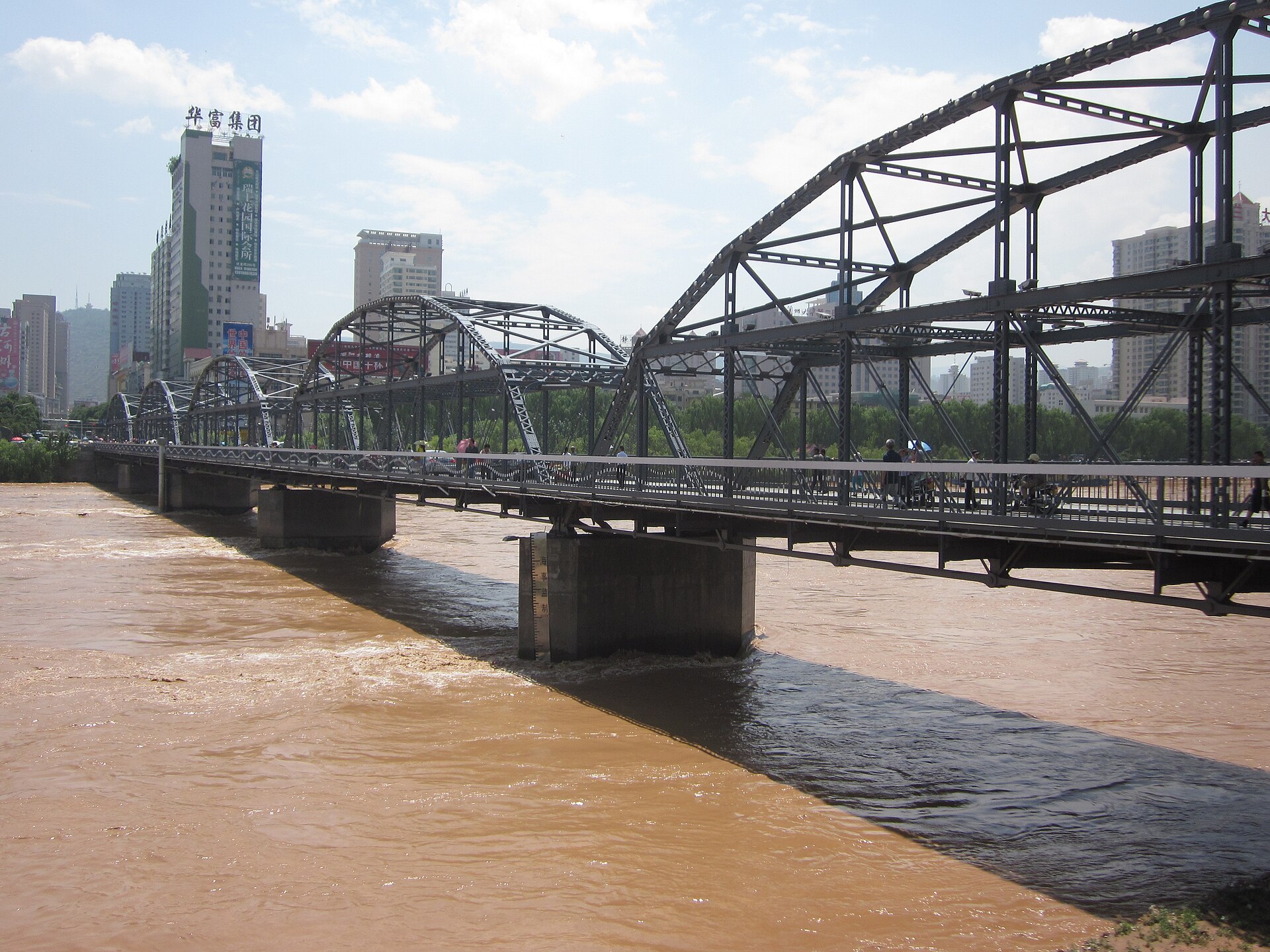
Grey steel trusses over brown water, walkable end to end in five minutes. Come at dusk when the hills go blue and the lanterns come on.
 Start your enquiry
Destinations / Gansu / Lanzhou
A rail city at 1,520 metres where the Yellow River runs brown through the middle of town, crossed since 1909 by an iron bridge the city still uses.
Explore the guide ↓Eastern Gansu · the Yellow River
Lanzhou exists because the Yellow River could be crossed here. The city sits in a narrow east–west valley with the river down the middle and loess hills pressed against both sides, which is why it is four kilometres wide and thirty long, and why the traffic behaves the way it does. It has been a garrison town, a teahouse stop, an oil town and a railway town, in that order, and it is now the practical beginning of almost every Gansu journey.
The bridge is the thing to look at. Zhongshan Bridge was built between 1907 and 1909 by a German firm with Chinese labour and steel shipped up the river, and it was the first permanent bridge anywhere on the Yellow River. It carried vehicles until 1989 and is now pedestrian, a lattice of grey steel with red lanterns along the rail, and the best place in the city to watch the water go past.
Everything else in Lanzhou is either food or a museum. The beef noodle breakfast is a civic ritual with a fixed grammar. The provincial museum holds the Bronze Galloping Horse, excavated in 1969 from a Han tomb at Wuwei, which is the image every Chinese tourism poster eventually uses. Both are worth a day, and a day is what the corridor gives you.
One bridge, one hill, one museum and an early breakfast.
Grey steel trusses over brown water, walkable end to end in five minutes. Come at dusk when the hills go blue and the lanterns come on.
The hill on the north bank, opposite the bridge: a short climb, a pagoda rebuilt in the Ming, and the whole valley laid out below.
The Bronze Galloping Horse, the Han bamboo slips and a good Silk Road collection. Two hours, and the best context for everything west of here.
Four hours by rail to the painted hills, or a day’s drive if you want the Qilian foothills on the way.
The city works all year; the light does not.
Warm, dry and clear, with the hills still green from spring rain. The best window for the bridge and the museum.
Hot in the valley — mid-thirties are normal — and the river is at its highest and brownest. Early mornings and late evenings, long lunches.
Cool, clear and the best month of the year in the city. Cold nights, blue skies, apricots and melons still in the market.
Cold, grey and dry, with occasional dust. Workable for a transit day; not a reason to come.
A rail hub with an airport two hours out.
Lanzhou is on the high-speed line from Xi’an (about three hours) and the conventional line west to Zhangye, Jiayuguan and Dunhuang. The airport is 70 km north of the city, which is an hour and a half you should plan for.
West by rail is the civilised option: Zhangye in about four hours, Jiayuguan five, Dunhuang eight on the overnight. The corridor road is slower and better.
The centre around the bridge and the Zhangye Road pedestrian street is the useful base. Two nights is enough for the city; one is enough if you are only changing trains.
Beef noodles, and the grammar of ordering them.
Lanzhou beef noodles are a morning food, eaten standing or at a formica table before nine. Clear broth, white radish, red chilli oil, green coriander, yellow noodles: the local shorthand is one clear, two white, three red, four green, five yellow.
You choose the cut: fine, thin, wide, extra wide, or the flat ribbons. The same dough, pulled to order, in about forty seconds. Ask for what the person in front of you asked for.
Hand-grabbed lamb, cold noodles in summer, apricot juice in autumn and the Hui bakeries around the mosque on Nan Guan. Lanzhou eats better than its reputation.
Dry air, dust and a valley that traps heat.
At 1,520 metres the city is a soft landing on the way to the plateau. No acclimatisation needed, no reason to slow down.
Spring brings yellow dust from the north, and the air is dry all year. A scarf, lip balm and sunglasses are not over-packing.
It runs fast, brown and cold, with hidden eddies. The promenade is for walking; the water is for looking at.
Tell us your train and how much time you have. Lanzhou is a good day and a better breakfast — we plan it around both.
Start my journey brief ↗