
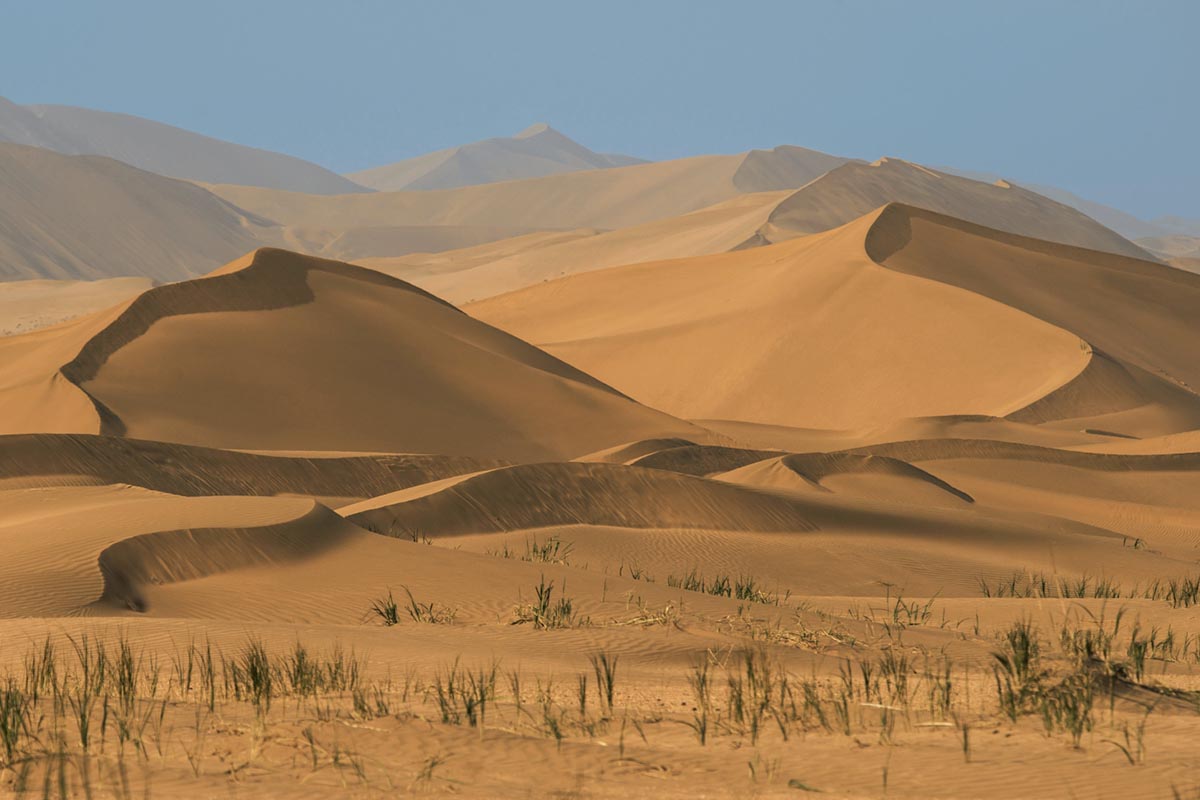
Desert / Badain Jaran desert camp
Private desert journey
Badain Jaran Desert Journey: 4 Days Among the Megadunes and Lakes
Between the Heihe river's end and the Gobi's emptiness rise the tallest stationary dunes on earth — some of them taller than four hundred metres, holding their shape for thousands of years, with more than a hundred lakes pooled in the corridors between. The Badain Jaran is a desert you visit with a driver, a water plan and respect; done that way, it is the finest desert landscape in Asia.
Ask about this itineraryThe Badain Jaran megadunes · a thousand metres of sand stacked on bedrock
height of Bilutu peak, the world's tallest stationary (non-advancing) dune — sand stacked on a bedrock core that anchors it against the wind
lakes held between the dune corridors, most of them saline, a dozen or so fresh — some fed by water that fell on the Qilian mountains centuries ago
year UNESCO inscribed the Badain Jaran 'towers of sand and lakes' as a World Heritage site, its second natural listing in Inner Mongolia
founding of Badain Jaran temple, the Mongolian Buddhist monastery deep inside the sand — a working temple with resident lamas, three days' camel travel from the edge in the old days
Why this desert
A desert with a resident population of lakes.
Most deserts are defined by what they lack. The Badain Jaran is defined by a contradiction: the tallest sand mountains on the planet, and water pooling in their shadows — springs pushing up through the dune bases, some of them fresh enough to support reeds, swans and the small herding families who have always lived here in the gaps between seasons.
This is a supported journey, and it is honest about that: the desert interior is 4WD country, navigated by drivers whose families have run these tracks for generations. We camp two nights in the dune corridors at their best angles for sunset and stars, visit the temple, climb one megadune at dawn, and leave the desert exactly as we found it. July and August are avoided — not for the heat, but for the respect owed to the place at its most fragile.
Route Briefing
In from Alxa Right Banner on the desert's southern edge, a loop through the lake corridors and the megadune belt, out via the temple. Two camp nights, one lodge night. Vehicle support throughout — this is a journey on tracks, not a walking expedition.
- undefinedundefinedundefined
- undefinedundefinedundefined
- undefinedundefinedundefined
- undefinedundefinedundefined
The Journey
Four days on the tracks.
The route flexes with wind and season; the drivers reroute daily, and the camp moves with them. Distances are short in kilometres and long in time — the dune fields are driven at a careful pace.
-
Day 01
Under the wheels and into the dunes
Alxa Right Banner → the sand
Meet in Alxa Right Banner town for the briefing: water discipline, the day's wind forecast, how we travel in convoy and why. Then the 4WDs take the southern tracks into the sand, and within an hour the world is dunes to every horizon.
First camp goes up in the corridor the drivers choose, on sand firm enough and screened from the wind. Dinner over coals; then the desert's real show starts — the sky. With the nearest town hours behind, the Milky Way runs edge to edge, and your guide will read the Mongolian star names off for you.
-
Day 02
Springs in the shadow of giants
The lake corridors
A full desert day on the tracks between the lakes: Yinderitu lake and its spring-fed freshwater pool, the swans and reeds that survive on water which fell as rain on distant mountains and moved underground for decades before surfacing here. The drivers time the crossings between the dune walls for the firm sand.
Climb one of the mid-height ridges in the late afternoon — an hour of switchbacking on the leeward face — and sit at the top while the dune field changes colour through every shade of red gold. Second camp, same rhythm: fire, food, stars, and the strange deep silence of sand country at night.
-
Day 03
Dawn on the giant, and lamas in the sand
Bilutu → the temple
Pre-dawn start for Bilutu, the giant — the world's tallest stationary dune. The climb from the lake side is three hours of one step up, half a step down; the reward is sunrise across the whole dune-and-lake chessboard, Gobi to the north, mountains hazed to the south.
Descend the slip face — eight running steps and you are down in twenty seconds — and drive to Badain Jaran temple, the 1755 monastery in the desert's heart. The resident lamas will make tea; the white pagoda and the prayer flags against the dunes are the image you will keep. Out via the eastern tracks to a lodge at the edge for the last night, with a real shower and a dinner that tastes of everything.
-
Day 04
The edge of the sand
Alxa Right Banner
An easy morning at the desert's edge — the interpretive centre explains the geology you have been living in, and the town's camel-milk products are worth trying — then transfer onward, to Zhangye and the Hexi corridor by road, or by way of Jinchang and the rail line east.
What's included
What is included, and what is not.
A desert interior trip is a logistics exercise first. Everything on this list exists so that the landscape can be the only hard thing about the days.
Included
Arranged and paid in your price.
-
E
x
-
E
n
-
T
w
-
O
n
-
A
l
-
A
l
Not included
Either yours to arrange, or a question we will gladly answer.
-
T
r
-
S
l
-
A
l
-
P
e
-
T
r
undefined
Enquiry
Ask us about this one.
Tell us your dates. We will come back with the wind and temperature outlook for your window, the camp plan, and a written outline with a price.
- Difficulty
- Moderate — dune climbs optional but steep
- Group size
- 2 – 8, private departures
- Best window
- May, Sep – Oct
- Cost guide
- From ¥9,800 per person, twin share
Enquiry sent
Thank you — your enquiry is with us.
We reply within one business day. A copy of what you sent has gone to your inbox.
Need to add something? Write to inquiry@chinadventure.com.
Back to the itineraryRead next