Badain Jaran dune lakes
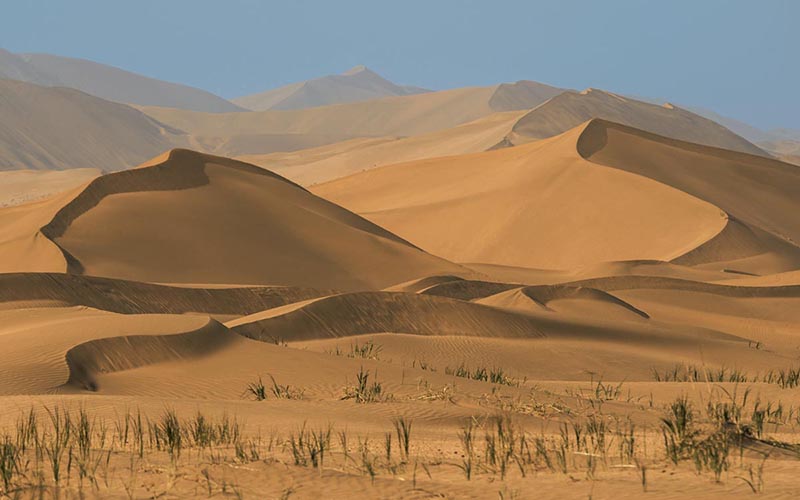
Camel or 4WD travel between spring-fed lakes at the feet of sand towers — Bilutu peak, the big lakes of Yinderitu and Nuoritu. The singing dunes are real underfoot.
 Start your enquiry
Destinations / Inner Mongolia
The tallest stationary sand towers on earth, lakes with no outlet in the dune hollows, and grasslands that run to the horizon. Inner Mongolia is China at its emptiest and widest.
Explore the guide ↓North China
Inner Mongolia arcs across the north of China for 2,400 km, and its two halves offer different countries. The west is desert: the Badain Jaran, whose dune towers rise to around 400–460 m and hold more than a hundred spring-fed lakes in their hollows — UNESCO-listed in 2024 as “Badain Jaran Desert — Towers of Sand and Lakes”.
The east is the Hulunbuir steppe, the best-preserved grassland in China, rolling to the borders of Russia and Mongolia with Mongol herding culture intact and rivers that braid across treeless country.
Between the two lies the Gobi’s northern edge and the river oases of Alxa. Pick one half and go deep — the province is bigger than most European countries, and the driving is the journey.
What the two halves hold.
Camel or 4WD travel between spring-fed lakes at the feet of sand towers — Bilutu peak, the big lakes of Yinderitu and Nuoritu. The singing dunes are real underfoot.
Dune fields around Zhongwei and the Alxa leagues, paired with the Ningxia wine and rock-art country just south.
Grassland camps, the Ergun river bends and the birch forests toward Shiwei and Enhe. July turns the steppe emerald.
Wrestling, horse racing and archery each summer, plus herding-season hospitality in the gers. Dates move with the local calendar.
Minus thirty and frozen dunes for the committed few. Extraordinary, short-day, specialist travel — we build it only with preparation.
The steppe has one great season; the desert has two.
The working window for both halves: green steppe, warm desert nights, Naadam in July.
Quiet and sharply beautiful in the desert; the steppe is brown but empty. Good for photography-led trips.
Ice-festival country toward Hailar and hard desert cold. Possible, extreme, and never improvised.
Connections, bases and the practical details that hold a good route together.
Yinchuan or Zhangye for the western deserts; Hailar for Hulunbuir. Crossing between halves inside one trip costs two full travel days.
The Badain Jaran interior is 4WD and camel country with licensed local drivers. Independent rental cars do not enter the dunes.
Desert camps and edge-of-dune lodges in the west; herder gers and steppe-town hotels in the east. We set expectations by season, not brochure.
Make room for local life, food and cultural encounters.
Milk tea, hand-pulled mutton and a ger that is always one size too big for its family. Homestays here are genuine, not staged.
The Badain slopes hum under a descending footstep — an acoustic quirk of the grain size. Local legend has its own explanation.
Roast lamb, milk curd, buuz dumplings, and the desert oases’ jujubes and melons. The west eats like the Silk Road, the east like the grassland.
Useful details to discuss when shaping your trip.
Fuel, water and shade are logistics, not conveniences. Every desert day carries a support plan — ours is standard.
Parts of Alxa require border-area arrangements and some lakes close to protect nesting birds. We check both before the route is drawn.
Sand towers or open steppe — tell us which horizon you want and the month you can travel, and we will build the deep version of it.
Start my journey brief ↗