The Hexi corridor
Lanzhou, Zhangye’s danxia and great Buddha, the Jiayuguan fort, the Yulin caves and two full days at Dunhuang. Flies in east, out west.
 Start your enquiry
Destinations / Gansu / All routes
Three ways into Gansu: the full corridor, a desert camp on its northern edge, and a walk through the Tibetan south.
Explore the guide ↓Gansu, all regions
Gansu is a corridor, so most of what we run here is a line rather than a loop. The three routes below are different in kind — a nine-day overland journey, a four-day desert camp, and a trek in the Tibetan south — and each can stand alone or attach to a bigger arc through Qinghai or Xinjiang.
One way, west.
Lanzhou, Zhangye’s danxia and great Buddha, the Jiayuguan fort, the Yulin caves and two full days at Dunhuang. Flies in east, out west.
The two-night version of the corridor’s best landscape and its best walls, for anyone adding Gansu to a longer trip.
Two cave sessions, the dunes at dusk and the Han passes, with enough time to stop moving.
North of the corridor.
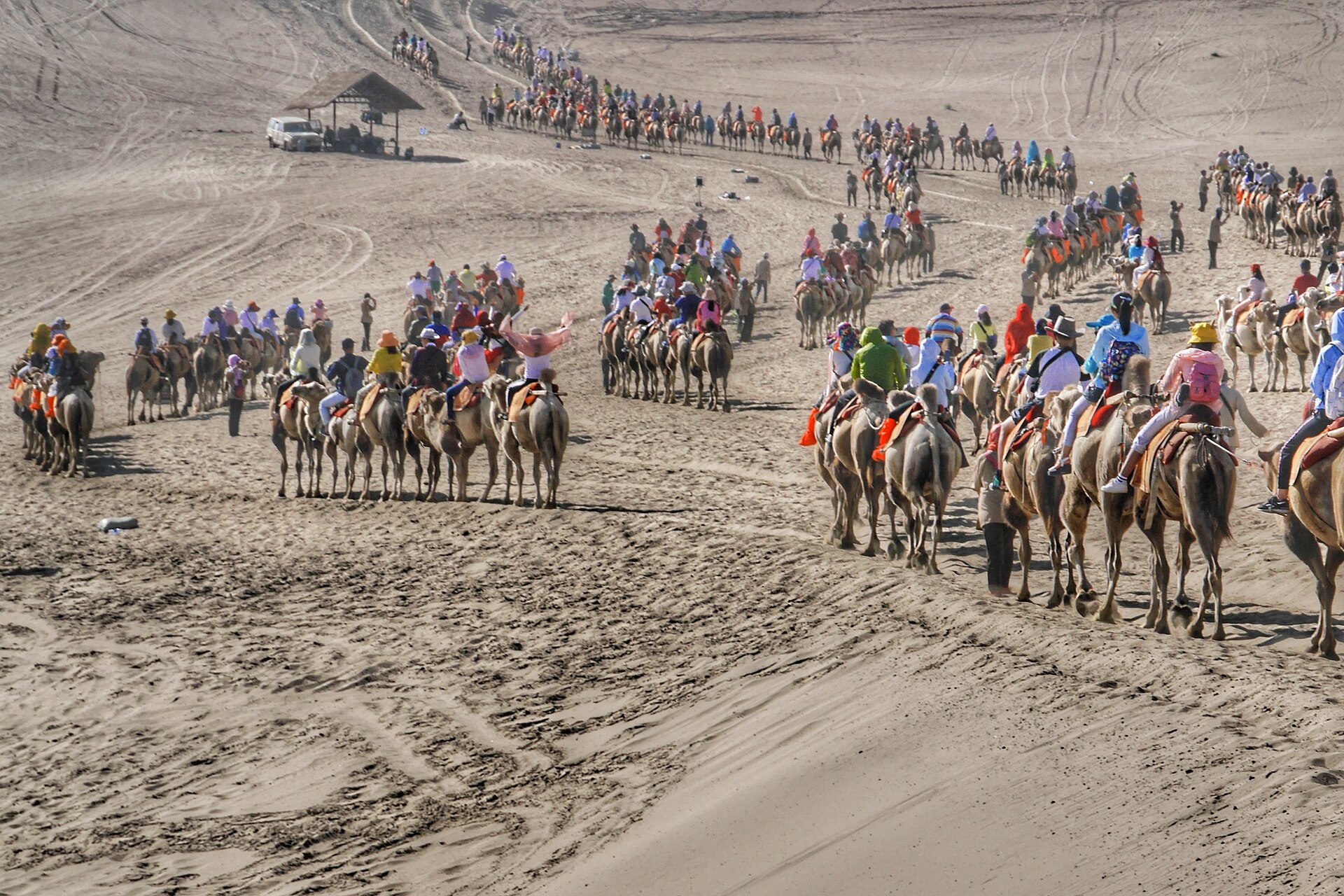
The tallest stationary dunes in China, with freshwater lakes between them. Reached from the corridor’s northern edge; camped, not lodged.
Water, fuel, permits and the reason the lakes sit where they do.
Tibetan Gansu.
Labrang’s kora, Sangke, and the road east to the stone city above Diebu.
Four villages under a rock wall, walked between rather than driven past.
Gansu is a hinge.
The Hexi corridor ends within reach of the Qinghai plateau, which is why the two provinces make one high-country journey.
The corridor continues into Xinjiang by rail, and the desert changes character at the border.
Badain Jaran, the Kumtag, the Taklamakan and the Tengger, compared.