Labrang monastery
The kora takes about two hours at pilgrim pace: prayer wheels, mani walls, the long line of stupas, and the monks’ debate courtyard at dusk.
 Start your enquiry
Destinations / Gansu / Xiahe & Gannan
The Tibetan south: a monastery town at 2,900 metres, grassland where the Yellow River bends, and a stone city of four villages above Diebu.
Explore the guide ↓Southern Gansu · Gannan prefecture
Gannan is the Tibetan part of Gansu: an Amdo prefecture on the eastern edge of the plateau, bordering Qinghai to the west and Sichuan to the south. The road from Lanzhou climbs through Linxia, crosses a pass and drops into a valley at 2,900 metres where the temperature is ten degrees cooler than the corridor and the signage changes script. It is the shortest route from a Chinese city to the Tibetan world, and the easiest place to see that world without a permit.
Xiahe exists because of Labrang. The monastery was founded in 1709 by the first Jamyang Zhaypa and grew into one of the six great monasteries of the Gelug school, with a resident population that once ran to several thousand monks. The town wrapped itself around it: pilgrims’ guesthouses, butter-tea shops, shops selling prayer flags and thermoses, and a kora path that circles the whole complex in about six kilometres.
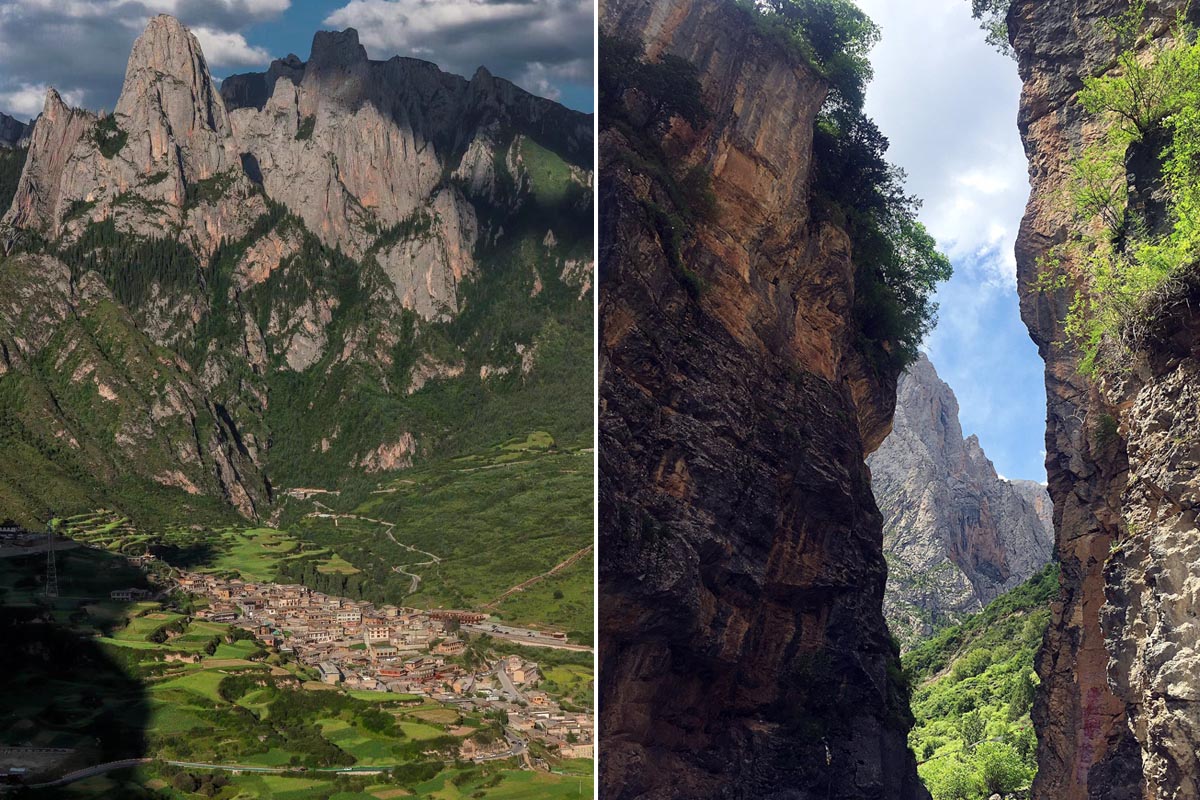
East of Xiahe the land opens into grassland — Sangke, then the wide bends of the Yellow River around Maqu — and then folds into the mountains above Diebu, where Zhagana stands: a wall of grey rock with four villages at its foot and a ridge line that looks like a set built for a film. It is the most photographed place in Gansu that is not a cave.
One kora, one grassland, one stone city.
The kora takes about two hours at pilgrim pace: prayer wheels, mani walls, the long line of stupas, and the monks’ debate courtyard at dusk.
Open grazing country with nomad tents in summer, yaks on the road, and the kind of sky that makes a wide lens pointless.
Four villages under a rock wall, connected by tractor tracks and footpaths. Walk up to the viewpoint before breakfast and the whole valley is in cloud.
Two monasteries facing each other across a valley on the provincial line, with a gorge walk behind them and far fewer visitors than Labrang.
Short summer, long winter, and a festival calendar that moves.
Green grassland, warm days, cold nights and the nomad camps out. The only months when the high valleys are reliably comfortable.
Clear, dry and golden. The best light of the year at Zhagana, with snow arriving on the peaks by late October.
Hard winter at 3,000 metres: frozen pipes, closed guesthouses, and a monastery that is at its most devotional and least convenient.
Labrang’s year turns on the lunar festivals — the Great Prayer Festival in the first month, the butter-lamp festival in the tenth. Dates move annually; we check them before promising a window.
Four hours from Lanzhou, and a day between the bases.
Xiahe is about four hours by road from Lanzhou, or an hour by air to Gannan Xiahe airport and forty minutes down. Zhagana is another five hours east, which is why it is usually a two-night stay rather than a stop.
Xiahe has Tibetan guesthouses and a couple of decent hotels; Zhagana has village guesthouses with shared bathrooms and thin walls. Both are part of the point, and both need booking in summer.
Pilgrims walk clockwise from dawn. Go early, walk with them rather than against them, and keep the camera down in the chapels.
Monasteries, herds and a borderland.
Amdo Tibetans, plus Hui traders in Linxia and a Han administrative presence. The region has been a border for centuries, which is why the architecture is fortified and the monasteries are walled.
Labrang is a working institution with schools, workshops and a printing house. Entry is ticketed, the chapels are not a museum, and the monks are not exhibits.
Yak yogurt, tsampa, butter tea and momos, plus the noodle shops of Linxia on the way in. Vegetarians should say so early; the default is meat and butter.
Three thousand metres, and a real winter.
Xiahe at 2,900 metres is a mild step; Zhagana and Langmusi are higher. Arrive from Lanzhou by road and the climb is gradual, which is the pleasant way to do it.
Twenty-five degrees at noon and four at dawn is normal in June. A down layer in summer is not a joke, and a rain shell is essential in Diebu.
Ask before portraits, never photograph a prostration from close range, and do not film inside the assembly halls. The rules are enforced by the monastery, not by us.
Tell us whether the monastery or the mountains are the point. Xiahe and Zhagana are five hours apart, and the road between them is the best part.
Start my journey brief ↗