
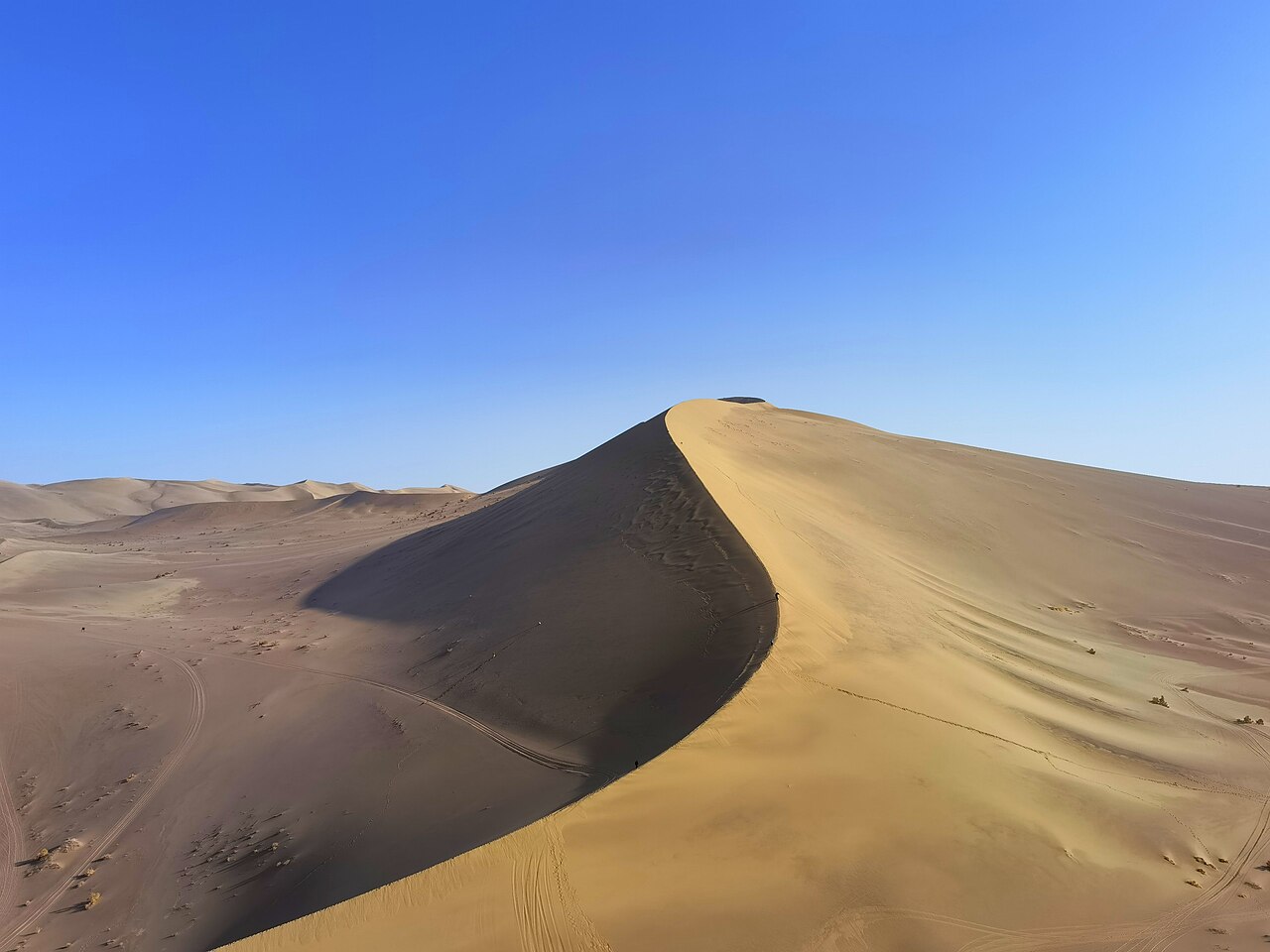
The Chinese name is honest: Mingsha Shan, the Sounding-Sand Mountain. The Sui dynasty chronicles already record that on dry days the dune hums. Marco Polo, crossing the Gobi’s edge, reported spirits that filled the air with the sounds of instruments — and lured careless travellers off the road. Both were describing the same thing: a dune that can produce a sustained, audible boom, low and organ-like, for minutes at a time.
The reports, ancient and modern
Singing sand is not a Chinese curiosity. It is documented at maybe three dozen sites worldwide — California’s Kelso dunes, Morocco, Chile, and China’s own Mingsha Shan and the megadunes of the Badain Jaran. The sound is real and reproducible: a slump or a wind-driven sheet of sand shearing down the leeward face can set the whole slope resonating, audible kilometres away, at a low frequency of roughly 70 to 105 hertz — about the pitch of a low cello note.
The physics
The mechanism, pinned down by field studies in the 2000s, is a wave resonance in the sliding layer itself. As a sheet of sand avalanches, the grains vibrate coherently, and the moving layer acts like the membrane of a loudspeaker — the sound frequency is set by the thickness of the sliding sheet and the grain size, not by the wind. Crucially, the dune must be dry and the grains within a certain size band; damp a singing dune with rain and it falls silent for days. The occasional musical quality — overtones, a whistling pitch — comes from the resonance wave bouncing inside the avalanche layer.
Where and when to hear it
Mingsha Shan at Dunhuang is the accessible one — though the permanent crowd means you are more likely to hear the organised descent of tourists than the dune itself. The honest place is the Badain Jaran, where the megadunes boom under their own slumping sheets with nobody else for tens of kilometres; our desert journeys there camp within earshot, and on dry evenings the dunes routinely perform. For the physics-adjacent practicalities — heat, water, timing — see our note on desert water discipline.
Where this leads
The Badain Jaran journey
The Hexi corridor journey
Badain Jaran, on foot