
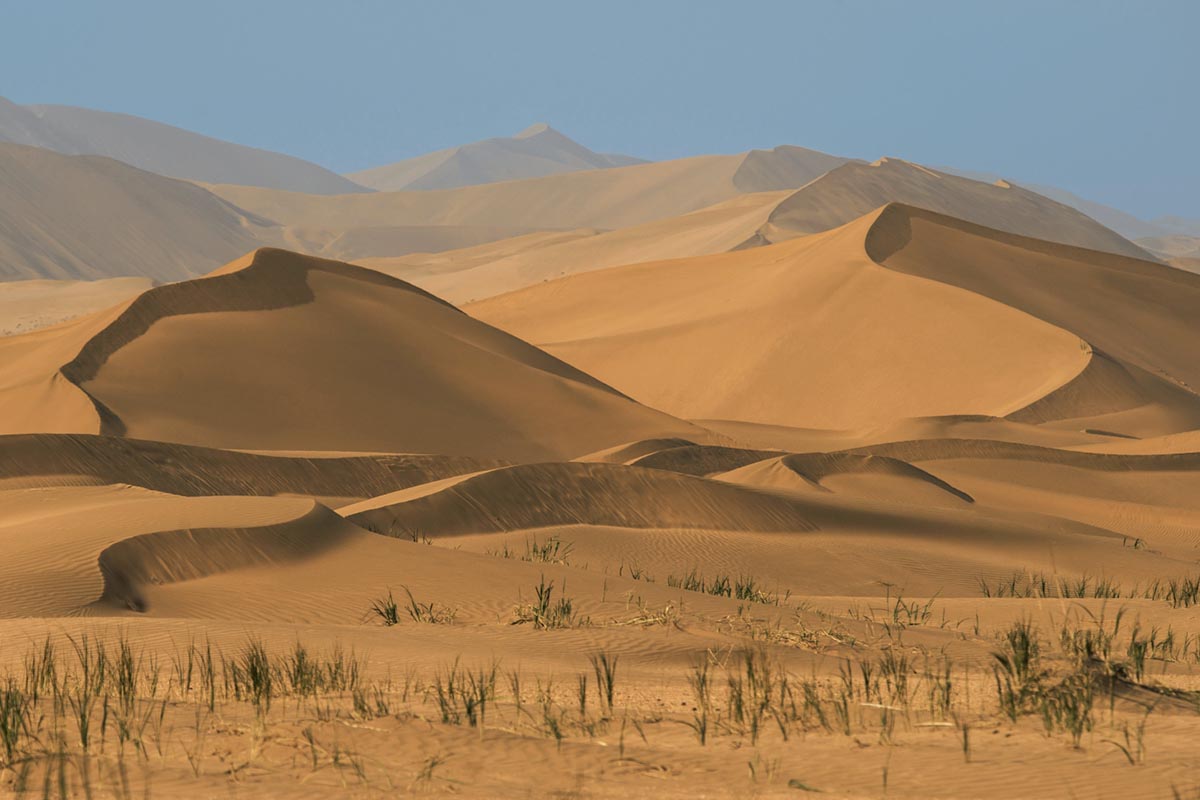
Chinese desert country — the Badain Jaran and Tengger in Inner Mongolia, the Taklamakan’s margins in Xinjiang, the Gobi’s gravels in between — is more forgiving than the Sahara in one way and less in another: distances to real help are longer, and the wind can shut everything down without warning. The disciplines below are the ones our drivers and guides actually use.
The rhythm of the day
A good desert day starts before dawn and folds by mid-morning. The hard hours — roughly eleven to four — belong to shade, food and maintenance; activity resumes as the temperature breaks, and the finest hours are the last two before sunset, when the dunes change colour and the sand underfoot firms up. Plan climbs and walks for those windows, and treat midday exertion as the amateur’s error it is.
Water budgets, honestly
The working number is four to six litres per person per day in drink, plus what the kitchen needs, plus a vehicle reserve — and in dry heat you replace electrolytes, not just volume. More important is the system: water is carried in sealed, portioned containers, a per-person reserve never mixed into the common supply, and consumption is scheduled, not thirsted for. Thirst is a late indicator; by the time you feel it you are already behind.
Why vehicle support
The megadune interiors — the Badain Jaran above all — are 4WD country, full stop. Tracks wind between the dune corridors, drivers reroute daily on wind and sand firmness, and a convoy means a mechanical failure is an inconvenience rather than an emergency. Choose operators who run their own vehicles with their own drivers; the difference is legible in everything from the food to the camp siting. Our Badain Jaran journey is built exactly that way, and the walking guide explains what can be done on foot and where.
The season map
May and late September to October are the honest windows: warm days, cool nights, stable weather. July and August are furnace months — surface temperatures on the sand can pass seventy degrees — and winter brings real cold, workable for short trips but not for camping. Spring has a further risk: the sandstorm season, which no schedule can promise around, only respect. Build a weather buffer day into any desert itinerary, and treat a forecasted gale as the desert declining the appointment.
Where this leads
The Badain Jaran journey
Badain Jaran, on foot
Singing sand