Tunxi & the villages
The base and the village floors. Flat walking, no altitude effect, and the place to spend the first and last nights.
 Start your enquiry
Destinations / Anhui / Altitude
The one province on this site where altitude is not the problem. The numbers, and what replaces them.
Explore the guide ↓Anhui, all regions
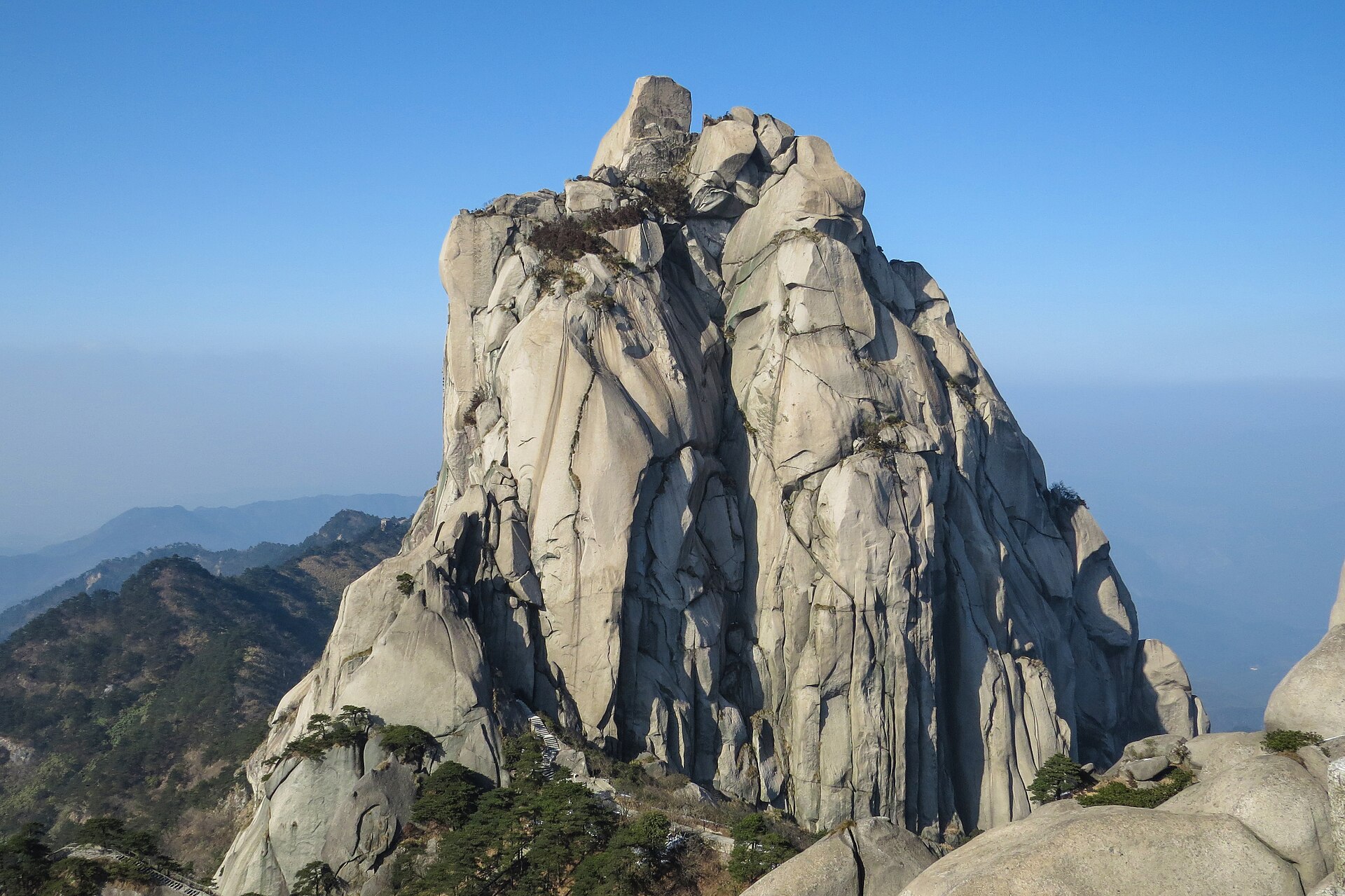
Anhui’s highest point is Lotus Peak on Huangshan at 1,864 metres. The second massif is the Dabie range on the western border, where Baimajian reaches 1,777; Tianzhu Peak is 1,489.8 and the highest summit at Jiuhua is 1,342. The villages of Huizhou sit between 200 and 500 metres, and Tunxi, where most trips begin, is at about 130.
That has a practical consequence worth stating plainly: nobody needs to acclimatise for Anhui. There is no altitude sickness at 1,860 metres in any meaningful sense, no sleeping-altitude arithmetic, and no reason to build in a rest day for the body to catch up. A traveller can land in the morning and be on the summit the next day without any of the caution that Sichuan or Tibet requires.
What replaces altitude here is vertical gain on stone. A day on Huangshan is roughly 1,500 metres of ascent and the same again of descent, distributed across thousands of steps, and the descent is what people remember. The villages are flat; the mountains are stairs. That is the fitness question, and it is a knee question as much as a lung one.
By place, with what it means for a day.
The base and the village floors. Flat walking, no altitude effect, and the place to spend the first and last nights.
Passes between 400 and 1,050 m, with days of 300 to 600 m of gain. The Hui–Hang road tops out at Lantian’ao at 1,050.
Summit hotels near 1,600, Bright Summit 1,860, Lotus Peak 1,864. The gain is all in steps, not in thin air.
A single summit with a cable car to the ridge and steps for the last section. The most exposed finish of the three mountains.
Town at 600, ridge paths above 1,000, Shiwang Peak at 1,342. Two cable cars remove most of the climb.
Gardens on the slopes below the peaks, walked on lanes and old roads. No altitude, no exposure, and the gentlest walking in the province.
Since altitude is not the constraint, three other things are. The first is cold: the summits sit near 1,800 metres and a clear January morning is −5 to −10 °C with wind on the exposed walks, which is colder than most visitors pack for.
The second is the surface. Huangshan and Tianzhu are stair mountains, and the Huizhou roads are polished stone. Wet stone in June and ice in January are the two conditions that end days early; strap-on cleats in winter and sticky rubber year-round are worth more than any fitness preparation.
The third is weather speed. Cloud can close the ridge in twenty minutes at any time of year, and the rescue services on these mountains deal mostly with people who kept going to a viewpoint after the visibility went. Turn around early; the mountain will still be there in the afternoon, or the next morning.