Huacheng & the old town
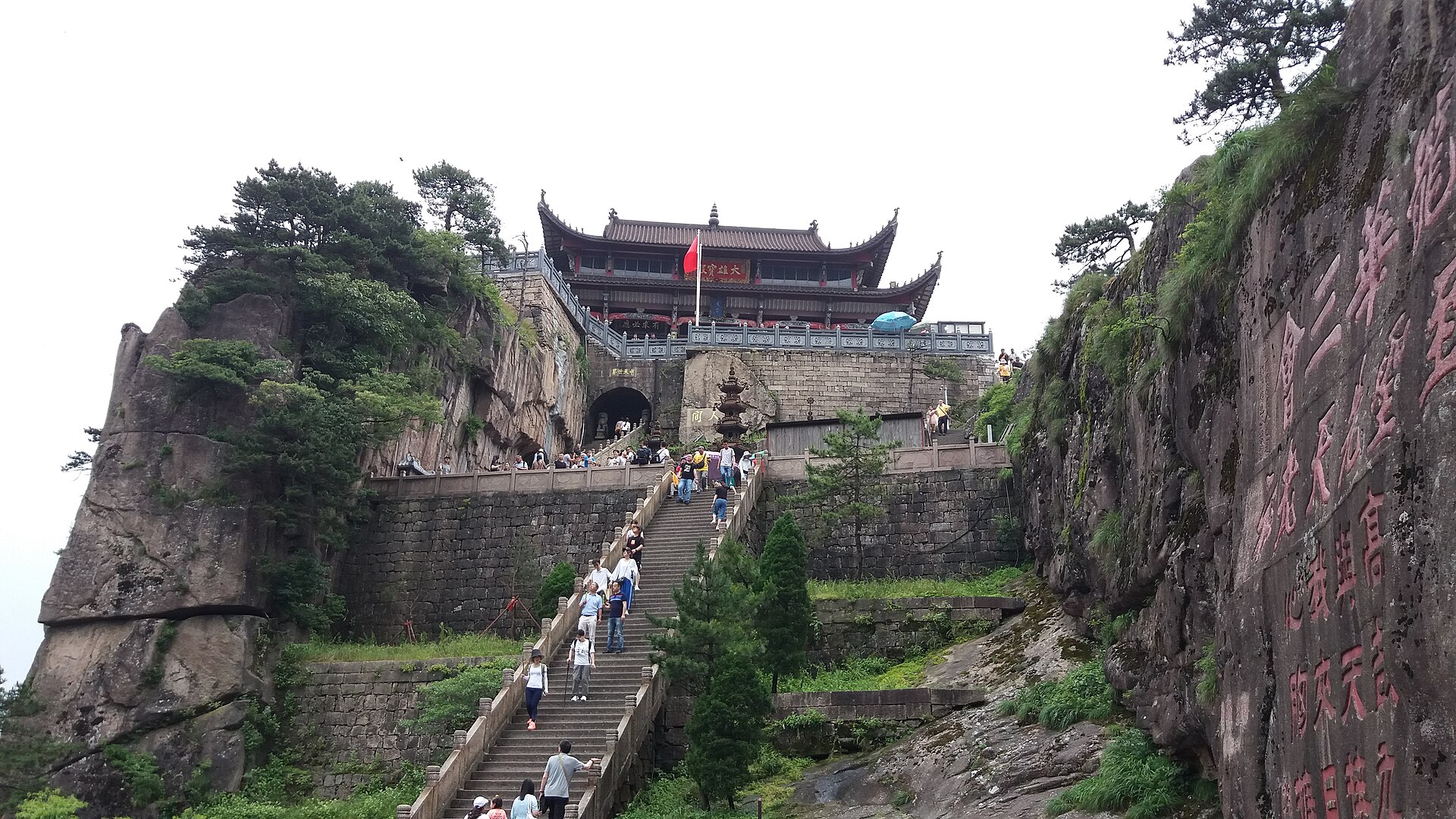
The oldest monastery on the mountain and the reason the town exists, with a lake in front of it and the museum of the mountain beside it. Start here, before the crowds thicken.
 Start your enquiry
Destinations / Anhui / Jiuhua Mountain
Ninety-nine granite peaks, seventy-eight surviving monasteries and a town of pilgrims halfway up. The seat of Dizang, and the busiest Buddhist mountain in China.
Explore the guide ↓Chizhou · 1,342 m
Jiuhua is a granite massif of ninety-nine peaks, thirty-odd of them above 1,000 metres, with Shiwang Peak the highest at 1,342. The scenery is genuinely good — towers and ridges not unlike Huangshan’s, with more forest and less exposure — but nobody comes here for the geology. They come because this is the seat of Dizang, the bodhisattva of the underworld, and because the mountain has been accumulating monasteries since the eighth century.
The founding story is specific. A Korean monk, Kim Gyo-gak, arrived at the end of the eighth century and settled in a cave on the slope. A local patron bought the land and built a temple, Huacheng, in 757. Kim died in meditation and his body did not decay, which in the Chinese Buddhist world is the definition of a saint; he was identified as an incarnation of Dizang, and the mountain became his domain.
What that has produced is unusual: a working religious town at 600 metres, wrapped around a loop of lanes and temples, with a cable car up to a ridge and a second one to the summit area. It is a pilgrimage site with a visitor-management problem, not a scenic area with a temple in it. That distinction changes what you should do when you arrive.
The town, the relic halls, and the ridge above them.
The oldest monastery on the mountain and the reason the town exists, with a lake in front of it and the museum of the mountain beside it. Start here, before the crowds thicken.
The Body Hall enshrines the mummified Kim Gyo-gak; Baishui Palace, up a stairway above the town, holds the body of a Ming monk who is said to have lived to 126. Both are places of active worship rather than exhibits.
The ridge path to the temple on Tiantai, with the classic view back over the town and the plain beyond. A cable car takes most of the height; the last stretch is steps and a squeeze through rock.
The granite ridge east of Tiantai, with the best scenery on the mountain and a fraction of the traffic. Walkable from the Tiantai cable car in a long half-day.
Pilgrimage dates, flowers and a cold, clear winter.
The best walking weather, with azaleas on the upper ridges in April and May. Rain is common but the mountain is green and the light is soft.
Hot, wet and crowded, with the summer pilgrimage traffic at its height. The cloud sits on the ridge, and the town is at its most intense.
Clear, dry and cool, and the best months for the ridge walks. The pilgrimage calendar brings crowds around the festival dates; check before booking.
Cold and quiet, with rime on the pines and very few visitors. Some upper paths close in snow. The monasteries are at their most themselves.
A bus to the town, two cable cars, and steps after that.
High-speed rail to Chizhou or Jiuhuashan station, then a shuttle bus to the mountain gate and a second bus up to Jiuhua town. Cars are not allowed above the gate.
The Baishui Palace funicular links the town to the upper town; the Tiantai cable car climbs toward the summit ridge. Neither reaches a summit, and both save 300 to 500 metres of steps.
In Jiuhua town, in monastery guesthouses or hotels. Staying on the mountain rather than in Chizhou is the difference between a dawn ridge and a midday one.
Why this mountain, of all of them.
Dizang is the bodhisattva who vowed not to become a Buddha until the hells are empty. That vow made him the patron of the dead and of filial duty, which is why the mountain is visited by families rather than only by monks.
The mummified monks of Jiuhua — several survive, not one — are the mountain’s distinct religious phenomenon, venerated as evidence of attainment. They are not displayed as curiosities, and photographing them is not appropriate.
This is an active religious site. Keep voices down in halls, do not photograph monks without asking, and walk clockwise around stupas. Pilgrims will be prostrating on the stairways; step around them rather than over them.
Crowds, steps and the festival calendar.
Jiuhua receives more pilgrims than any other Buddhist mountain in China, and on festival days the town is solid. Avoid the first half of the lunar seventh month and the national holiday weeks.
The ridge walks are stone steps, up and down, with handrails in places and none in others. Knee trouble is the usual reason a day gets shortened.
Shoulders and knees covered, hats off inside. It is not enforced everywhere, but it is noticed everywhere.
Tell us whether this is a pilgrimage, a ridge walk or an hour of architecture, and we will build the day around the right one of the three.
Start my journey brief ↗