Bright Summit & the summit hotels
The middle of the mountain and the only place to sleep above 1,600 m. Sunset and sunrise platforms are ten minutes away, which is the argument for staying up rather than day-tripping.
 Start your enquiry
Destinations / Anhui / Huangshan
Seventy-two named granite peaks, a cloud sea that behaves like weather and a summit network with no road. The mountain that taught Chinese painting what a mountain should look like.
Explore the guide ↓Southern Anhui · 1,864 m
Huangshan is a granite batholith that came up and then cracked into towers. The heritage area covers 160.6 square kilometres, with 88 summits above 1,000 metres and 72 of them named — 36 large, 36 small. The three that matter are Lotus Peak at 1,864, Bright Summit at 1,860 and Tiandu at 1,810. Between them is a network of stone stairways, ridge paths and two cable cars, and no road at all.
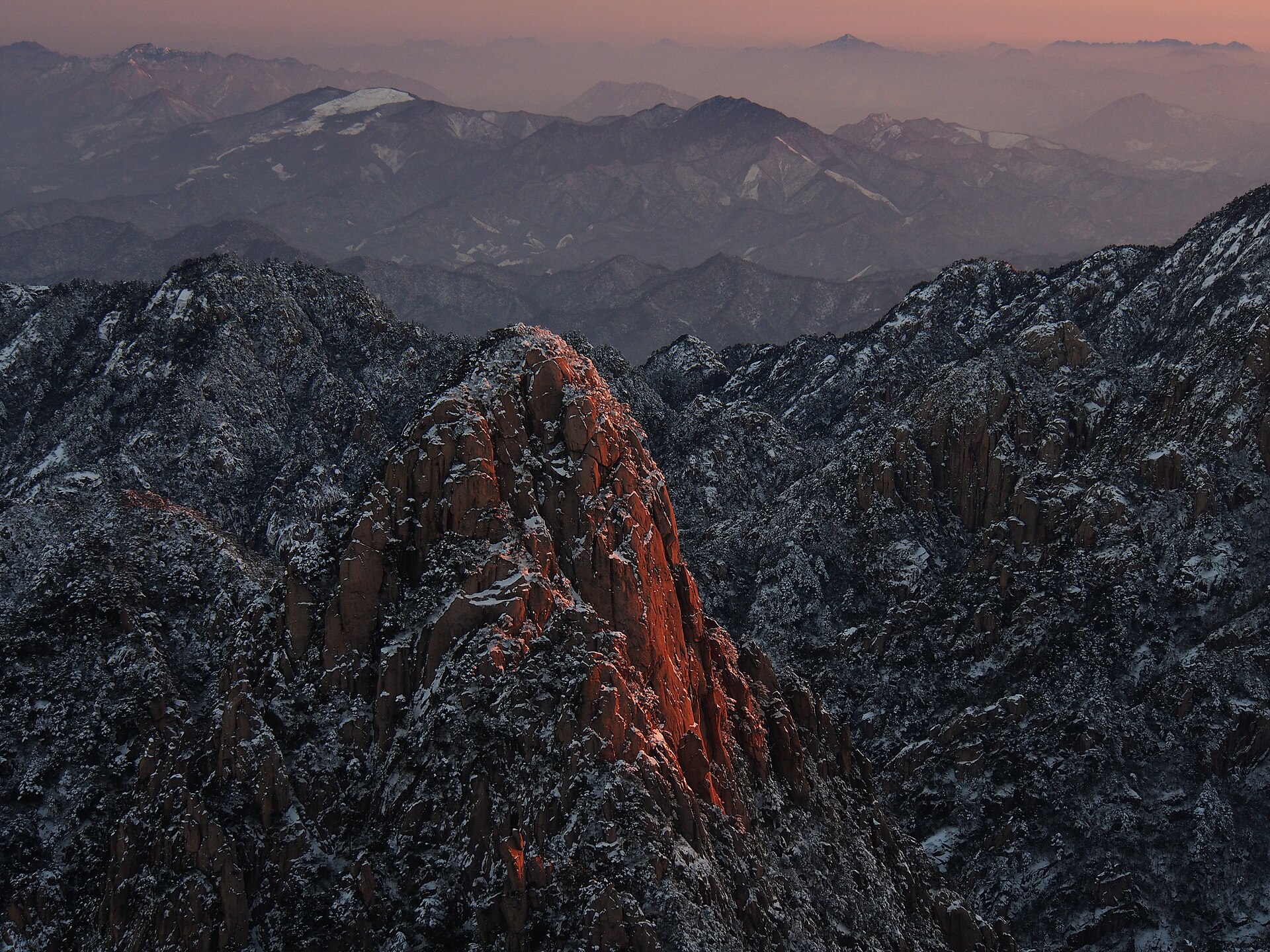
What makes the mountain famous is not the rock but the water in the air. The valleys hold moisture overnight, the ridge tops dry out, and on the right mornings the cloud sits below the summits like a sea with islands in it. That happens most often in the cold half of the year, which is why the winter mountain looks more like the paintings than the summer one does.
The other ingredient is the pine. Huangshan pine grows out of bare granite, sideways, with flat plates of needles, and it is the single reason the mountain reads as a landscape rather than a quarry. The trees are protected individually: the Guest-Greeting Pine at Jade Screen has its own keepers.
Four parts of one mountain, and a fifth that is underneath it.
The middle of the mountain and the only place to sleep above 1,600 m. Sunset and sunrise platforms are ten minutes away, which is the argument for staying up rather than day-tripping.
A loop of stairways down the western wall, with a funicular at the bottom for the climb back. The most dramatic three hours on the mountain, and the emptiest, because it is all steps.
The cluster of towers above the northern scarp, seen from a platform that the painters used. Best in the first hour after sunrise, before the tour groups arrive from the cable car.
The southern approach, the pine that appears on every poster, and the stairway up Tiandu — the steepest of the three summits, and the one that feels most exposed.
Winter is the season the mountain was painted in.
Rime on the pines, snow on the granite, and the highest probability of the cloud sea. Summits sit near 1,800 m, so expect −5 to −10 °C on a clear morning and short days. Carry simple strap-on cleats.
Spring: green returning, waterfalls running, and more cloud than autumn. May is warm and busy. The azaleas on the upper ridges flower in late April and May.
The wet season. The mountain is often inside the cloud rather than above it, the stairs are slick, and the holiday weeks are shoulder to shoulder. Not the season for a first visit.
The clearest skies of the year and the best light, with October the peak. Cold nights, dry air, and the highest chance of a clean horizon at sunrise.
One south gate, three cable cars, no road.
High-speed rail to Huangshan North, about 25 minutes from Tunxi and 40 from the mountain’s south gate at Tangkou. Tunxi has the old town and the airport; Tangkou has the gate.
Yungu from the east, Jade Screen from the south, Taiping from the north. Most itineraries go up one and down another, which turns the summit network into a traverse rather than an out-and-back.
On the mountain for one night if the weather is anywhere near settled — the summit hotels are plain and expensive, and they are the difference between seeing sunrise and reading about it. Otherwise Tangkou, at the gate.
Why a landscape became a visual language.
From the seventeenth century the 黄山画派 — Shitao, Mei Qing, Hongren — built a whole manner of painting out of these towers and pines. What looks like stylisation in the scrolls is closer to reportage than anyone expects.
Li Bai reached the range in the eighth century and wrote about immortals. Xu Xiake, who walked most of China in the 1610s and 1620s, is credited with the line that after Huangshan no other mountain is worth seeing, which is the kind of thing travellers say and guidebooks repeat.
Cliff carvings run from the Song to the Republic, cut into the granite at the viewpoints. They are the reason the mountain reads as a cultural landscape as well as a natural one, and the reason it is a mixed World Heritage site rather than a natural one.
Steps, knees, queues and one rotating summit.
Roughly 1,500 metres of ascent distributed across thousands of steps, with descents that are harder than the climbs. Trekking poles help, and knees decide more itineraries than fitness does.
Lotus Peak and Tiandu have alternated between open and closed for restoration for years, on multi-year cycles. Check which stairway is open for your dates rather than assuming both.
The queue at Yungu between 08:00 and 10:00 in high season can cost two hours. Either be at the gate at opening, or walk up and take the cable car down.
Tell us whether you will sleep on the summit and whether the descent matters more than the sunrise. That decides which cable car you use, and which side of the mountain you see.
Start my journey brief ↗