Hongcun
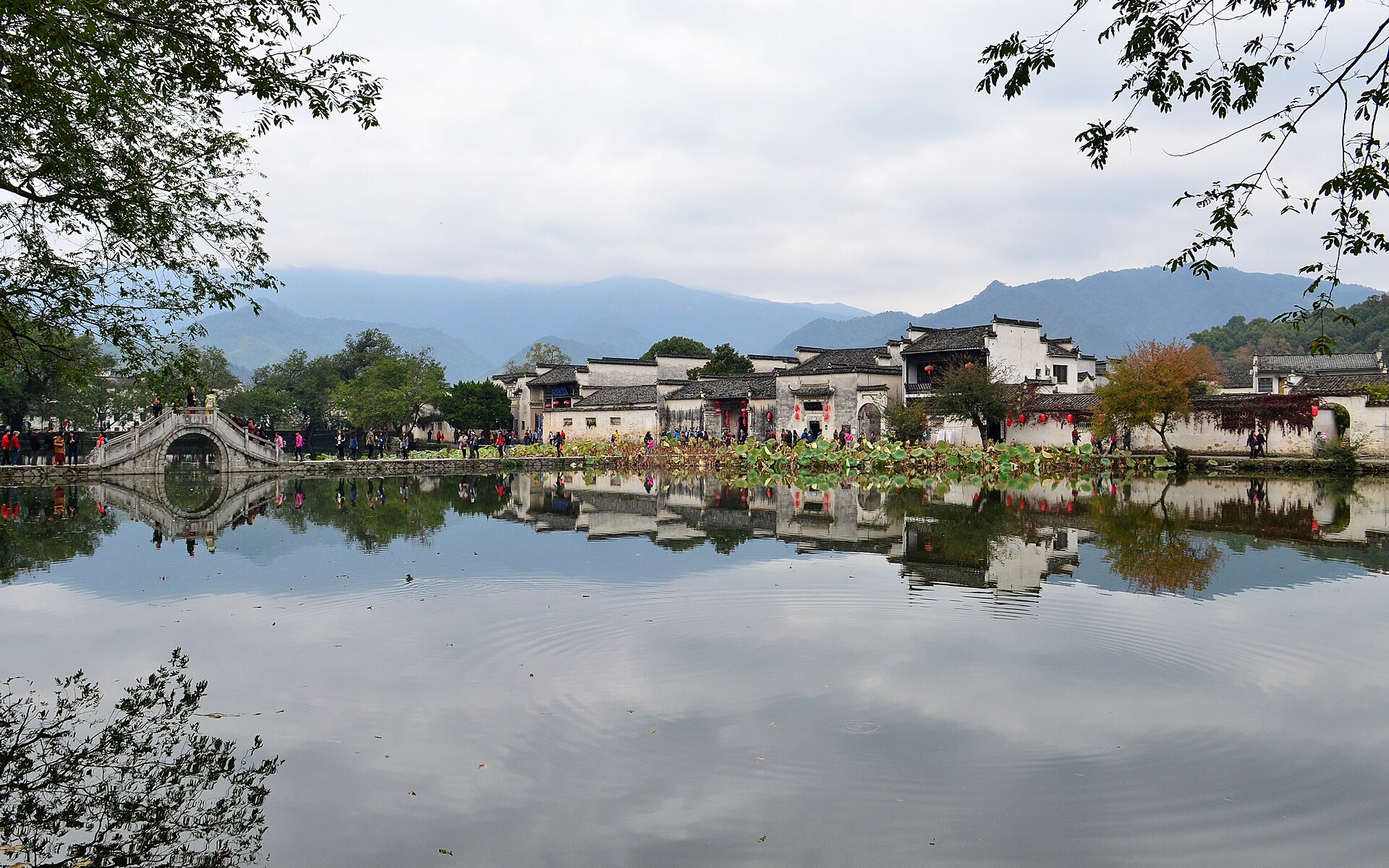
Built around a channel system that fills the South Lake and the moon pond at its centre. The most photographed village in China, and worth it before nine in the morning, when the lanes are still a working place.
 Start your enquiry
Destinations / Anhui / Huizhou
A prefecture that no longer exists, whose merchants built the finest vernacular architecture in China and then left it behind. Two of the villages are World Heritage; the rest are inhabited.
Explore the guide ↓Southern Anhui · the old Huizhou
Huizhou was an administrative region for roughly a thousand years and has not been one since 1987, when the area was reorganised around Huangshan. It covered six counties — Shexian, Yixian, Xiuning, Qimen, Jixi and Wuyuan — and the name survives in the architecture, the cooking, the dialect and the tea. Wuyuan is now in Jiangxi, which is the sort of detail that explains a lot of local argument.
The villages were built by absent men. Huizhou had more sons than farmland, so from the Ming dynasty onwards its men left to trade — salt in Yangzhou, tea and pawnshops across the empire — and sent money home. The result is a rural architecture of urban ambition: three-storey merchant halls, carved stone gateways, ancestral halls with fifty bays, and houses whose decoration was paid for in another province.
The planning rule is the thing to look for. Huizhou villages were laid out around water before they were laid out around anything else: a channel enters the village, feeds ponds and courtyards, and leaves. The lanes follow it, which is why the street plan looks organic but the drainage is exact. Once you notice the channels, the villages stop looking picturesque and start looking engineered.
Two World Heritage villages, and four better-kept secrets.
Built around a channel system that fills the South Lake and the moon pond at its centre. The most photographed village in China, and worth it before nine in the morning, when the lanes are still a working place.
A single main street that widens and narrows between stone gateways, with three carved halls open to visitors. Smaller than Hongcun, denser, and slightly less crowded.
Laid out on a bagua plan around a central pond, with the Baolun hall and its carved beams. Less visited than the two World Heritage villages and better for it.
Tangmo has a Tang-era garden and a street of surviving shopfronts; Nanping has eight ancestral halls and almost no coaches. Half a day each, at walking pace.
Rapeseed, rain, autumn and the quiet winter.
Rapeseed in flower across the fields between the villages, and the busiest month apart from the holiday weeks. March is better than April for both flowers and crowds.
Warm, then wet. June is the start of the rains, which is good for the water channels and bad for the stone lanes. Fewer visitors, softer light.
The best months. Drying racks out, camphor and maple turning, and the light low and clear. October is the peak, and the villages fill at weekends.
Cold, damp and quiet, with occasional snow on the roofs and almost nobody in the lanes. Many restaurants close; the ones that stay open are better.
One rail hub, two clusters, short drives.
Tunxi — the old town district of Huangshan city — has the airport, the station for the slow line, the old street and the best restaurants. Huangshan North is the high-speed station, 15 km out.
Yixian county holds Hongcun, Xidi, Nanping and Lucun, all within 20 minutes of each other. Shexian holds Tangmo, Tangyue and the old town of Shexian itself. They are on opposite sides of the mountain.
Drivers and taxis are cheap and the distances are short: Hongcun to Xidi is 20 minutes, Hongcun to Tunxi about an hour. There is no useful rail link inside the county.
Where the money came from, and what it bought.
Huizhou traders dominated salt, tea and pawnbroking for four centuries, and the wealth came back as halls, archways and genealogy. The 棠樾 archway group outside Shexian is a family’s record of itself carved in stone.
Brick, wood and stone carving are the region’s defined crafts, and the best of it is on lintels, brackets and doorframes rather than in museums. Lucun’s Zhichang hall is usually cited as the finest timber carving in the region.
Huizhou made the ink and the inkstones that the rest of China wrote with: 徽墨 from the Tang onwards, 歙砚 from the same county. Both are still made, and both are better bought in Tunxi than in a scenic area.
Tickets, hours and the coach timetable.
Hongcun and Xidi are around ¥104 each, Chengkan around ¥107, Tangmo ¥80, Nanping ¥38 and Lucun ¥45. Nothing is included in anything else; budget for four or five village entries across two days.
Coaches run 09:30 to 15:30. Before nine and after four the same lanes are quiet. This single piece of timing is worth more than any route choice.
Villages are flat and compact: two to four kilometres of lanes in a morning, plus field paths of two to six kilometres between them. Nothing here needs fitness; everything needs time.
Tell us how early you are willing to start and whether you want the famous two or the quiet four. The answer changes which county you sleep in.
Start my journey brief ↗