Huangshan maofeng · Fuxi
The original gardens are in the Fuxi and Caoxi valleys on the southern slope of the mountain, between 700 and 800 metres. Small-leaf bushes, picked as single buds before Qingming, pan-fired by hand.
 Start your enquiry
Destinations / Anhui / The tea country
Three of China’s most famous teas come from these hills, and all three were created within a generation at the end of the nineteenth century. The gardens are landscapes; the picking calendar is a travel calendar.
Explore the guide ↓Huizhou · Shexian, Xiuning, Qimen and Taiping
Tea grows on the slopes that were too steep for rice, which in Huizhou means most of the county. It was the second leg of the merchant economy after salt, and the reason so many villages have a tea house, a drying floor and a track leading up to terraces that are measured in strips rather than areas.
The remarkable thing is the chronology. Huangshan maofeng was created in 1875 by a Shexian merchant called Xie Zheng’an, who wanted a green tea that looked like a sparrow’s tongue and sold it first in Shanghai. Keemun black tea was developed in the same two years, by Yu Ganchen in Dongzhi and then Hu Yuanlong in Qimen, using techniques borrowed from Fujian and Jiangxi. Taiping houkui followed at the turn of the century and won gold at Panama in 1915, as did Keemun. Three of the country’s most celebrated teas, from one prefecture, inside a single working generation.
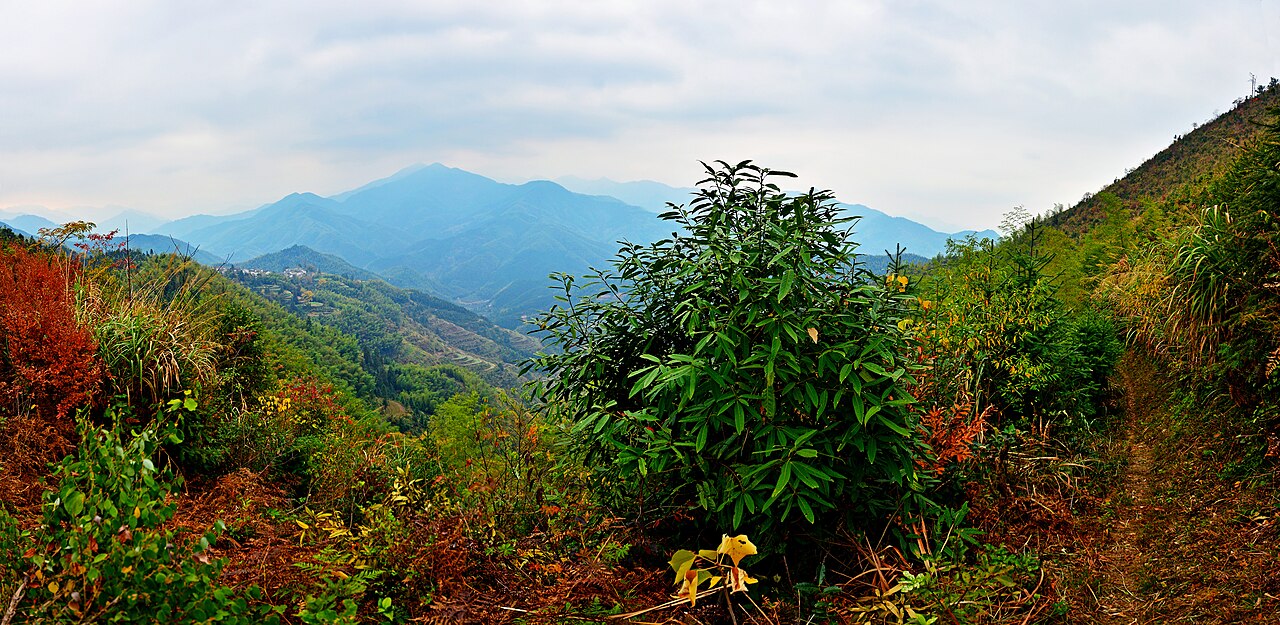
For a traveller this is a landscape you can walk. The tea hills are between 300 and 800 metres, cut by lanes and old roads, and the villages at their feet are the same ones the merchants built. April is the month to come: the bushes are being picked, the drying floors are running, and the whole county smells of it.
Where each one comes from, and what the ground looks like.
The original gardens are in the Fuxi and Caoxi valleys on the southern slope of the mountain, between 700 and 800 metres. Small-leaf bushes, picked as single buds before Qingming, pan-fired by hand.
Grown in a handful of villages around Houkeng, in a valley with its own microclimate. The leaf is pressed flat between cloths and dried in four stages, which is why it looks like nothing else in Chinese tea.
The Qimen valley west of Tunxi, where the bushes are picked three times a year and the leaf is fully oxidised. The aroma the trade calls Keemun fragrance is a function of the valley, not the process alone.
Songluo on Songluo Mountain in Xiuning is the sixteenth-century tea that taught the region how to pan-fire a leaf; tun green, the traded grade, was what the merchant houses actually shipped.
The picking calendar, month by month.
The maofeng flush. Buds are picked before Qingming, the gardens are full of pickers, and the drying floors run all night. The single best window for a tea visit.
Houkui, picked around the Grain Rain. The leaf is at its best and the villages around Houkeng are working. Cooler and quieter than the maofeng weeks.
Keemun’s second and third flushes, and the start of the rains. The tea is stronger and cheaper; the walking is wetter.
Not a picking season, but the best weather for walking the terraces, and the time to buy the spring tea that has settled. October in the tea hills is superb.
Four valleys, one rail hub, short drives.
Tunxi, with the airport and Huangshan North station. Fuxi is an hour east, Houkeng about 90 minutes north-east, Qimen about 90 minutes west.
The maofeng valleys are reached by road from Shexian; the villages are small and the gardens are above them. Half a day with a car, and more if you want to see the firing.
The Keemun valleys run west from the county town along the Likou and Shanli roads. This is working countryside with almost no tourism infrastructure, which is the point.
The trade that built the villages.
Huizhou merchants ran 茶号 — tea firms that bought rough leaf, finished it, graded it and packed it for export. In the 1920s Tunxi alone had more than a hundred of them.
Panama 1915 was the moment Chinese tea learned to compete on brand. Keemun and houkui both took gold there, and both still print it on the tin.
Taiping houkui was given to Nixon during the 1972 visit, which is the reason a flat green leaf from a valley in Anhui is better known abroad than its production volume would suggest.
Buying tea without being sold a story.
Tea bought in April is this year’s; tea bought in December is often last year’s at this year’s price. Ask for the picking date, not the harvest year.
The gift boxes in scenic areas are priced for the box. Buy loose leaf from a firm in Tunxi or from the garden itself, and taste before you commit.
The terraces are on private land. Ask before walking into a garden, keep to the paths between plots, and do not pick: the flush belongs to whoever farms it.
Tell us which of the three teas you actually drink, and we will build the route around that valley rather than around the map.
Start my journey brief ↗