Two different kinds of walking.
The trails in this region are cut stone over mountains. The villages are the opposite: flat, dense, and measured in metres rather than kilometres. Confusing the two is the most common mistake made about Huizhou — travellers arrive expecting a hike and get an afternoon of doorways, or arrive expecting a museum and find themselves walking eight kilometres between fields.
Both are worth doing, and they reward different things. On a trail the question is where you are going. In a village it is what the water does: where it enters, how it is directed, which courtyard it crosses, and where it leaves. The Huizhou villages were laid out around water management before they were laid out around anything else, and the lanes follow the channels.
Two of these villages — Xidi and Hongcun — were inscribed by UNESCO in 2000 as the Ancient Villages of Southern Anhui. The others are smaller, less visited, and in several cases more rewarding for exactly that reason.
The three loops.
Each is designed as a half or full day that stays at village level, with short road transfers between clusters rather than long drives. Distances given are for walking inside and immediately around the villages.
Hongcun, Takawa and Lucun
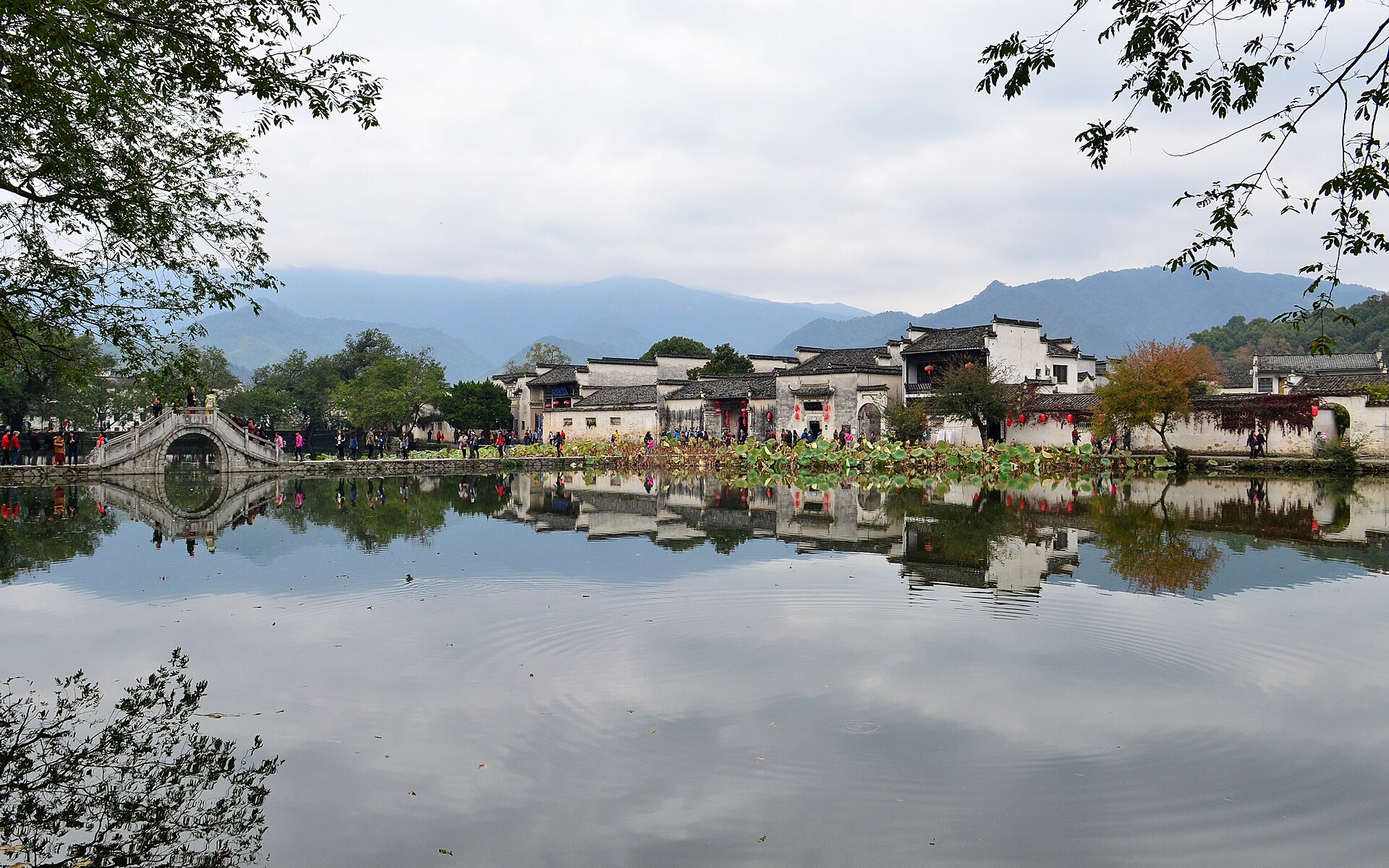
Yixian · 6–8 km · half to full dayThe classic circuit, and the one to do on a weekday if you can. Hongcun is built around a water system that feeds the South Lake and the moon pond at its centre; the paved lanes are narrow enough that the walking is dictated by the buildings. From the village, a field path runs about two kilometres north-east to Takawa, a small hamlet on a slope that is famous for autumn colour and almost empty the rest of the year. Lucun, another two kilometres from Hongcun, holds the Zhichang hall — a merchant house whose timber carving is usually described as the finest in the region. Walking all three and returning to Hongcun is a comfortable day.
Xidi and Nanping
Yixian · village lanes · full day with a transferXidi is the more formal of the two World Heritage villages: a single main street, three memorial arches, and a set of halls that read as a civic sequence rather than a set of houses. Nanping, a short drive away, is the opposite — a village of ancestral halls, several of them open, in a working settlement with few visitors and no restoration gloss. The walking here is entirely inside and around the two villages; the day is made by the comparison, not by distance.
Chengkan and Tangmo
Huizhou district · half day each · the quiet pairingChengkan is laid out on a bagua plan, with lanes radiating from a central axis and a substantial Ming ancestral hall — the Luodongshu shrine — that is worth the visit on its own. Tangmo, nearby, was built around a water mouth garden and a stone-paved street along a channel, and is small enough to walk in two hours. Neither is on the main coach circuit. Together they make the best day for someone who has already seen Hongcun.
Know before you go.
Village tickets are separate and not cheap
The two World Heritage villages are the expensive ones — published adult admission for Hongcun and Xidi sits around ¥104 each, with a lower price if booked online, and half price for students and seniors. Chengkan is around ¥107, Tangmo around ¥80, Nanping around ¥38 and Lucun around ¥45. Takawa is a smaller charge again. None of this covers a guide, and the ticket for one village does not admit you to another.
The crowds have a schedule
Hongcun and Xidi receive coach groups from mid-morning to mid-afternoon, heaviest at weekends and during the spring flower season. The lanes are narrow; a group of forty fills one completely. Walk early, break in the middle of the day, and go back out after four. The other villages do not have this problem.
Stay inside, not outside
Most visitors stay in a hotel outside the village and walk in. Staying in a converted merchant house inside changes the trip: you get the lanes at dawn and after dark, when the day visitors have gone and the water channels are the loudest thing in the village. Rooms are small and not always quiet; that is the trade.
Spring and late autumn
Rapeseed flowers the fields from late March into early April; persimmons go onto drying racks in November and the leaves turn on the slopes above the villages. Both are photogenic and both are busy. July and August are hot and humid with heavy rain; January is quiet, cold and often grey, which suits the architecture better than it sounds.
Two or three days, at village pace.
An outline to adapt. Opening hours, ticket prices and which halls are open are confirmed for your dates.
- Day one — Hongcun and the fields. Arrive early, walk the village before the coaches, then take the field path to Takawa in the afternoon and return by the lanes. Sleep in Hongcun.
- Day two — Lucun, then west. A morning at Lucun for the carving, then transfer to Xidi for the late afternoon and evening, when the main street empties. Sleep in Xidi or Nanping.
- Day three — Nanping and out. Nanping’s halls in the morning, then either back to Huangshan or north to Chengkan and Tangmo if you have a fourth day.
If you are also walking the trails, put the villages after the mountains rather than before. The stone roads are physically harder and the villages make a better recovery day than a preparation for one.
Prepare for the actual route.
This is not hiking. Comfortable shoes for stone paving, a layer you can take off, and something waterproof — the lanes are exposed and umbrellas are awkward in a crowd. Bring cash for small entries and village food. A small torch helps in the unlit lanes after dinner, and a willingness to sit down for an hour in the middle of the day is more useful than any equipment.
For a quote, tell us which villages matter to you, whether you want to sleep inside them, and how much time you want in each. Ask the proposal to separate village admission, guiding, meals and transfers — admission alone can be a meaningful part of a short trip’s cost.
Your questions, answered.
Is Hongcun too crowded to enjoy?
Not if you time it. Before nine and after four it is a working village again. The middle of the day belongs to the coaches.
Which single village if I only have one?
Hongcun for the water system and the setting; Xidi for the architecture and the street. If you want quiet rather than either, Chengkan.
Can I walk between the villages?
Hongcun to Takawa and Lucun, yes — field paths, about two kilometres each way. Between Xidi and Nanping, or Chengkan and Tangmo, the distances are on roads without footpaths, so a short transfer is the sensible choice.
Do I need a guide in the villages?
The architecture is legible without one, but the sequence of a hall — gate, court, hall, shrine — is not obvious, and a good local guide is what turns a set of rooms into a building. Half a day is enough.
References & photography.
World Heritage status, village descriptions and distances follow UNESCO documentation and local scenic area notices. Admission prices are indicative, vary by sales channel and season, and should be confirmed at the gate.
- UNESCO: Ancient Villages in Southern Anhui — Xidi and Hongcun, inscribed 2000.
- Hongcun water system: South Lake, moon pond, and the channels that feed them.
- Takawa and Lucun: about two kilometres from Hongcun by field path.
- Photo: 颐园新居 · South Lake of Hongcun · CC BY-SA 4.0. Resized by Wikimedia.