Tianzhu Peak & the ridge
The path from the cable car along the ridge to the platform opposite the pillar, with the Duxian bridge and the Tianchi pool at the end. The last section is steps cut into rock with chains.
 Start your enquiry
Destinations / Anhui / Tianzhu Mountain
One pillar of granite above a ridge of them, worshipped as the Southern Peak of China for seven hundred years, and named after the province’s own abbreviation.
Explore the guide ↓Anqing · 1,489.8 m
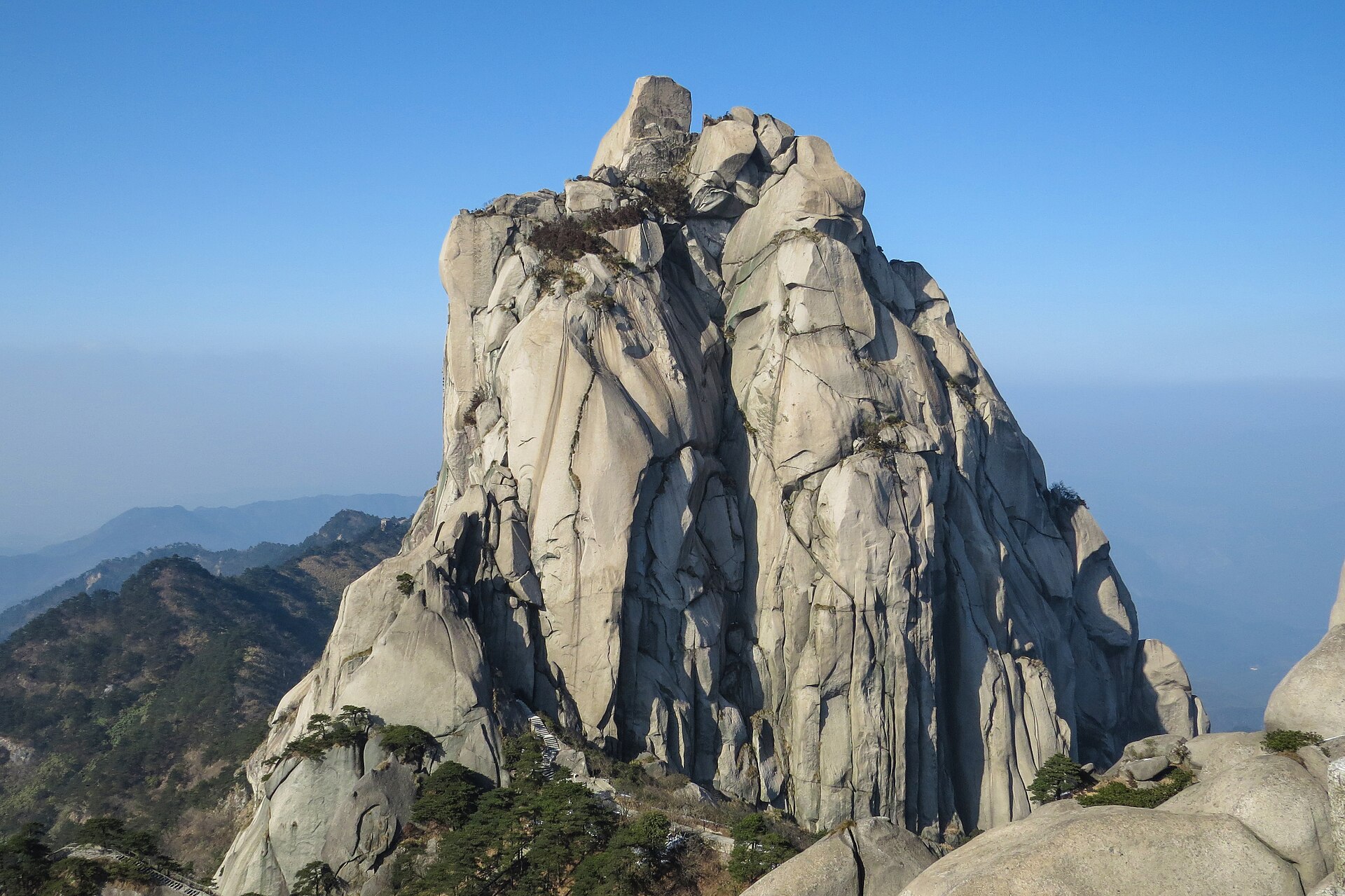
Tianzhu means heaven’s pillar, and the name is not decorative: the summit is a single granite tower standing clear of the ridge, 1,489.8 metres, with a shoulder you can walk to and a top you cannot. Around it the geopark covers 413 square kilometres of the eastern Dabie belt, and the rock is the reason it exists — the collapsed and stacked granite landforms here are distinctive enough that Chinese geologists named a class of them after the mountain.
The cultural weight is out of proportion to the height. In 106 BC the Han emperor Wu climbed it and designated it the Southern Peak of the empire, a status it held until 589, when the Sui moved the title to Hengshan in Hunan. That seven-hundred-year interval is why every sign in the county calls it 古南岳, the old Southern Peak, and why the mountain has an imperial biography rather than just a scenic one.
It also gave the province its name. Tianzhu was known as Mount Wan, from the state of Wan that held this ground in the Spring and Autumn period; Anhui’s single-character abbreviation, 皖, comes directly from it. At the foot of the mountain, the Shangu Liuquan valley holds close to four hundred rock inscriptions cut over a thousand years, which is the largest concentration in the province.
The pillar, the caves below it, and the carvings at the foot.
The path from the cable car along the ridge to the platform opposite the pillar, with the Duxian bridge and the Tianchi pool at the end. The last section is steps cut into rock with chains.
A route through a jumble of collapsed granite boulders, with gaps, squeezes and stone stairways threaded between them. The most entertaining hour on the mountain and the reason children like it.
The valley at the foot where the Shangu stream runs, lined with about 400 carvings from the Tang onwards, including Wang Anshi’s. Half a day, mostly flat, and almost empty.
Sanzu Chan Temple, south of the mountain, is where the third Chan patriarch Sengcan taught. Rebuilt more than once, and still a working monastery rather than a monument.
Azaleas, cloud and a cold, clear winter.
The best window: azaleas on the upper ridges, cloud in the valleys, and temperatures that make the stairways pleasant. May is the pick.
Hot and wet, with the mountain often in cloud. The waterfalls and the streams are at their best; the views are not.
Clear, dry and cool, with the best visibility of the year and the fewest people on the ridge paths. October is the peak for light.
Cold, with rime and occasional snow on the granite, and a small ski area on the northern side. The pillar in snow is the best photograph on the mountain.
One county town, one gate, two ways up.
High-speed rail to Anqing or Tianzhushan station, then 40 minutes by road to Qianshan and the mountain gate. Anqing is the larger city and the better base for a night either side.
One cable car takes you most of the way to the ridge; a second serves the upper section. Neither reaches the pillar, and the last stretch is on foot.
Qianshan town at the foot, or the small hotels near the gate. There is very little on the mountain itself, which makes this a day mountain rather than an overnight one.
An imperial title, a province’s name and a poem.
Emperor Wu’s designation in 106 BC made this one of the five sacred peaks, and the ritual geography of imperial China was built around them. The Sui reassignment in 589 did not remove the association; it just moved the ceremony.
Mount Wan gave Anhui its abbreviation. The character 皖 is on every licence plate and every official document in the province, which makes this the rare landscape that named a place rather than the other way round.
The county claims the setting of the孔雀东南飞, the earliest long narrative poem in Chinese, and the childhood home of the Two Qiaos of the Three Kingdoms. Huangmei opera, the province’s own form, comes from the same county.
Steps, chains and one exposed summit.
The final approach to the pillar platform is cut into rock with chains and handrails, and is not for anyone unhappy with height. The ridge path before it is straightforward.
The summit is 1,489 m and the cloud can arrive in twenty minutes. Carry a shell even on a clear morning, and turn around if the rock gets wet.
The rock carvings at Shangu Liuquan are 15 minutes from the gate and worth the extra half-day. Most visitors skip them, which is a mistake.
Tell us whether you want the summit or the carvings, and whether anyone in the group dislikes chains. Those two answers set the route.
Start my journey brief ↗