
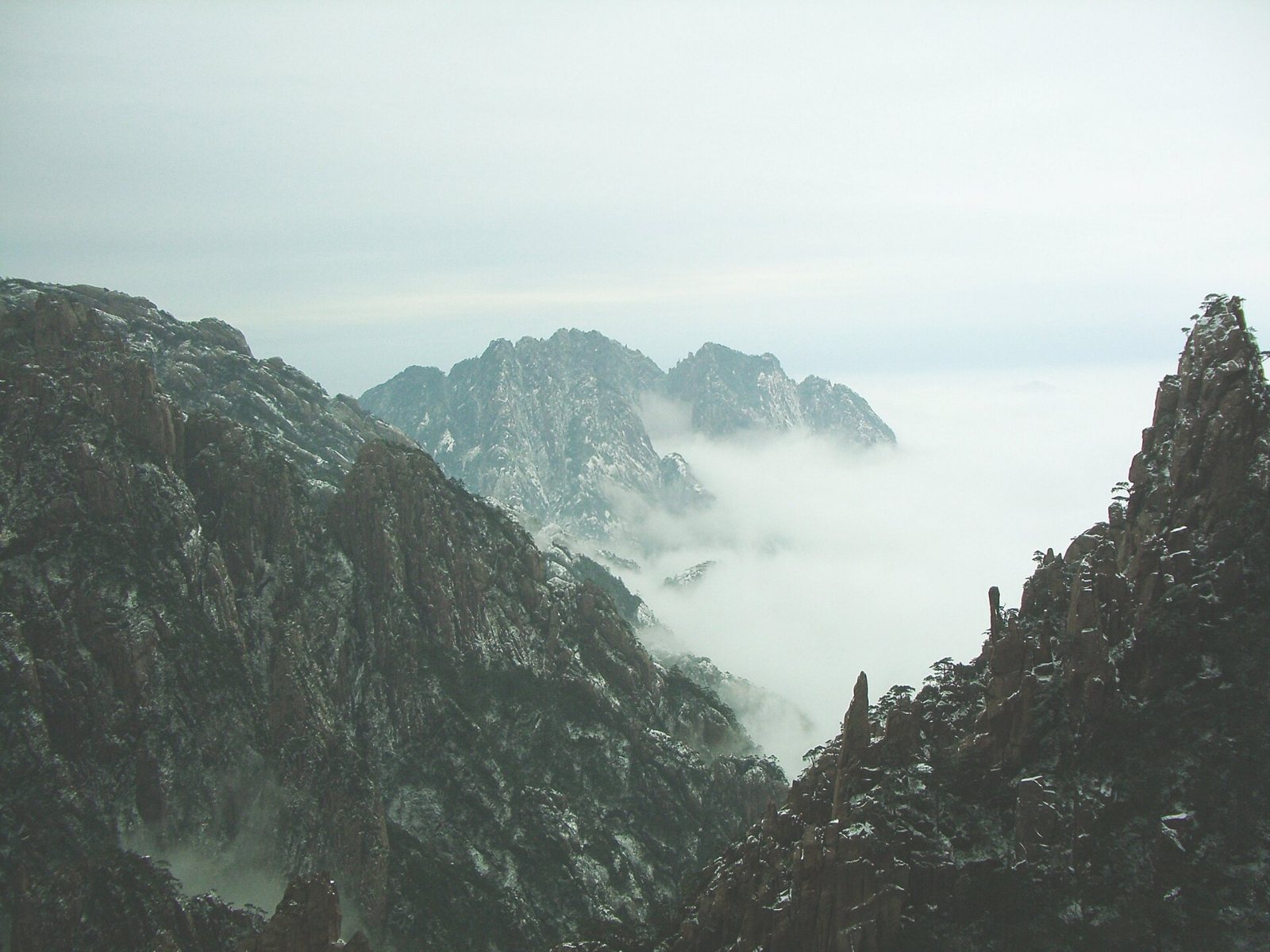
These two places get bundled together because they look alike in photographs and because both appear on the same shortlist of "mountains in China that are not the Wall". The resemblance ends at the car park. Huangshan is a single granite massif that you climb on foot, sleep on, and descend from with sore calves. Zhangjiajie is a sandstone plateau cut into thousands of pillars, and the park is designed so that almost nobody has to climb anything.
That difference decides more about your trip than the scenery does. It decides how many days you need, what you pay, who can come with you, and whether the following day is a walking day or a recovery day.
Two different jobs.
Huangshan, in Anhui, is the mountain Chinese landscape painting spent centuries imitating: granite peaks, pines growing out of cracks, cloud sitting in the valleys below the ridge. The pleasure is in the walking — a network of stone staircases links the peaks, and the summits are reached on foot. There are cable cars, and they save a real amount of effort, but they only remove the lower third. Everything above is steps.
Zhangjiajie, in Hunan, is a UNESCO-listed forest of quartz sandstone pillars, some over 200 metres tall, rising out of green ravines. The park is 264 square kilometres and the vertical work is done for you: an elevator bolted to a cliff, three cable cars, a monorail, and a fleet of shuttle buses linking the viewpoints. You will still walk eight to twelve thousand steps a day, but on paved paths and boardwalks rather than staircases.
Huangshan: the steps are the ticket.
A normal visit is two days and one night. You take a cable car up in the afternoon, walk the ridge between the peaks, sleep at a summit hotel, get up before dawn for sunrise, and walk out the next morning. The alternative — up and down in a day — is possible and unpleasant, because the descent is roughly 6,000 steps and your legs will remember it for three days.
The staircases are the point and also the obstacle. They are uneven, worn smooth in the middle, and frequently steep enough that you use a handrail. Anyone with knee trouble, a fear of exposure, or a reluctance to climb 1,500 metres of vertical in a day should think hard before choosing Huangshan over Zhangjiajie. Children manage it; people in their seventies manage it slowly; but it is not a stroll.
Two practical details catch people out. First, entry is by real-name reservation with a timed slot, tied to the gate you chose — south, north or west — and there is effectively no walk-up ticket worth relying on. Second, the two famous summits are managed separately: Tiandu Peak requires an advance reservation, and Lotus Peak opens on a rotation rather than permanently, so check which of the two is open in your week rather than assuming both.
The mountain is only half of what Anhui offers. At the foot are the Huizhou villages — Hongcun, Xidi, and the smaller hamlets between them — white walls, grey tiles, and in March and April rapeseed in flower around them. Autumn works the same way in reverse, with persimmons drying on racks in November. A Huangshan trip that skips the villages is a mountain trip; with them it becomes a landscape trip.
Zhangjiajie: the landscape is vertical, the walking is not.
The park is a plateau that has been eroding into pillars for millions of years, and the viewpoints sit on the rim looking down into it. Getting from the valley floor to the rim is the only hard part, which is why the Bailong Elevator exists: 326 metres of glass lift built into a cliff face, and the reason a queue can reach two to three hours on a busy day.
Inside the park the shuttle buses are free with the ticket and cover the distances between Yuanjiajie, Tianzi Mountain, Yangjiajie and the Golden Whip Stream. The cable cars — Tianzi, Yangjiajie, Huangshizhai — are optional and separately charged. The result is a park that a fit sixty-five-year-old can see properly, and one where a family with young children can cover ground without a negotiation every hour.
Two things to know before you plan days. Tianmen Mountain, with the glass walkways and the natural arch, is not part of the national park and needs its own ticket and its own half day; it is reached by a cable car that starts in the city, not from Wulingyuan. And the Grand Canyon glass bridge is a third separate ticket, twenty minutes away by road. People routinely budget for one gate and discover three.
What each costs.
Huangshan is the simpler bill: one mountain, one ticket, and a small number of lifts. Zhangjiajie is cheaper at the gate and more expensive by the end of the second day, because the park is only the first of three paid attractions.
| Item | Huangshan | Zhangjiajie |
|---|---|---|
| Entrance | ¥190 peak (21 Jan–19 Dec), ¥150 in winter; valid three consecutive days with re-entry | ¥236 including the shuttle buses, valid four consecutive days; ¥165 without the buses |
| Lifts, one round trip | ¥170: Yungu ¥80 up, Yuping ¥90 down | ¥137: Bailong Elevator ¥65 up, Tianzi cable car ¥72 down |
| Second gate | None. The villages are free to walk. | Tianmen Mountain, ¥261–288 depending on the line |
| Three days, before hotels | About ¥400 | About ¥640 |
Three notes on those figures, because the published prices are more confusing than they need to be. Huangshan does still charge by season: the winter rate runs from 20 December to 20 January and cuts both the ticket and the cable cars. Zhangjiajie does not — Wulingyuan has charged a flat rate all year since 1 January 2025, and any page still quoting a half-price winter ticket is out of date.
Second, the ¥236 and the ¥239 you will see side by side are the same product. The official combined ticket is ¥236; several booking platforms list it at ¥239. Third, Huangshan's shuttle bus from Tangkou is ¥19 each way and is not included, which is easy to forget when you add up the "ticket".
Neither figure includes hotels. On Huangshan a summit room is the single largest line in the budget and the reason many people try to do the mountain in one day; at Zhangjiajie you sleep in Wulingyuan town or the city, where the same money buys considerably more room.
Getting there decides more than you think.
Huangshan North is on the main Hangzhou–Nanchang corridor. From Shanghai Hongqiao the fastest trains take about two and a half hours for roughly ¥193–226 in second class, and from Hangzhou about ninety minutes. The station is then an hour from the mountain gate at Tangkou, with a shuttle bus for about ¥33. Door to mountain, from central Shanghai, is four to five hours — a realistic weekend.
Zhangjiajie is further from the coast. Zhangjiajie West connects to Changsha in about two hours and to Chongqing in about two and a half, which makes it a natural stop on a Hunan or south-west route. From Shanghai there are direct high-speed trains, but they take seven to nine hours and cost around ¥753; the flight takes two and a half hours. From the station it is another thirty to forty minutes to the park gate.
How to choose.
Take Huangshan if the walking is the reason you came. If you want stone stairs, a summit sunrise, tea fields and Huizhou villages within a long weekend of Shanghai, it delivers something Zhangjiajie cannot: the feeling of having climbed the thing rather than been delivered to the top of it. It also pairs naturally with a longer Anhui or Zhejiang route.
Take Zhangjiajie if you want the scale without the staircases. If you are travelling with parents, with children, or with someone whose knees have opinions, the park is engineered for you, and the pillars are genuinely unlike anything else in the country. It also sits inside a strong regional route — Fenghuang, the Hunan countryside, and onward to Chongqing.
Do not do both in one week unless you fly between them. The rail connection runs back through Changsha and costs the better part of a day in each direction, which is exactly the day you would rather spend on the mountain. Ten days is enough for both; seven is not.
Prices and access checked 3 November 2026 against the Huangshan scenic area's published 2026 tariff and the Wulingyuan official ticket page. Ticket systems, cable-car maintenance windows and summit closures change by season; confirm the current position before booking non-refundable travel.
Walking either mountain?
See the Huangshan and Huizhou routes →