The snow leopard tour
Six field days on the Sanjiangyuan highland. Early starts because the cats hunt in the first and last light; the middle of the day goes to tracks, scrapes and reading which ridge was used last night.
 Start your enquiry
Destinations / Qinghai / Yushu & Guoluo
The southern plateau: a Tibetan town at 3,680 metres, a red sandstone gorge holding the densest known snow leopard country in China, and the calving grounds of the chiru.
Explore the guide ↓Southern Qinghai · Yushu prefecture
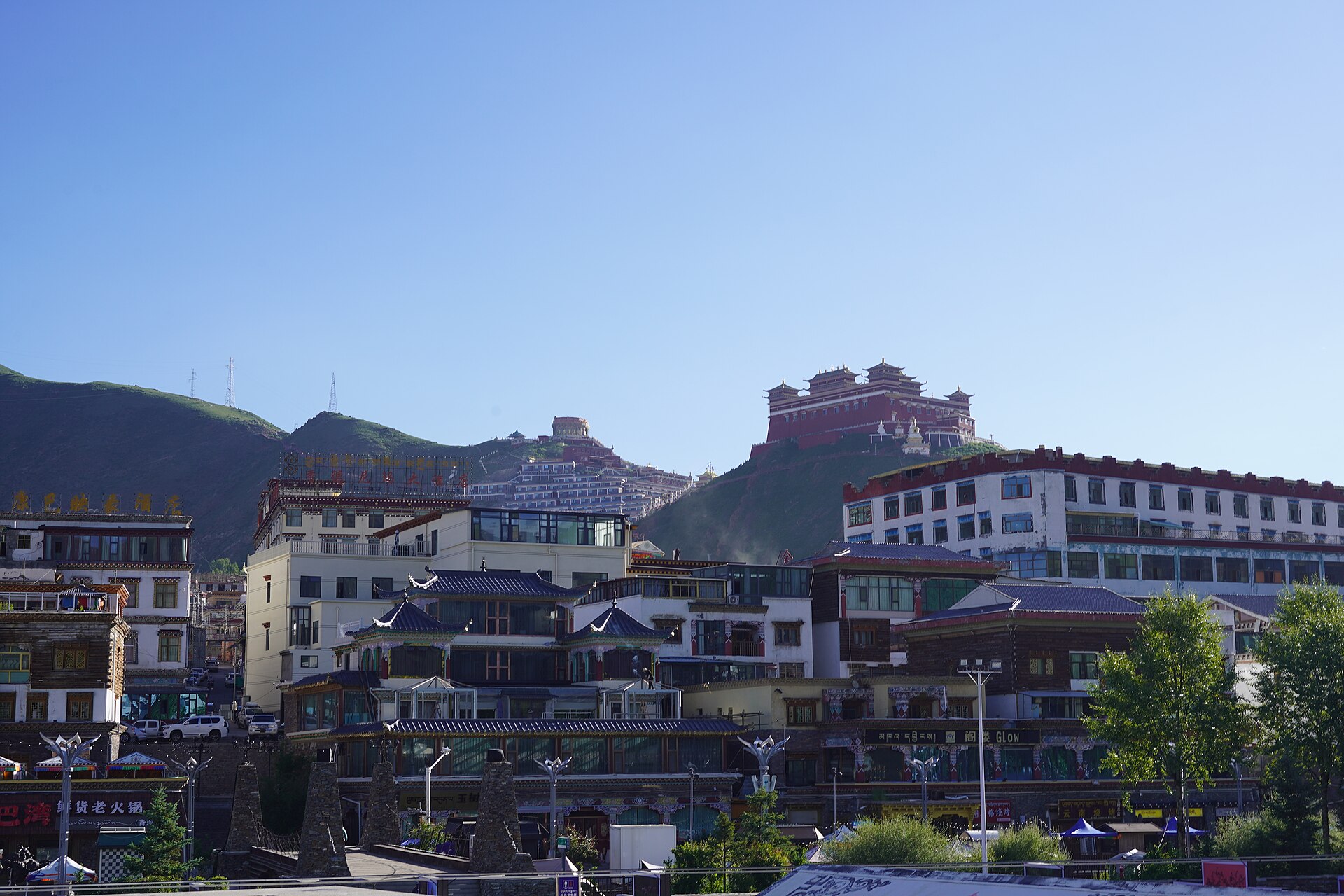
Yushu — Jyekundo in Tibetan, Jiegu in Chinese — sits at 3,680 metres in the far south of the province, and the prefecture around it is the size of a small country. Almost all of it is above 4,000 metres. This is the headwater country: Sanjiangyuan National Park protects the sources of the Yellow, Yangtze and Lancang rivers, and the park is the reason the wildlife here is worth planning a week around.
The centre of that week is Angsai, in Zadoi county, inside the Lancang source park. The gorge is 300 square kilometres of Cretaceous red sandstone — the most complete plateau danxia landscape in China — cut by the upper Mekong and fringed with the tallest stands of large-fruited juniper anywhere. Long-term work here by Peking University and the Shan Shui conservation centre has identified 85 individual snow leopards and 12 common leopards, which makes it one of the few places on earth where the two cats share a valley, and one of the best places anywhere to look for the snow leopard.
West of the prefecture the land opens into Hoh Xil, above 4,600 metres. Each year from May to July female chiru — Tibetan antelope — leave three separate ranges and walk to the same lake basins to calve; in a good year up to 35,000 cows gather around Zonag Lake alone. Most of that ground is roadless and closed, but one leg of the migration crosses the Qinghai–Tibet highway, which is why the animal became the symbol of the whole plateau.
Two cats, one antelope, and a lot of walking past rocks.
Six field days on the Sanjiangyuan highland. Early starts because the cats hunt in the first and last light; the middle of the day goes to tracks, scrapes and reading which ridge was used last night.
Red sandstone, juniper and a valley shared by snow leopard and common leopard. The conservation story behind the density, and what a week above four thousand metres actually looks like.
The calving migration, the three ranges the females leave, and the single road that crosses their line.
Why a sighting is a by-product of time in the valley rather than a schedule, and how the days are built around that.
The cats have a season and the antelope have another.
The fixed departure month for the snow leopard tour: snow lines are high, the valley is accessible, and the cats are working the ridges above the gorge.
The chiru migration. Calving concentrates at the end of May and through June; the return walk runs from late July.
Clear, cold and stable. Good for the country and the driving, quieter for cats.
Hard winter at 3,700 metres and above. Some access closes, and the high reserves are not a place to improvise.
A flight or a long road, and a real arrival.
Yushu is reached by air or by a long road from Xining. Either way the arrival is at 3,680 metres, which is not a formality — the first day is a rest day whether the itinerary says so or not.
Angsai is a working valley with permits and local arrangements attached. Access is organised in advance, and the plan can move for access, weather or the chance of a sighting.
Six field days is a realistic shape for a first snow leopard trip, and still no guarantee. We say so before anyone books rather than after.
Herding country, monastic country.
The grassland is worked land. Ask before crossing a fence, before photographing a family, and before assuming a track is a road.
Yushu is a deeply religious place with a dense monastic landscape. Dress for it, walk clockwise around the sites, and keep the camera down in the halls.
Sanjiangyuan is a national park with zoning that matters: core areas are closed to tourism, and the routes that exist are in the general control zone. That is why the wildlife is there.
Height, cold nights and paperwork.
3,680 metres on arrival, 4,000-plus in the field. Two staged nights somewhere lower first, or a slow road in, make the week possible rather than painful.
Dawn is below freezing at this height in any month. The cats are found at dawn. Bring the down layer.
Remote areas and reserves need permits and local arrangements in advance. We confirm the current position for every departure rather than relying on last year’s rules.
Tell us whether the cats or the antelope set the dates. The valley, the season and the patience all follow from that.
Start my journey brief ↗