The salt flat at dawn
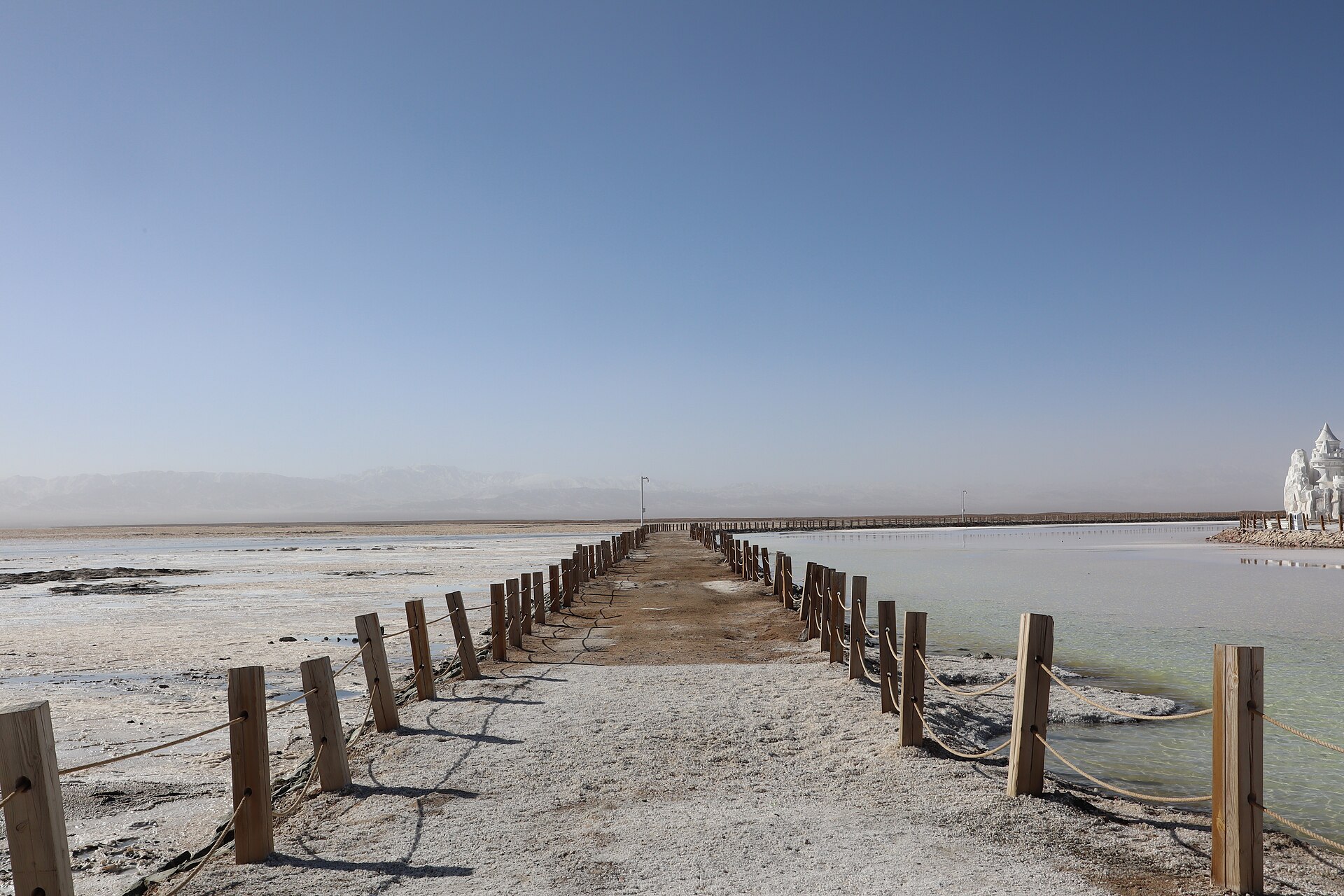
The mirror works in the first hours after sunrise, before the wind gets up. A causeway crosses the brine; the far side is usually the emptier one.
 Start your enquiry
Destinations / Qinghai / Chaka & the Qaidam
A salt flat that doubles the sky at 3,100 metres, then the empty basin west to Golmud and the Kunlun road that ends at a 6,178-metre summit.
Explore the guide ↓Haixi · the Qaidam basin
Chaka is a working salt lake before it is a photograph. At 3,100 metres the brine sits a few centimetres deep over a white crust, and on a calm, clear morning the water returns the sky so completely that the horizon disappears. That is the whole effect, and it is entirely weather-dependent: wind ripples the surface and takes it away, cloud flattens it, and midday sun burns it out. Go early, go with your own vehicle, and give it a flexible day.
West of Chaka the country changes character. The Qaidam basin is a high desert of salt pans, gravel and oil infrastructure, ringed by ranges that hold snow into June. Golmud at 2,800 metres is the last real town before the Kunlun, a railway city built on potash and traffic, and the base for the one mountain journey we run here.
From Golmud the road climbs south over the Kunlun pass and onto the plateau proper — the same corridor the railway follows to Lhasa. For most travellers it is a spectacular drive and a view of the line; for climbers it is the approach to Yuzhu Feng, the 6,178-metre mountain that has become Chinese mountaineering’s classic first 6,000er.
One mirror, one road, one mountain.
The mirror works in the first hours after sunrise, before the wind gets up. A causeway crosses the brine; the far side is usually the emptier one.
Base camp at 5,000 metres within walking distance of the vehicles, two glacier days, a 5,600-metre high camp and a summit on 20-to-30-degree snow.
The drive south out of Golmud onto the plateau, with the railway alongside and the Yuzhu massif closing the view.
The line that made this corridor ordinary: overnight from Xining to Golmud, and onward to Lhasa for anyone continuing high.
May to October, and the salt wants a still morning.
Cool, clear and quiet; the ranges still hold snow. The mirror is at its most reliable in the early mornings.
The warmest window and the busiest. Afternoon convection brings cloud, so the salt flat is a dawn appointment rather than an afternoon one.
Dry, stable, cold at night. The best month for the drive and for the mountain.
Cold, windy and empty. The high road is a serious proposition rather than a scenic one.
Rail, road, and a lot of nothing in between.
Xining to Golmud by overnight train is the civilised approach; Chaka sits between the lake and Golmud on the road, and is usually a dawn stop rather than a night.
Fuel and food are far apart out here. Every route we run carries water, a spare and a plan for the next town, because the next town is genuinely far.
Yuzhu runs privately between May and September with no fixed join-in dates. Acclimatisation days are built into the seven, and the price per person falls as the group grows.
A landscape that is worked, not just visited.
The basin is an industrial landscape: brine ponds, extraction plants, the railway that carries it out. It is worth understanding before photographing it.
Mongolian and Tibetan herders still work the margins of the basin. Gates, dogs and grazing rights are real; ask before crossing a fence line.
Golmud exists because of the line and the minerals. Its restaurants run late, its hotels are practical, and nobody is on holiday.
The jump is the point.
Chaka at 3,100 metres, Golmud at 2,800, base camp at 5,000. The sequence is deliberate and the two days at Golmud are the ones that make the mountain possible.
The white crust reflects everything: sunglasses are not optional, and the wind that ruins the mirror will also strip your lips.
There is none, anywhere, for hours. Hat, long sleeves, and water on a schedule rather than on thirst.
Tell us whether the salt flat is the destination or the first stop on the way to the mountain. The two weeks are built very differently.
Start my journey brief ↗