The 360-kilometre circuit
Clockwise, with the prevailing wind behind you for most of it: four riding days of 80 to 100 kilometres and a support vehicle carrying everything else.
 Start your enquiry
Destinations / Qinghai / The lake country
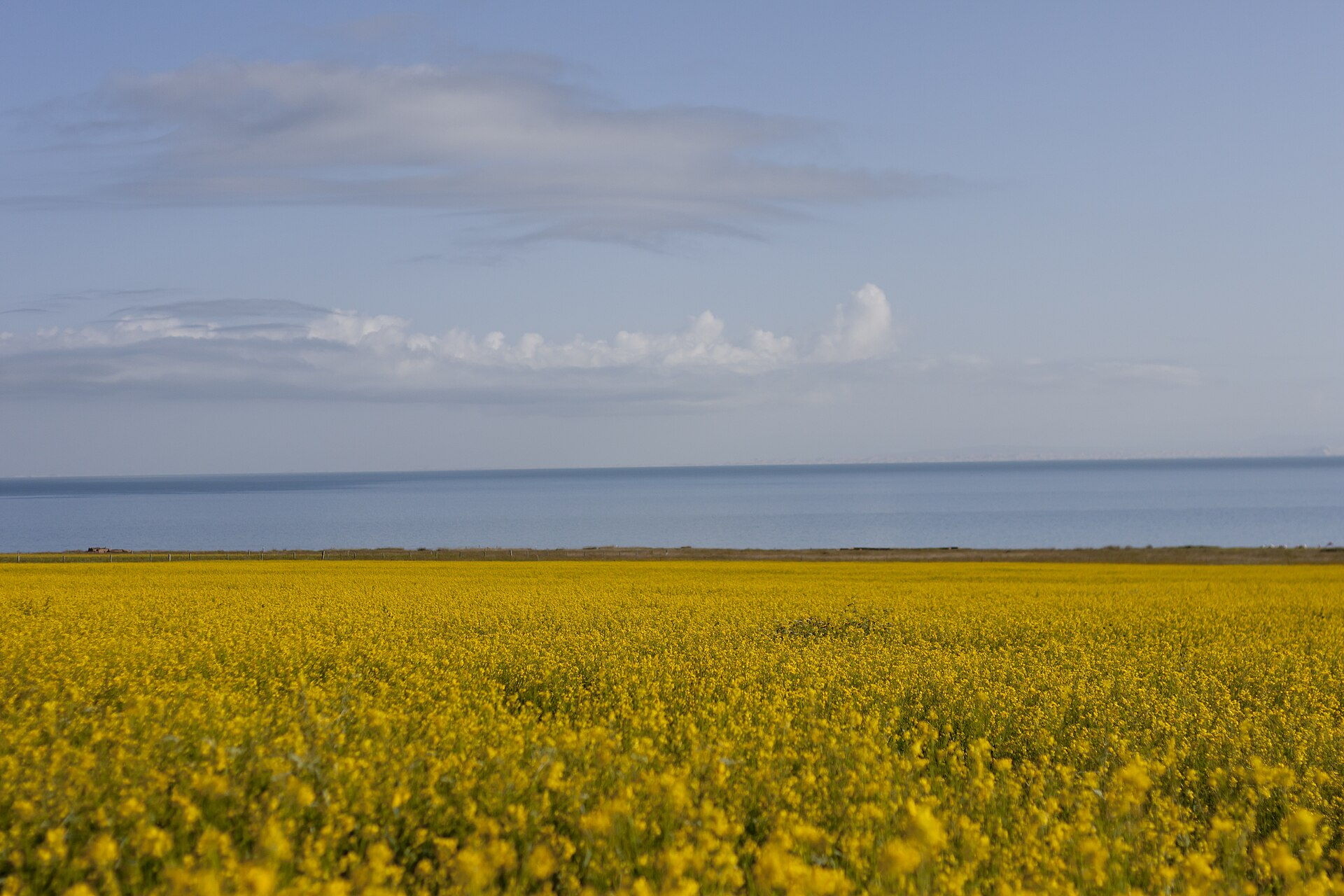
A saline sea at 3,200 metres, ringed by rapeseed in July and herder camps the rest of the year — the reason most Qinghai journeys exist.
Explore the guide ↓Haibei & the lake · 3,200 m
Qinghai Lake is the largest lake in China: roughly 4,600 square kilometres of brackish water at 3,200 metres, held between grassland and the first ridges of the plateau. It does not read as a lake from the shore. It reads as a coast, with weather fronts crossing it and a horizon that takes a while to accept.
The two anchors are Heimahe on the south shore and Erlangjian further east — the first for sunrise and herder country, the second for the developed shore and the easiest access from Xining. Between them the land is grazing: yaks, prayer-flag passes, and families who have worked this shoreline for generations.
In July the rapeseed around the fields comes into bloom and the whole southern shore turns yellow against blue water, which is the image everyone arrives with and, unusually, the one the place actually delivers. The cost is company: July and August are the domestic peak. June and September give you the same country with cold nights and empty roads.
Ride the ring, walk the shore, or sit still and let the light move.
Clockwise, with the prevailing wind behind you for most of it: four riding days of 80 to 100 kilometres and a support vehicle carrying everything else.
Sunrise at Heimahe, the developed shore at Erlangjian, and the twenty-odd kilometres of road between them that most people drive too fast.
Yak camps, mani walls and family guesthouses on the north and west shores — simple beds, and the quietest nights on the plateau.
The lake is a reserve and a major staging ground. The colonies are watched from the reserve roads: Bird Island itself has been closed to visitors since 2017, and the birds have done better for it.
Four short windows, one clear best.
The bloom, the warmest air and water, and every domestic tour group in the province. Book early and ride early.
Green, cold at night, birds tapering off, roads quiet. The best value month for the circuit.
Clear skies, yellowing grassland, no crowds, freezing mornings. Photographers’ month.
The shore empties and the lake ices over. Beautiful, hard, and not what the journeys are built for.
Two and a half hours from the city; a week if you ride it.
The drive from Xining is two and a half to three hours. Most journeys take the south shore first and work anticlockwise by road, or clockwise by bike.
Heimahe and the south shore have the herder guesthouses; Erlangjian has the larger hotels. Heating and hot water are the two things to confirm.
It is the reason the circuit runs clockwise, and the reason a headwind day can add two hours. We build the schedule with a spare half-day rather than pretending otherwise.
The lake is a pilgrimage before it is a destination.
Tibetan pilgrims circle the lake as a devotional act, and the circuit is theirs long before it was ours. Give way, and do not photograph people mid-prostration without asking.
A guesthouse night is a family’s house. Yak yogurt, butter tea, and a stove that decides the evening.
No swimming, no driving onto the shore meadows, no litter — the grassland is grazing land, and the reserve rules are enforced.
Wind, sun and a night at 3,200 metres.
The first night at 3,200 metres is a real step from Xining. Two city nights first make it unremarkable; skipping them does not.
Sunburn at noon, near-freezing before dawn, hail without warning in July. Take the shell and the warm layer every day of the season.
The plateau is dry and the wind is constant. A litre and a half a day per person is the working figure, more on the bike.
Tell us whether you want to ride the ring or walk the shore. The difference decides the month, the mileage and how many nights you spend above three thousand metres.
Start my journey brief ↗