
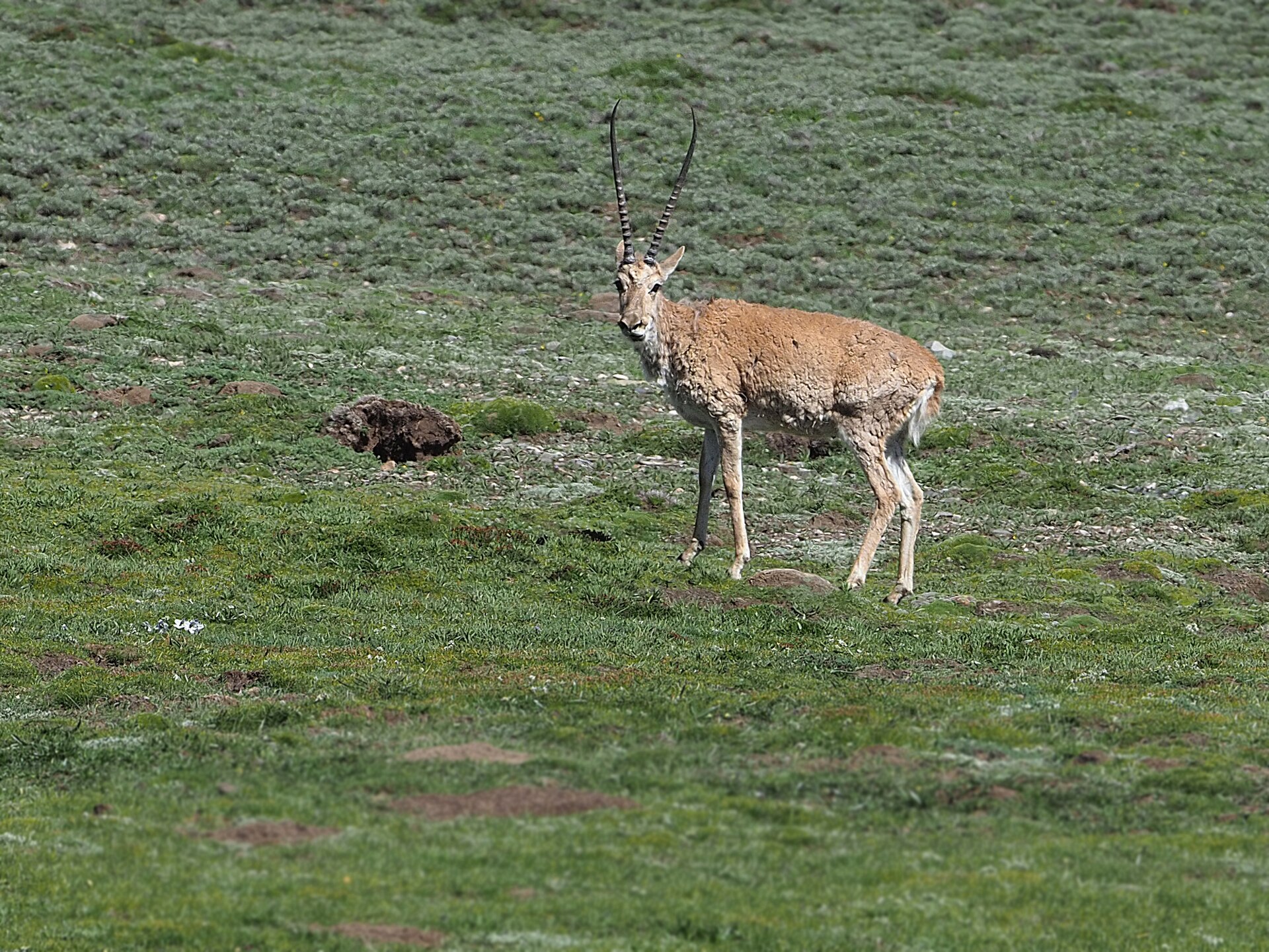
The Tibetan antelope — chiru — runs one of the great ungulate migrations on earth, and almost nobody sees it. The females spend the year spread across three ranges: the Sanjiangyuan headwaters of Qinghai, the Changtang plains of Tibet, and the Altun Shan of Xinjiang. Every May they walk out of those ranges toward the same destination — the lake basins in the heart of Hoh Xil, the reserve the maps also call Kekexili, at an average altitude above 4,600 metres — where the grass and the predator lines suit a newborn calf.
Three ranges, one nursery.
The nursery is Zonag Lake and its neighbours in the reserve interior, and the numbers are the story: up to 35,000 females gather at Zonag in a good year, arriving from ranges hundreds of kilometres apart. Calving runs into July. Then, from late July, the cows walk home again, each with a calf — back to Sanjiangyuan, Changtang or the Altun Shan depending on where they started, and the crossing season reverses with them.
Almost all of that journey happens in roadless ground no visitor can enter. The reserve interior is closed, and we think that is correct: the migration’s value is that it happens to the animals, not to an audience. What a traveller can honestly watch is the one leg the migration itself offers up — the highway.
The crossing at the road.
One leg of the route intersects the Qinghai–Tibet highway near the Wudaoliang protection station. During the season the herds assemble on the verge in numbers — around 4,500 females cross the highway in a typical year — rangers hold the traffic, and the animals cross in their own time once the lead female decides the road is safe. The same drama repeats where the railway bridges the route. In a strong morning you watch hundreds of animals pour across open grassland in a line that has not changed in generations.
Watching it honestly.
Three rules make the watching good, and one of them is unpleasant but true. First: the window is late May to early July for the inbound leg, late July into August for the return with calves — outside those weeks the animals are deep in the reserve and the road shows nothing. Second: the rangers count the movement daily, so timing is a phone call, not a guess. Third — the true one — there is no independent entry into the reserve, at any time, for anyone, and no special arrangement fixes that. What the road offers is legal, free, and in season genuinely spectacular; what it does not offer is a guarantee, because the herds vote. Everything out here sits above 4,600 metres, so the day is built like our plateau days always are: slow, short, and sequenced after acclimatisation, never as a first stop off the plane.
The history in one sentence.
A generation ago this migration was nearly deleted — the fine underfur of the chiru, the basis of shahtoosh shawls, drove a poaching wave through the 1980s and 1990s that emptied whole valleys. The reserve was created in 1996 and raised to national level in 1997, the armed anti-poaching patrols went in, and the gunfire has been silent for more than a decade now: the herds that cross the highway today are the recovery, visible at sixty kilometres an hour from a public road.
Planning the plateau.
We build the migration as a full plateau day between Golmud and the Sanjiangyuan grasslands, with the crossing window in daylight and Golmud’s hotels on either side — there is no visitor accommodation near the reserve boundary, by design. It pairs naturally with the Sanjiangyuan field week, which works the same plateau with the same plateau clock. The species guide for the Hoh Xil calving migration carries the groundwork, and the altitude rules behind the sequencing live in our altitude notes.
Plan the plateau?
Tibetan antelope: the species guide
The snow leopard tour: the Sanjiangyuan field week
Our altitude notes, before you book
First find the sheep: reading the plateau