
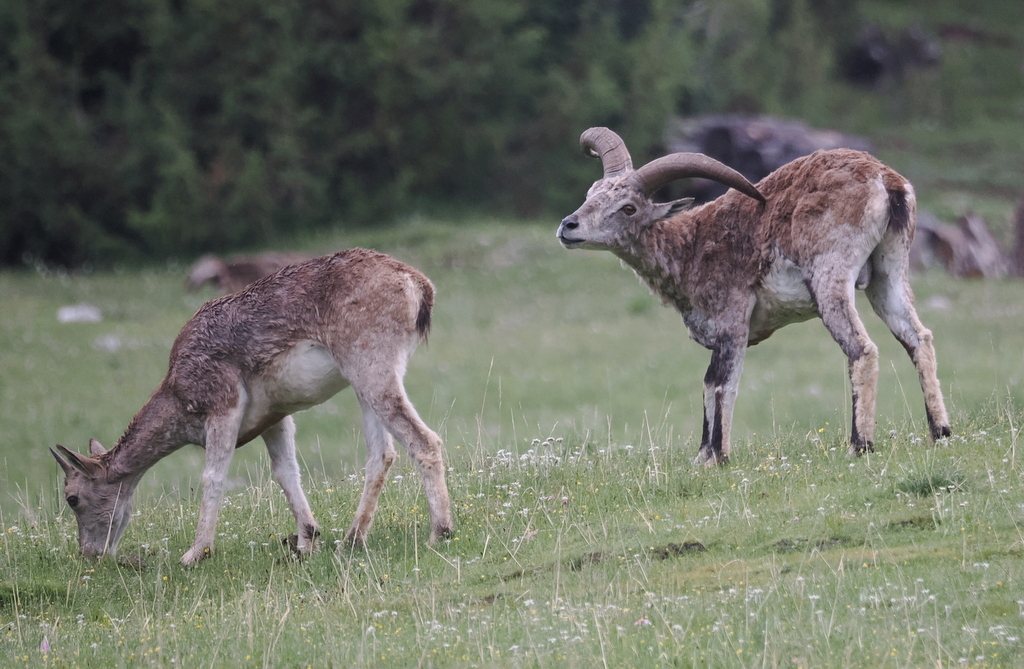
Everyone arrives on the Tibetan plateau asking about the cat. The guides start with the sheep. On a snow leopard trip the blue sheep are not the warm-up act — they are the fieldcraft itself, because the cats follow the herds, and reading where the herds are feeding, moving and resting is most of the week’s work of finding where the cat will be.
The sheep are the story.
Himalayan blue sheep sit in the “High” row of the Sanjiangyuan odds for a reason: most weeks deliver them, along with white-lipped deer and blood pheasants. But the point of the sheep is not the sheep. A herd on a skyline tells you the ground is safe enough to graze, which tells you where the ambush lines are not; a herd bunched and nervous tells you the opposite. The cats hunt at first and last light — field days on our route start at 06:00–07:00 — and the herds are the instrument you read in those hours.
The rest of the medium row carries the week: kiang on the flats, Tibetan gazelle, black-necked cranes in the wetlands. These are not filler either. They are what the plateau is doing while you wait for the cat, and a week that can read them is a week that understands the ground the leopard needs.
The fox that watches back.
The Tibetan fox has become the plateau’s unofficial second target, and it deserves the billing. It sits in the Medium row — most weeks deliver one — and unlike the cat it works the same daylight hours you do, standing in the grass with the famous flat face turned towards whatever is moving, including you. Kiang, gazelle and the fox make the waiting hours into a working safari; the predators row below them — Pallas’s cat, lynx, Himalayan wolf — is where the luck deepens.
85 cats in one valley.
The reason Yushu prefecture justifies a whole week is a fieldwork number: in one valley of this prefecture, 85 individual snow leopards have been identified from camera work — a world-class density that still guarantees nothing. That is the honest arithmetic of the trip. Six field days out of seven, run at the cats’ hunting hours, on ground chosen by the season, gives you a real chance and no promise; a good week is not a guaranteed cat, and we would rather say so before booking than explain it on the last evening.
What six field days buy.
The week is based in Yushu town at 3,680 metres — you acclimatise there first, which is one reason the trip works as a first plateau trip as well as a predator trip — and runs five field days on the high grassland plus the arrival and departure days, for groups of two to nine. The full structure is on the snow leopard tour page, the valley-reading method in How to read a snow leopard valley, and the wider cast of Chinese ungulates — the Sichuan forests rather than the plateau — in The herd carries the forest.
Read the plateau?
The snow leopard tour: six field days in Yushu
How to read a snow leopard valley
The herd carries the forest
Altitude changes the route