Hohhot & the near grass
The temple city: Dazhao and its silver Buddha, the museum with its dinosaurs, and two grasslands within two hours — Xilamuren at 1,700 m and Huitengxile at 2,000.
 Start your enquiry
Destinations / Inner Mongolia
Grass and rivers in the north-east, forest and crater lakes in the Khingan, dunes and dry lakes in the west. One province, four landscapes, and 2,400 kilometres between the ends of it.
Explore the guide ↓North China · the Mongolian frontier
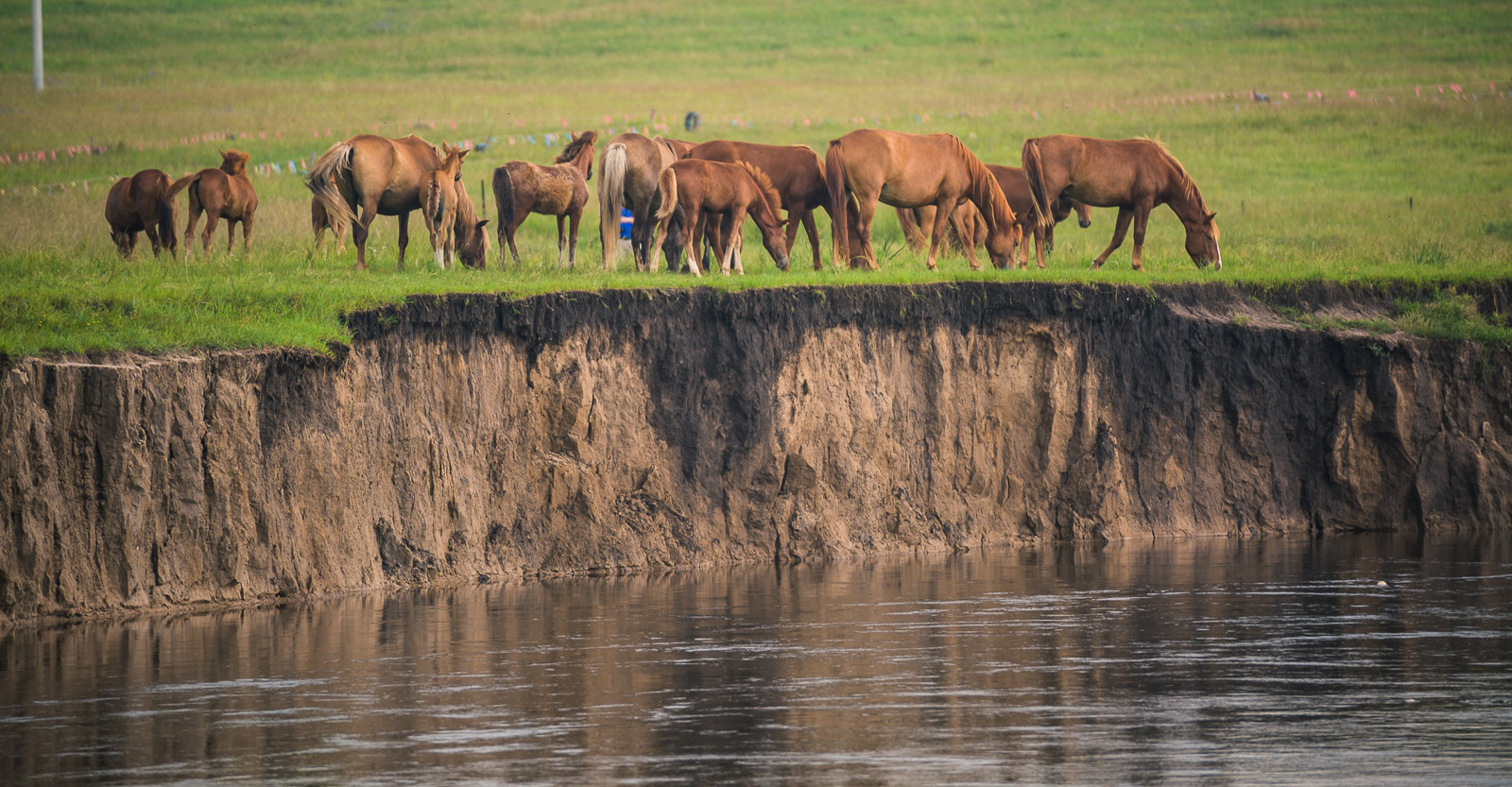
Inner Mongolia is the third-largest province in China and the least uniform. The north-east — Hulunbuir, the Ergun river, the Russian border — is grassland at 650 to 700 metres, with rivers that braid across it and a winter that starts in October. Two hundred kilometres south-west, the Greater Khingan rises into forest and volcanoes, with crater lakes and mineral springs. Eighteen hundred kilometres west, past Hohhot and the Yellow River loop, the land turns to desert: the Badain Jaran, the Tengger, the Gobi.
The practical consequence is that nobody sees Inner Mongolia in one trip. Grassland and desert are three days’ drive apart with very little in between; the internal flights are frequent and cheap in summer, and they are what makes a two-region journey possible. We build the province as two separate trips — the east, and the west — and say so before anyone books a loop that does not exist.
Hohhot sits in the middle, on the railway, with the nearest real grassland two hours north. That is where most people start, and where the province’s Tibetan Buddhist temples and its excellent museum are.
Read them west to east, or east to west — but read them separately.
The temple city: Dazhao and its silver Buddha, the museum with its dinosaurs, and two grasslands within two hours — Xilamuren at 1,700 m and Huitengxile at 2,000.
253,000 square kilometres of grassland and river, the Ergun wetland, Enhe on the Russian border, and the clearest big sky in China.
A UNESCO geopark of crater lakes, lava fields and 76 springs, with one river that steams at −30 and a two-week gold autumn.
The tallest stationary dunes in China at 460 metres, more than a hundred lakes between them, and a monastery at the foot of one of them.
Two fixed departures and the routes that connect them.
Hailar, the Ergun wetland, two nights with herder families and a day on the Russian border. Grass, rivers and horses, at the pace the grassland actually runs.
Dunes to 460 metres, lakes between them, and nights on sand with no light on the horizon. Reached from the west, not from Hohhot.
Days, seasons, access and what combines with what — including the Gansu and Beijing continuations.
What our team has written about the steppe, the desert and the border.
How the Inner Mongolian window compares with Gansu, Qinghai and Xinjiang — and why June is not the same as August.
Water, fuel, permits and the reason the lakes sit where they do. Read this before booking a desert camp.
The Gansu corridor runs along the southern edge of the Gobi; the two provinces share a border and a landscape logic.
Naadam, the July peak and the national holidays that fill the grassland resorts.
A green season of twelve weeks and a winter of five months.
Grass at full height, herds on the far pastures, Naadam in the second half of July. Warm days, cold nights, and wind that does not stop.
The best fortnight for the Khingan, where the larch turns gold, and for photography on the grassland, which is tawny rather than green.
The hay is in, the tourist camps close and the first snow comes early in the north-east. Quiet, cold and beautiful, with very little open.
−20 to −40, a winter Naadam in Hulunbuir and an ice festival. Short, vehicle-based trips with two hours outside at a time.
The Inner Mongolian facts that move each year: grass, Naadam and the winter window.
When the grass comes up, when it is cut, when Naadam falls and which roads close first.
Why the green season is shorter than the brochures suggest, and where to be at each end of it.
Tell us whether the picture in your head is grass or sand. They are 1,800 kilometres apart, and that single answer decides the route.
Start my journey brief ↗