The high dunes
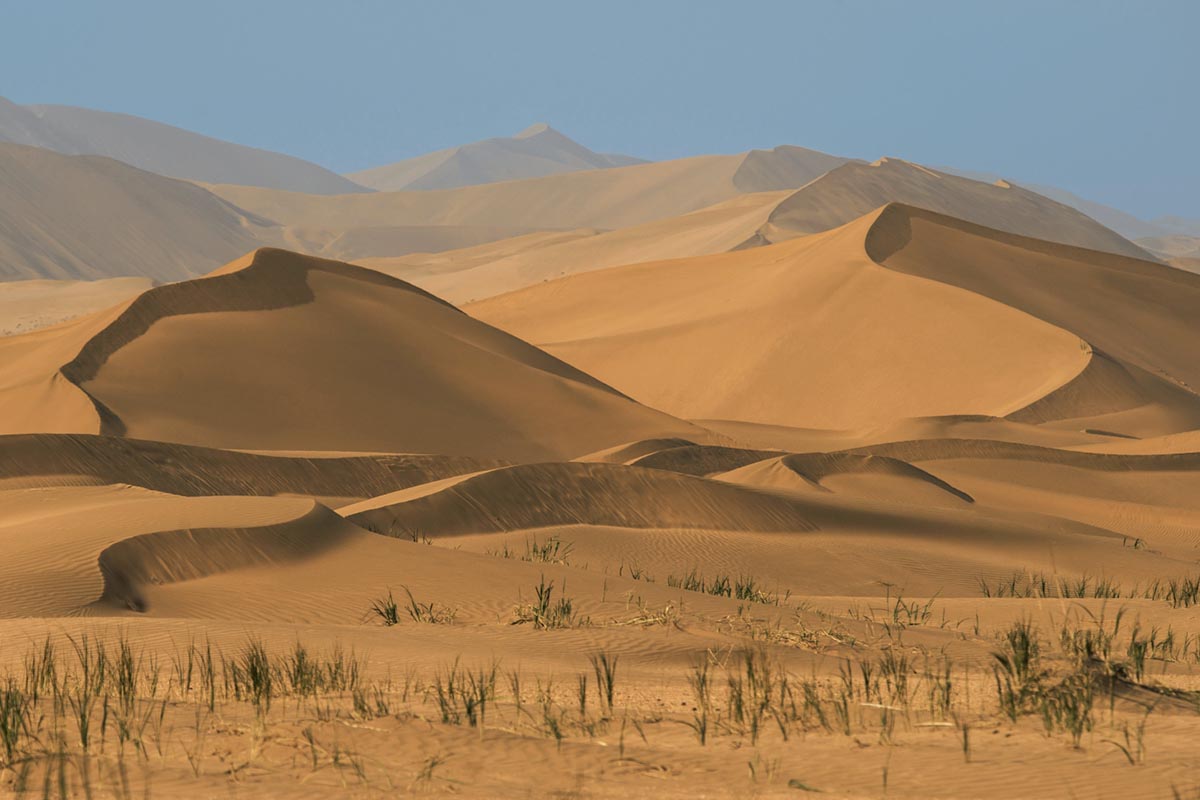
The tallest crests are in the north-east of the desert, reached by 4×4 on sand tracks. Climbing one at dusk takes forty minutes and is the whole reason for coming.
 Start your enquiry
Destinations / Inner Mongolia / Alxa
The tallest stationary dunes in China — 460 metres — with more than a hundred lakes between them, and a monastery at the foot of one.
Explore the guide ↓Western Inner Mongolia · the Gobi
The Badain Jaran sits in the west of Inner Mongolia, against the Gansu border, in Alxa league: a sand sea of about 47,000 square kilometres with the highest stationary dunes on earth — individual crests reaching 460 metres above the lake basins between them. It is not the biggest desert in China, but it is the strangest: because between those dunes there is water.
More than a hundred lakes lie in the interdune basins, some fresh, some salt, some with reeds and birds and a single temple on the shore. The hydrology is still argued about; the likely answer is snowmelt and rainfall from the surrounding mountains moving underground and surfacing where the dunes pinch the aquifer. What matters to a traveller is simpler: you can camp on sand at 1,500 metres with a freshwater lake twenty minutes’ walk away.
Access is from two directions. From the east, Alxa Left Banner (Bayanhot) is the administrative base, six hours by road from Yinchuan. From the south-west, Zhangye in Gansu is closer to the best dunes and is how most of our journeys come in — the Hexi corridor on one side, the desert on the other.
Dunes, lakes and one monastery with no road to it.
The tallest crests are in the north-east of the desert, reached by 4×4 on sand tracks. Climbing one at dusk takes forty minutes and is the whole reason for coming.
More than a hundred lakes between the dunes: freshwater with fish and birds, salt pans ringed white, and reed beds that hold water long after the rest has dried.
A small Tibetan Buddhist temple on the shore of one of the lakes, reached only by sand track. Rebuilt, quiet, and the strangest setting for a monastery in China.
Alxa is camel country: Bactrian herds, camel milk, and a culture built around moving between water points. The desert is a working landscape here, not a set.
A long window with two difficult edges.
Warm days, cold nights and wind. The clearest light and the fewest people; sandstorms are possible and close the desert for a day at a time.
Hot — 35 °C and above by afternoon — but the lakes are at their best and the nights are superb. Desert days start at five and end at nine.
The best weeks: 20 °C days, cold nights, still air and long light. The season the camps prefer.
Cold, windy and mostly closed. The desert is beautiful and hostile; only a handful of operators run, and we do not.
Two ways in, both long.
Zhangye in Gansu is the closest city to the northern dunes: three to four hours of road, then sand tracks. This is the route we use from the Hexi corridor.
Yinchuan to Alxa Left Banner is about two hours on the motorway, then another four to the desert edge. The eastern approach suits a Ningxia combination.
Everything moves by 4×4 on sand, with a driver who knows the tracks. There are no roads, no fuel and no phone signal beyond the first dune line. Two nights is the minimum; three is better.
Camels, water points and a border.
Wells, springs and lakes define the routes herders and travellers have used for centuries. A desert journey here is a sequence of water points, and the drivers know them by name.
Alxa league is Mongol, sparsely populated and culturally distinct from the Hohhot region. The monastery at the lake and the camel herds are its two anchors.
North of the dunes the sand gives way to gravel desert and then to Mongolia. The border is closed, the emptiness is not.
Sand, sun, and no margin for error.
Four litres a person a day in summer, and a shelter that actually blocks wind. The desert is dry enough that dehydration arrives without thirst.
Camera bags, phone ports, boot laces. Dry bags, a lens cloth and a buff are worth more than a second lens.
The Badain Jaran is a national nature reserve, and access is by permit through a licensed operator. We arrange it with the camp and the local reserve office, per group.
Tell us how many nights on sand you want. One is a visit; three is when the desert starts to feel like a place rather than a backdrop.
Start my journey brief ↗