Tianchi
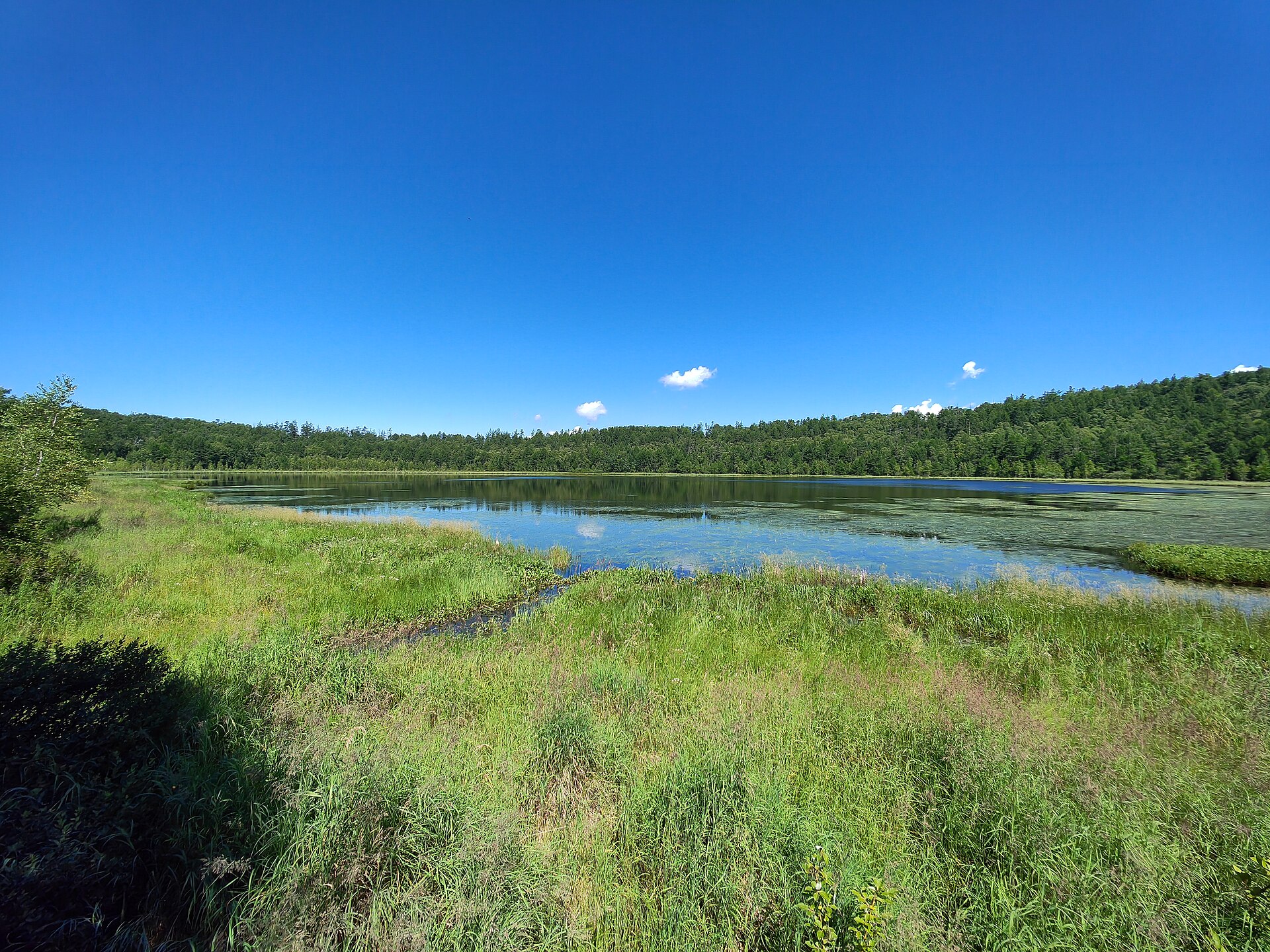
A round lake in a basalt crater with no visible inlet or outlet, ringed by larch. The walk up is a few hundred steps; the view from the rim is the whole point.
 Start your enquiry
Destinations / Inner Mongolia / Arxan
A UNESCO geopark of crater lakes, lava fields and 76 springs, in forest at 1,300 metres, with one river that steams at −30 and never freezes.
Explore the guide ↓The Greater Khingan · 1,000 – 1,700 m
Arxan sits where the Mongolian plateau breaks into the Greater Khingan range: a small town in a valley at about 1,000 metres, surrounded by larch and birch, with a volcanic field to its south-west and a river running through both. The town exists because of the springs — 76 of them, cold and hot, which is what the Mongolian name means: “holy water”.
The landscape is the point. Arxan became a UNESCO global geopark on the strength of its volcanic record: crater lakes on basalt plateaus, a lava field of contorted rock at Shitanglin, and the Halaha river cutting through it all. Tianchi, the biggest crater lake, sits at 1,332 metres and is the third-largest of its kind in China; Tuofengling, another crater lake an hour away, has the layered lava walls visible inside the rim.
Then there is the river that does not freeze. A stretch of the Halaha runs over hot springs, and at −30 it still steams, with birds on the open water in January. It is the single most photographed thing in the province in winter, and the reason Arxan has a winter season at all.
Two crater lakes, one lava field and a river that refuses.
A round lake in a basalt crater with no visible inlet or outlet, ringed by larch. The walk up is a few hundred steps; the view from the rim is the whole point.
Higher, quieter and better geology: layer after layer of lava visible in the crater wall, with a boardwalk around the rim and forest to the horizon.
A field of contorted basalt with larch and pine growing out of it — the clearest evidence that this landscape is volcanic rather than glacial.
A stretch of river warmed by springs, steaming at −30 with frost on every branch. Best at sunrise, when the vapour is thickest.
Three short seasons and a long white one.
Green forest, wildflowers, warm days and cool nights. The lakes are at their best and the town is full of domestic visitors in July and August.
The two weeks people come for: larch turning gold against dark pine, frost at dawn, clear air. Book ahead; the window is short and everyone knows it.
−25 to −35, snow on the forest, and the steaming river. Winter trips run from Hailar or by direct flight, and are short and vehicle-based.
A small airport, a slow train, and one good road.
Arxan has an airport with flights from Hohhot and Hailar in season, and a railway station on the slow line from Ulanhot. Most journeys fly in and drive out, or join it to Hulunbuir.
The geopark is large — 3,653 square kilometres — and the sights are 30 to 80 km apart. A private vehicle and two full days is the honest minimum.
Arxan town has hotels and hot-spring guesthouses; the villages inside the park are simpler. In September, book both well ahead.
Logging, hunting and a border that moved.
Han, Mongol and Evenki families, with a history of forestry and, before that, hunting. The reindeer herders are further north, around Genhe and the Aoluguya area.
The town’s hot springs have been used medicinally for a century and a half, with different springs prescribed for different complaints. It is folk medicine, and it is also a very pleasant way to spend an evening.
The commercial forests were logged for decades; the logging ban changed the economy and left the towns looking for a reason. Tourism is now the reason, which is why the roads are good.
Cold nights, mosquitoes, and a lot of boardwalk.
Ten degrees at dawn is normal in midsummer. A fleece and a windproof layer are standard; in September add a down jacket.
June and early July bring mosquitoes in the forest. Repellent, long sleeves and patience.
The lakes and the lava field are all boardwalk and stair, with handrails. Nothing technical, but a full day on it is a real walk — grippy shoes, not sandals.
Tell us whether you are coming for the green or the gold. The two versions of Arxan are three weeks apart and look like different provinces.
Start my journey brief ↗