Hangzhou & the lake
West Lake, Lingyin’s halls in the woods, Longjing’s tea terraces and a city that has been a resort for a millennium.
 Start your enquiry
Destinations / Zhejiang
A lake with a causeway, canal towns, tea hills, bamboo slopes and rhyolite spires above the sea. The most densely landscaped province in China, and the easiest to travel slowly.
Explore the guide ↓East China · the Yangtze delta
Zhejiang is small — about 100,000 square kilometres — and almost entirely spoken for. Hills run through the west and south, a flat plain occupies the north around Hangzhou and Jiaxing, and the coast breaks into an archipelago of more than a thousand islands. High-speed rail joins every town you have heard of, and most of the ones you have not.
What makes it different from a generic rich delta is that the landscape is a cultural product. West Lake has been dredged, diked and planted for a thousand years, and its famous views are compositions that poets and painters fixed centuries ago. The Grand Canal was dug to move grain. The tea terraces were cut into hillsides for a cash crop. The canal towns are engineering as much as architecture.
The consequence for a traveller is pleasant: the province is set up for slow travel. Two nights in Hangzhou, two in Shaoxing, a couple in the bamboo hills or down on the Yandang coast, and the whole thing is done by train and taxi. It is the easiest place in China to spend a week without a single hard day.
A lake, a canal plain, hills and a coast.
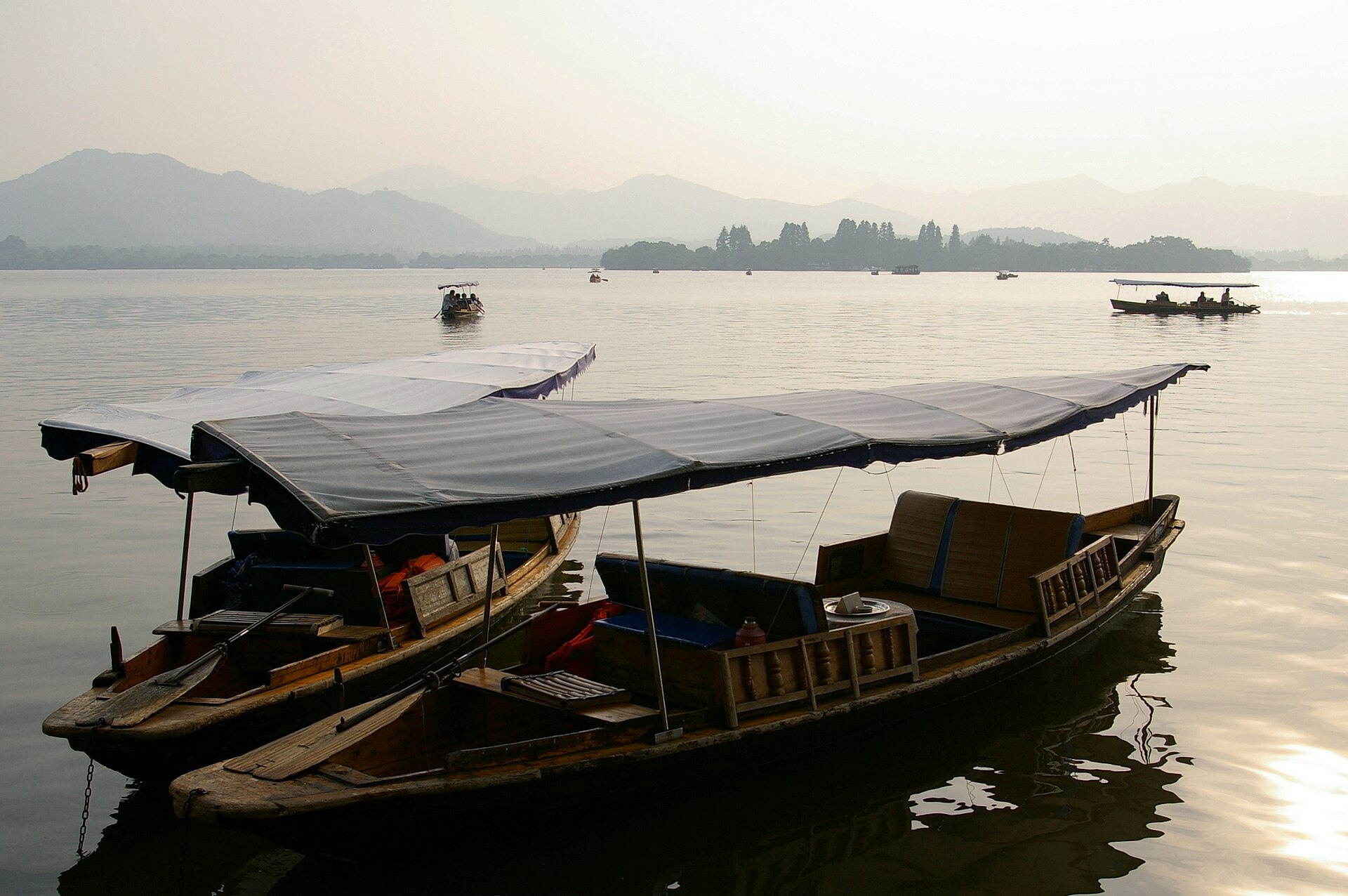
West Lake, Lingyin’s halls in the woods, Longjing’s tea terraces and a city that has been a resort for a millennium.
A water town of stone bridges, black awnings, wine jars and the houses of two of China’s most quoted writers.
A mountain of bamboo and 1920s villas two hours from Hangzhou, now the country’s most polished rural hotel scene.
Rhyolite pillars, a 197-metre waterfall and three valleys of stone, in the far south near Wenzhou.
An archipelago off the coast, with the island monastery of Putuoshan, fishing ports and beaches that Shanghai uses in summer.
No fixed departures: Zhejiang is a rail network with a lake at one end.
The lake-and-canal week, the bamboo weekend, the southern mountains and the island extension — with days and seasons.
The lake at dawn, Lingyin and the tea hills, and the canal warehouses at Gongchen Bridge.
Putuoshan’s monasteries and the fishing ports, reached by ferry from Zhuajiajian.
What our team has written about the lake, the tea and the towns.
The older, shorter guide to the city and its sights.
West Lake on a sunny October Saturday is a national event. This is the calendar that explains why.
Shaoxing wine, Hangzhou’s river fish and the delta’s sweet-savoury register.
An hour by rail, and the other half of the delta’s garden tradition.
A long spring, a short autumn, and a wet summer.
The best window. Tea picked from late March, hills green, soft light, and the lake manageable outside the Qingming and May Day holidays.
Plum rains in June, then heat and humidity, with typhoons possible from late July. The mountains are the answer.
Dry, clear and mild, with osmanthus in late September and the best month of the year in October.
Cold, damp and grey, at 4–8 °C with no central heating in old buildings. Quiet, cheap and atmospheric in the canal towns.
The Zhejiang facts that move: tea, rain and typhoons.
The tea calendar, the plum rains, the typhoon window and the holiday weeks that fill the lake.
When the first flush is picked, what pre-Qingming means, and why April is the month to be in the hills.
Tell us whether you want the lake, the canals or the coast — and how many early mornings you are willing to give the province. That is what it rewards.
Start my journey brief ↗