West Lake
Walk the Su Causeway early, before the boats start. The western shore is quieter, the islands need a boat, and the night market on the east side is a different pleasure.
 Start your enquiry
Destinations / Zhejiang / Hangzhou
A lake that has been composed for a thousand years, a temple founded in 326, and tea terraces in the hills behind them. The most visited landscape in China, and still worth the early start.
Explore the guide ↓Northern Zhejiang · the Qiantang
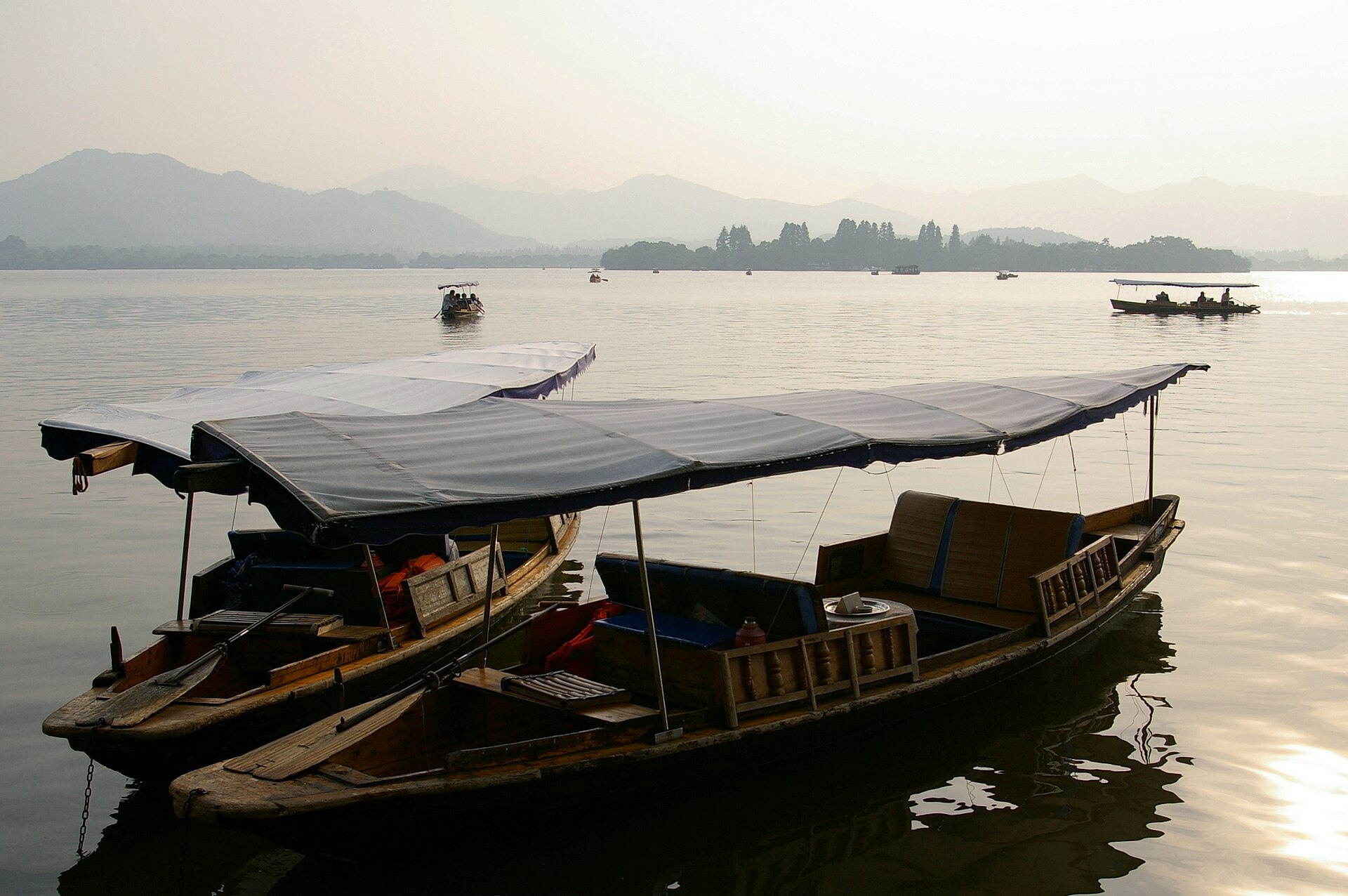
Hangzhou’s West Lake is the most famous designed landscape in China, and the model for a thousand imitations. It is a shallow, roughly circular lake about three kilometres across, enclosed by hills on three sides, with causeways and islands laid out in the twelfth century and views that were named, painted and reproduced until they became the standard image of “beautiful China”.
The city behind it has been a capital, a treaty port and a tech hub in turn, and it is now the most pleasant large city in the country: bike lanes, a cleaned-up canal, and a lakeside that is pedestrian for long stretches. The old streets east of the lake — Hefang, Qinghefang, the lanes around the Southern Song ruins — are touristy and still good.
Behind the lake, the hills run west towards Longjing village, where the tea is grown on terraces cut into the slopes, and Lingyin temple sits in a wooded valley with hundreds of rock carvings in the cliff opposite. Both are half-day trips from the lake and both are better early, before the coaches.
The lake at dawn, two temples and a tea valley.
Walk the Su Causeway early, before the boats start. The western shore is quieter, the islands need a boat, and the night market on the east side is a different pleasure.
A working monastery in a wooded valley, with the Hall of the Great Hero and, opposite, a limestone cliff carved with hundreds of Buddhist figures from the tenth to fourteenth centuries.
Terraces of tea bushes above a village of teahouses, an hour’s walk from the lake. Buy tea from a grower, drink it where it was picked, and ignore the tasting rooms with coach parking.
The southern terminus of the canal, with warehouses, wharves and a reconstructed street. Inscribed by UNESCO in 2014; the barges still run.
Spring and autumn, and the crowds in between.
The best window: tea being picked, hills green, soft light. Avoid Qingming (early April) and May Day, when the lake is a procession.
Plum rains, then heat. The lake is at its most lush and its most uncomfortable; lotus flowers in July are the compensation.
Osmanthus, clear air and the best month of the year. October’s national holiday week is the busiest of all — come after it.
An hour from Shanghai, and a hub for the province.
High-speed rail from Shanghai is 45–60 minutes; from Beijing four and a half hours. The airport is 30 km east.
The lake is walkable and bikeable, the metro reaches most of it, and taxis are cheap. Do not drive: the lakeside roads are restricted and parking is a misery.
East of the lake for the city and the restaurants; the western shore for quiet; Longjing for the tea. Three nights is right.
The delta’s three luxuries.
Picked before Qingming in late March and early April for the expensive first flush, then again through April and May. The terraces are working farms, and the difference between the grades is real.
Hangzhou was the centre of the imperial silk trade and the southern terminus of the canal that carried it north. The silk museum is better than it sounds.
Every view on the lake has a name and a poem. Knowing two of them changes what you are looking at; the guidebooks print them for a reason.
Crowds, humidity and a lot of walking.
Between seven and nine the lake belongs to people doing tai chi and nobody else. By ten on a weekend it is a queue.
38 °C with high humidity is normal in July and August. Plan mornings and evenings, and spend the middle of the day in a museum or a teahouse.
The good growers sell out of first-flush tea by May. If tea is the reason for the trip, come in April.
Tell us whether the lake or the tea hills are the point. One is a city break; the other needs a car and a morning.
Start my journey brief ↗