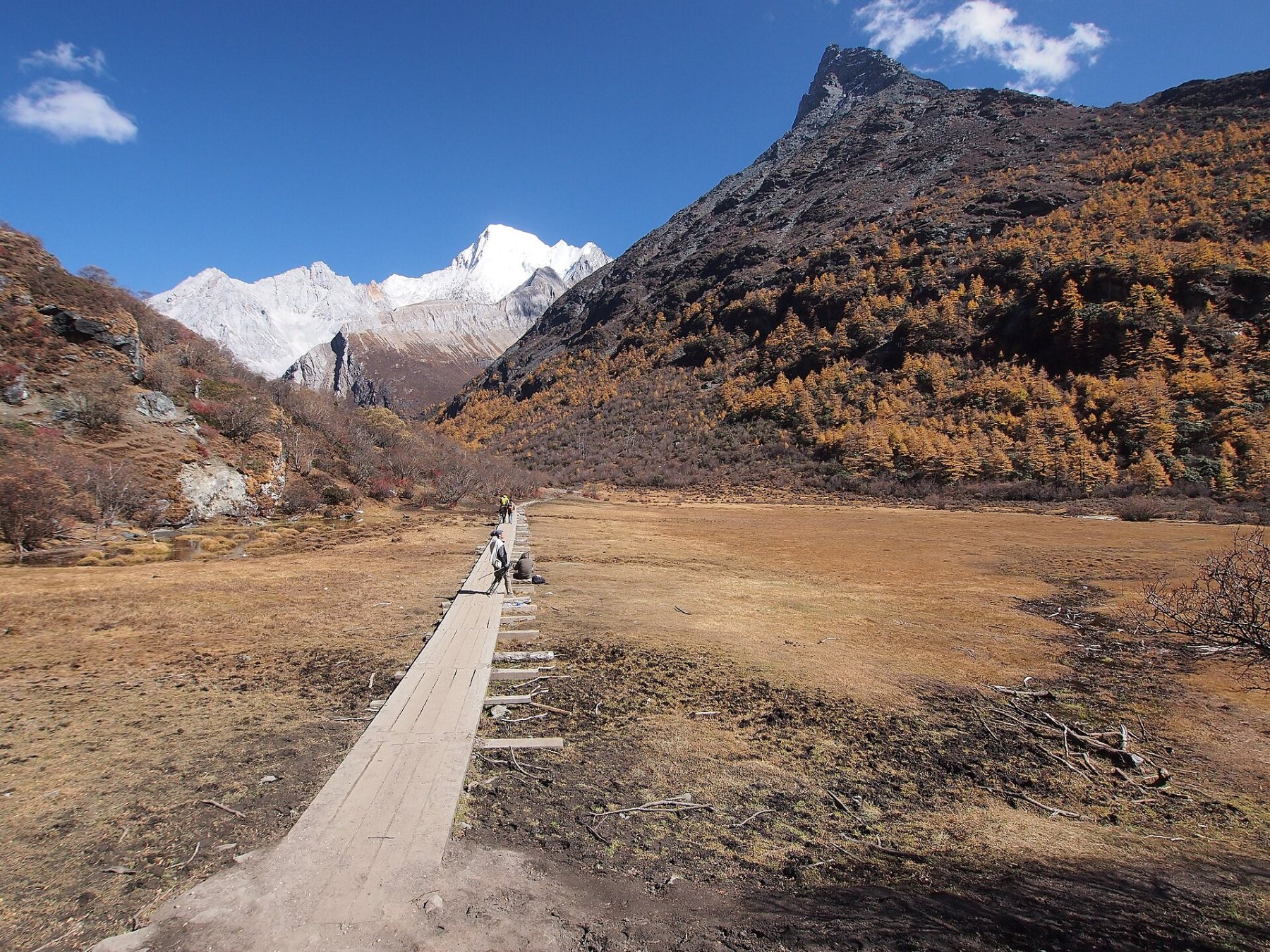
A timber boardwalk running into a golden autumn meadow below Xiannairi

Destinations / Sichuan / Yading

Altitude at Yading.

Nobody is stopped by the summit. People are stopped by the bed, the airport and the last four hundred metres of scree — and each of those has a number attached.

Explore the guide ↓

Yading · 2,900–4,700 m

Gate town
2,900 m
Village
3,900 m
Milk Lake
4,600 m
Airport
4,411 m

It is the bed, not the summit.

Sleeping altitude is the strongest single predictor of whether somebody feels well in the days that follow. Yading makes this unusually clear, because the place offers three beds only a few kilometres apart but more than a thousand metres apart in height: 2,900 in the gate town, 3,900 in the village, 3,750 in the county seat.

The walk itself is a separate question. The long route gains 550 metres from Luorong to the lakes over five kilometres, and the last kilometre to Milk Lake is a staircase of wet scree at 4,500. That is a fitness and pacing problem, not an acclimatisation one — provided you have slept sensibly for two nights beforehand.

Every rung, and the step between them.

What you gain and lose on the standard approach. Steps over 800 metres in a day are where people get into trouble.

PlaceHeightStepNote
Chengduabout 500 m—The basin floor. Nobody feels anything here.
Kangding2,560 m+2,060The first real step if you drive, and a big one. One night here is the standard move.
Xinduqiao / Tagong3,300–3,700 m+740–1,140Where the overland route sleeps. Headaches are common on the first night.
Shangri-La town (gate)about 2,900 m−400 to −800A deliberate descent, and the best first night near the reserve.
Daocheng county seatabout 3,750 m+850 from the gateBanks, hospital, food. Not a place to acclimatise, a place to be acclimatised.
Yading village3,900–4,060 m+1,000 from the gateThe only bed inside the reserve, and the reason for the dawn photographs.
Chonggu monastery3,880 m—Where the boardwalk and the carts begin.
Pearl Lake4,080 m+200The short walk. Two hundred metres of climb, thirty minutes, and the usual first test.
Luorong pasture4,150–4,180 m+300End of the cart track, start of the long route.
Milk Lake4,600 m+450Five kilometres and a scree staircase from Luorong.
Five-Colour Lake4,700 m+100Twenty more minutes, and the high point of any legal route.
Airport4,411 m—Arriving here is a 3,900-metre step from Chengdu in one hour.
Road passabout 4,760 m—Crossed twice by the shuttle; nobody sleeps on it.

The airport is the trap.

Flying to 4,411 metres is the fastest way to lose two days of a three-day trip.

What happens

Daocheng Yading airport is one of the highest commercial airports in the world. You board at 500 metres in Chengdu and step out an hour later at 4,411, where the oxygen pressure is roughly sixty per cent of sea level. The body has had no time to do anything about it.

What to do instead

Descend the same day. The drive to the gate town takes about three hours and drops you 1,500 metres, which is the single most effective thing you can do in your first afternoon. Sleep at 2,900, walk gently, and go up the next morning.

What not to do

Do not take the afternoon flight, drive to the village and sleep at 3,900 on the first night. That itinerary exists, it is sold, and it produces the worst nights and the shortest trips we hear about.

Three nights that work.

The shape we use, and why each night sits where it does.

Night one, 2,900 m

Gate town. Arrive, eat, walk for half an hour, sleep low. If you flew in, this night is not optional.

Night two, 3,900 m

The village. Up after breakfast, in the valley by mid-morning, the boardwalk in the afternoon at a slow pace, and a bad night is possible but usually mild. Two nights here beats one night at 4,000 further up.

Day three, 4,700 m

The long route, starting at 08:00 from Luorong with the whole day in front of you. Sleeping a second night at 3,900 afterwards is fine; going higher to sleep is not part of any route that is currently open.

The cautious version

Two nights at 2,900 before the village, and the long route on day four. This costs a day and saves the trips of everyone who turns out to be sensitive.

What helps, and what is folklore.

A short list, in order of how much difference it makes.

Going up slowly, and coming down to sleep

Nothing else comes close. Everything on this page is a footnote to that sentence.

Acetazolamide

The standard preventative, usually 125 mg twice a day starting the day before ascent. It works, it makes some people's fingers tingle, and it is a prescription decision — talk to your own doctor before you travel, not to a pharmacy in Chengdu.

Water and carbohydrates

Dry air at altitude dehydrates quickly, and appetite falls exactly when you need calories. Drink more than feels necessary, eat rice and noodles even when you do not want to.

Ibuprofen for the headache

Effective and ordinary. A headache that does not respond to it after an hour is information.

Piped oxygen in the room

Several village hotels run it. It improves sleep, which improves everything else, but it treats the symptom rather than the acclimatisation.

Cans of oxygen

Useful for a bad hour, useless as a strategy. Carrying one up the long route and puffing at 4,600 is not acclimatisation, and it will not help you sleep.

Rhodiola

The most widely sold remedy in China and the weakest evidence in the literature. Take it a week before if you like; do not rely on it, and do not let it displace the two things above.

Alcohol and sleeping pills

Both suppress breathing at altitude and both make the first nights worse. Skip the welcome drink.

When to turn around.

The line between a bad afternoon and a medical evacuation.

Ordinary altitude discomfort

Headache, breathlessness on effort, poor sleep, loss of appetite in the first day or two. Manageable: rest, water, food, do not go higher, and it usually settles within 48 hours.

Stop and descend

Breathlessness at rest, vomiting, confusion, an unsteady walk, or a cough that produces pink froth. Those are the signs of serious altitude illness, and descent is the treatment. In the reserve, that means getting down to Zhalagang and the visitor centre as fast as a cart will take you.

The 14:30 rule

The published cut-off on the long route is written for the light and the weather, but it serves altitude too: it guarantees you are off 4,600-metre ground with daylight and energy in hand.

The honest test

If you are still gaining height at 13:00 and the summit is an hour away, you are deciding to come down in the dark. Turn around. The lake will be there.

Pacing on the day.

How the last kilometre is actually walked.

The valley

Luorong to the base of the climb is flat and fast: five kilometres on a good path, about ninety minutes.

The staircase

The last section gains 450 metres in roughly one kilometre of switchbacks and loose rock. The pace that works is fifty to eighty steps, then stop and breathe until the heart rate drops. Everybody who passes you will be sitting down somewhere above you ten minutes later.

Descent

Harder on the knees than the climb is on the lungs, especially in the wet. Poles, and a slower pace than feels natural.

Afterwards

The fall back to 3,900 for the night is the reason the long route is safe: you sleep lower than the high point, which is exactly the pattern the body wants.

A trip at a sane pace.

Tell us your age, your fitness and how you have handled altitude before. We will build the first three nights to suit the answer.

Start my journey brief ↗