
China carries two great crane winters, and they could not be less alike. One happens on a lowland lake that empties; the other happens on a highland wetland that freezes. One involves the majority of a world population; the other involves the majority of a national one. Both peak in the same months, and both are watched for free. Choosing between them is really choosing between two kinds of landscape.
Two species, two strategies.
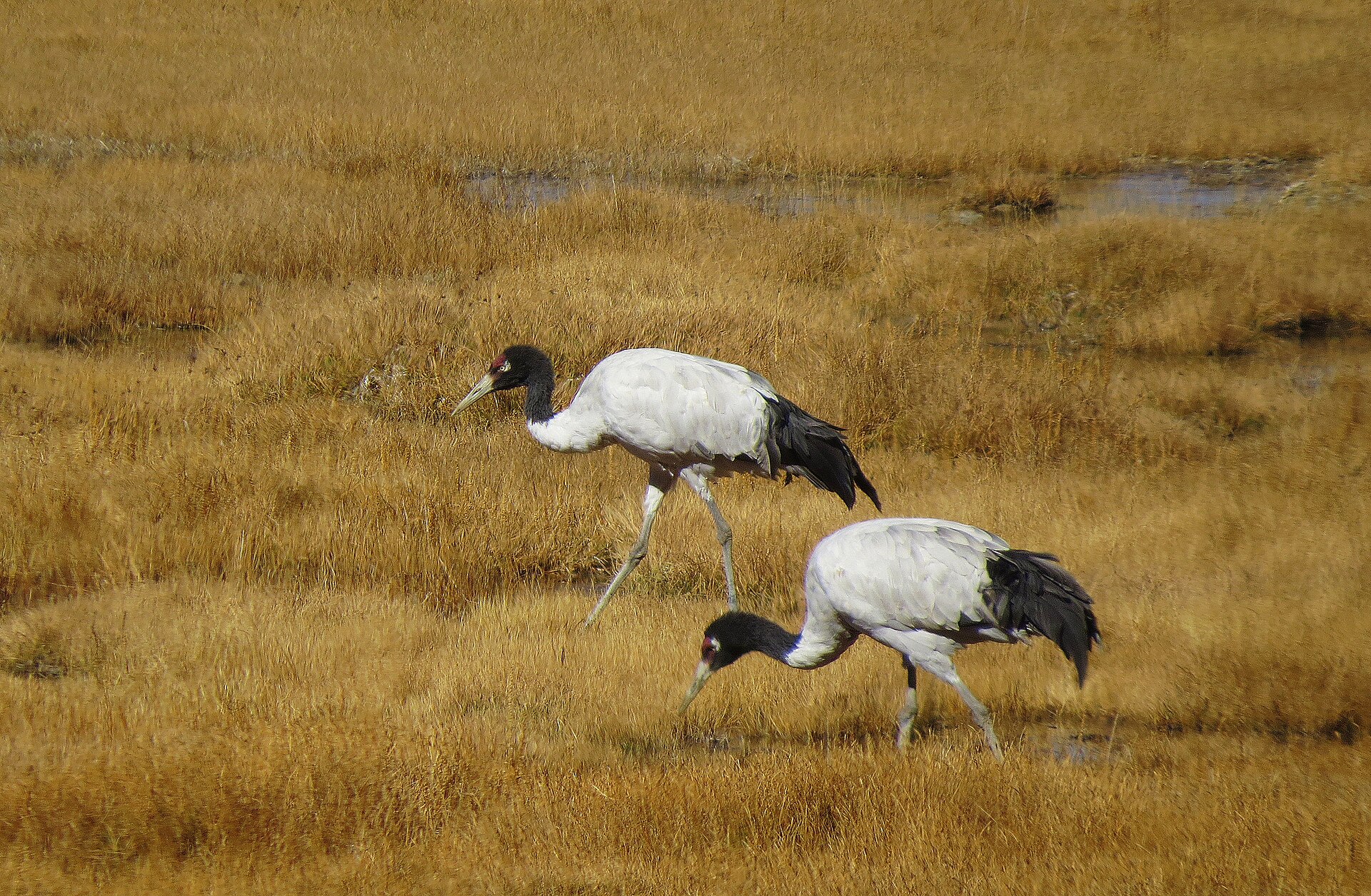
The Siberian crane bets everything on one site: around 5,800 birds — more than 80% of the species — winter on Poyang Lake in Jiangxi, feeding on the tuber beds the receding water exposes. The black-necked crane spreads its bets: the only crane that lives most of its life above 3,000 metres, it winters across a chain of plateau wetlands, and nowhere holds all of it — but Napa Hai, above Shangri-La in Yunnan, reliably holds over 90% of the species’ central migration population.
The lake winter: Poyang.
The Poyang winter runs on water level. Cranes arrive from late October, the peak sits in the weeks after the water bottoms out — realistically mid-December to the end of January — and the birds move weekly between the sub-lakes and the flooded shore fields. Watching it is a hide-and-watchtower game at three grounds, all free, all within ninety minutes of Nanchang. The full mechanics are written up in the crane winter, and the species guide lives on the Poyang page.
The plateau winter: Napa Hai.
The Napa Hai winter runs on altitude and daylight. The wetland sits at 3,260 metres above Shangri-La; the reserve counted 61 cranes when it was founded in 1984 and 573 in the winter of 2025–26, a record, alongside more than fifty thousand wintering waterbirds in total — black storks, common cranes, bar-headed geese. The rhythm is older than the counts: first birds in mid-October, the flocks building to a peak around late November and early December, numbers holding through February, and most birds gone by late March or April. The old local saying has it arriving “before the ninth of the ninth month” and leaving “before the third of the third” — and recently even that rule has stretched, with a few cranes summering since 2023. Watching it is an edge-of-the-wetland game from a town base a few minutes away, with the whole plateau landscape as the setting.
Choosing between them.
Choose Poyang for scale and proximity: the largest concentration of wild cranes on earth, minutes from a provincial capital, no altitude, no cold beyond a Jiangxi winter. Choose Napa Hai for the setting and the species: the world’s highest-living crane against monastery country and snow ridges, with a plateau trip built around it. The honest deciding factor is altitude — Napa Hai’s days are planned the way our plateau weeks are, slow and downward-sequenced, and it is the wrong first stop for someone who has never slept high.
Doing both.
The windows overlap almost exactly — both winters peak between late November and the end of January — which makes a two-winter journey straightforward: Nanchang first for the lake, then a flight west to Shangri-La for the plateau, with the trip’s altitude curve rising at the end rather than the start. We build the two routes as the Poyang crane tour and the black-necked crane tour, and they share one rule: the birds keep the final vote, so both plans carry spare mornings.
Plan a crane winter?
The Poyang crane tour: the lake winter
The black-necked crane tour: the plateau winter
The crane winter: how the drained lake works
Watching wildlife without disturbing it
Napa Hai: the cranes' winter lake