
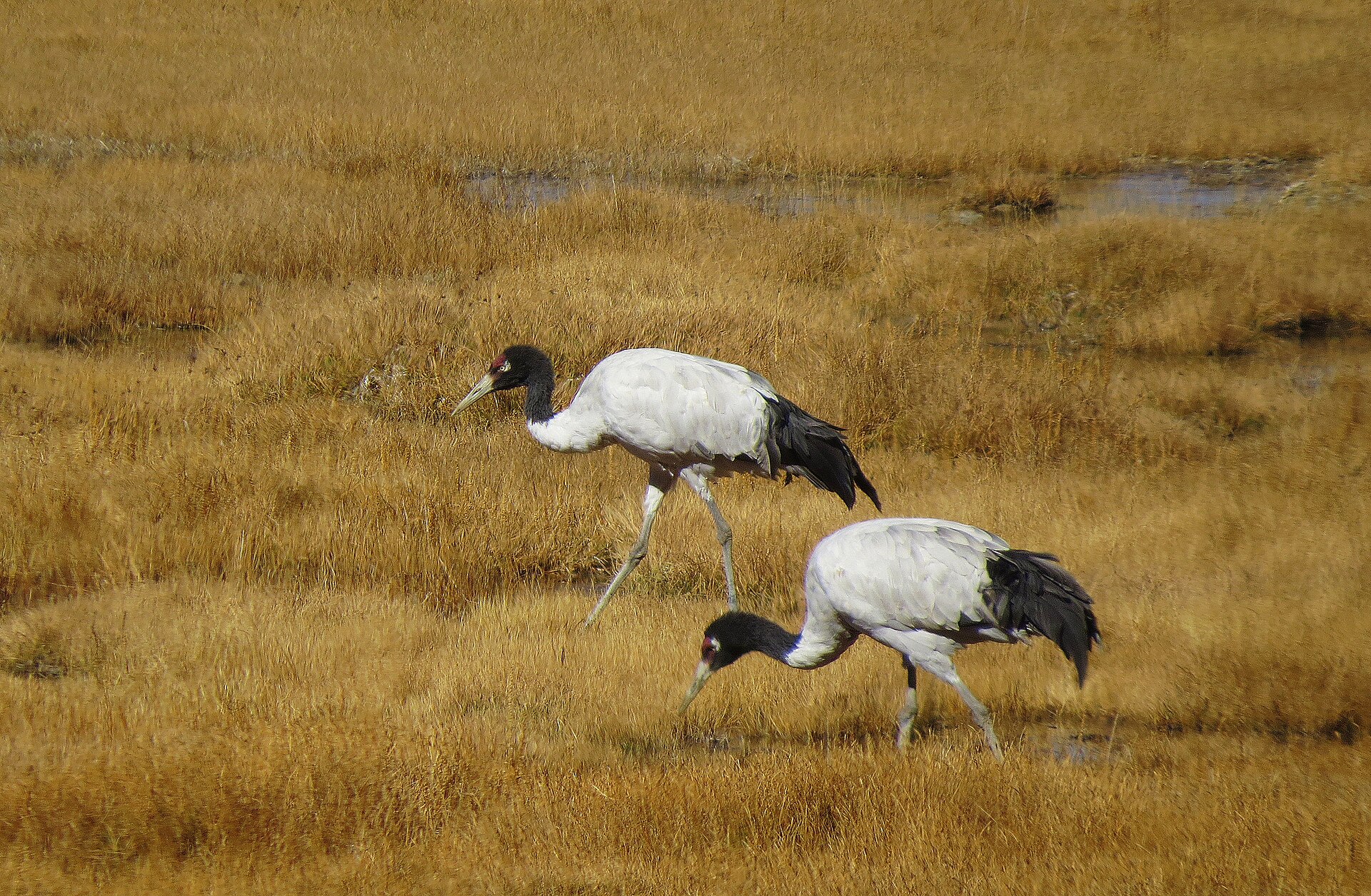
A pair of black-necked cranes foraging in a golden highland wetland

Wildlife / Black-necked crane tour

Private birding tour

The black-necked crane tour.

Five winter days on a 3,260-metre wetland that belongs to the cranes: mornings at the edge of Napa Hai as the pairs and family parties feed, afternoons built around altitude rather than mileage, and a reserve whose winter birds now top fifty thousand.

  • Duration5 days
  • Nights4
  • Best windowNov – Mar
  • Starts & endsShangri-La
Ask about this itinerary

Black-necked cranes · the winter wetlands above Shangri-La

The bird573 black-necked cranes

the winter 2025–26 count at Napa Hai — a record, up from 61 when the reserve was founded in 1984

Share of the population90%+

of the species' central migration population winters here each year

Best windowNov – Mar

first birds arrive mid-October; the peak builds to late November and holds through February

WalkingEasy

wetland-edge mornings; the altitude sets the pace, not the distance

Why this route

The only crane that lives on a plateau, wintering on one.

The black-necked crane is the world's only crane species that lives most of its life above 3,000 metres, and Napa Hai — a seasonal wetland above Shangri-La, on the birds' western migration route — is where most of the central population spends that life's winters. The reserve counted 61 birds when it was founded in 1984; the winter of 2025–26 counted 573, a record. On peak winter mornings the whole wetland carries more than fifty thousand waterbirds: the cranes, plus black storks, common cranes, bar-headed geese and cormorants.

The birds keep a rhythm the reserve knows by heart: first arrivals in mid-October, the main flocks building through November to a peak around late November and early December, numbers holding near their maxima in January and February, and the departure mostly done by late March or April. The old local saying — arrive before the ninth day of the ninth month, leave before the third of the third — has recently stretched at both ends: some cranes now stay through the summer, a habit change first recorded in 2023.

This trip is built the way our Poyang winter is: multiple mornings at the wetland's edge, because fog and the birds' own schedule move a session, and a guide who scouts before you reach the ground is worth more than any fixed plan. It is a private departure — you choose when to come inside the window.

Route Briefing

In and out of Shangri-La, one wetland worked properly, and the return road used as the trip's second act. Five stages, one vehicle.

  1. Day 01Arrive Shangri-Lathe altitude afternoon — old town, slow walk, early night at 3,280 m
  2. Day 02Napa Haifirst wetland morning; the guide reads where the flocks are holding this week
  3. Day 03Napa Haia second morning at a different edge — fog insurance and new ground in one
  4. Day 04Napa Hai → Lijianga last reserve session, then the road down off the plateau
  5. Day 05Lijiang → outan optional wetland stop on the way, then flights from Lijiang

Species odds

What the wetland actually offers.

The field estimates we plan the winter around — not a survey and not a promise.

Napa Hai · the wetland edges

Above Shangri-La · the trip's core ground, worked on three mornings

High
black-necked cranes in season — the peak builds from late November and holds through February
High
the wintering crowd the cranes share the wetland with: black storks, common cranes, bar-headed geese, cormorants

Napa Hai holds over 90% of the species' central population each winter; the 2025–26 count was 573 birds. The flocks' holding ground moves, which is why the guide scouts first.

The plateau between sessions

The road country west and north of the wetland

Medium
high-plateau passerines and raptors over the grasslands
Low
anything the road happens to offer — this column is never the plan

The drive days are travel, not safari. Whatever the grasslands offer is a bonus, and we say so plainly.

The season is the promise: first birds mid-October, peak from late November, most gone by late March or April. A few cranes now stay through the summer — a change first noted in 2023 — but the trip is built on the winter arithmetic, not the exceptions.

Day by day

The five days.

The altitude is the co-planner. Mornings belong to the cranes, middays are deliberately slow, and no day asks for mileage.

  1. Day 01

    Up to the plateau, slowly

    Arrive Shangri-La

    Fly or rail into Shangri-La at 3,280 m and take the afternoon the way the altitude demands: a slow walk in the old town, a warm room, an early night. Nothing about today is wasted — tomorrow's first wetland morning depends on sleeping well at this height.

    The town sits a few minutes from the wetland itself, which is the whole reason this trip works: the reserve is a commute, not an expedition.

    • OvernightShangri-La
    • Altitude3,280 m
    • The ruleNothing fast on day one
  2. Day 02

    The first morning at the wetland

    Napa Hai

    A pair of black-necked cranes foraging in a golden highland wetland
    First light is when the flocks are feeding closest to the edges

    First light at the wetland edge. The cranes leave their night roosts early and feed through the morning in pairs and family parties — parents with a single young bird, usually — and the guide's read of where the flocks are holding decides which edge we take.

    Midday goes back to town: warmth, lunch, and the monastery quarter if the legs feel fine. A short late-afternoon session finishes the day from whichever point the light suits.

    • OvernightShangri-La
    • SessionSunrise, plus a short dusk look
    • The paceWetland-edge standing, not walking
  3. Day 03

    A second morning, a different edge

    Napa Hai

    The second morning at a different part of the wetland — the trip's fog insurance and its best chance at behaviour you cannot schedule: the guarding displays between family parties, the black storks working the shallows, bar-headed geese coming in to land.

    By the second winter morning the arithmetic that runs our Poyang trip applies here too: one session is a coin toss, two is a pattern. Afternoon is left open — the reserve, the town, or rest, by how the altitude has treated you.

    • OvernightShangri-La
    • SessionSunrise, open afternoon
    • Also hereBlack storks · common cranes · bar-headed geese
  4. Day 04

    A last session, then down off the plateau

    Napa Hai → Lijiang

    One more reserve morning — the third chance, and the one that most often produces the extended feeding scenes — then the drive down to Lijiang, from 3,280 m to 2,400 m, with the country changing the whole way.

    Arrive in Lijiang for a low, warm evening. The altitude day-by-day is planned downward from here on purpose.

    • OvernightLijiang
    • SessionSunrise, then the road
    • DriveThe plateau descent, most of a day
  5. Day 05

    An optional stop, and the road home

    Lijiang → out

    Flights out of Lijiang, with room in the morning for a stop at one of the route's lower wetlands if the winter holds birds there — a different cast at a friendlier altitude, and a fine closing note for the trip.

    If your dates have room, this is where the journey extends naturally: Lijiang connects onward to the rest of Yunnan without backtracking.

    • OvernightNone — trip ends in Lijiang
    • OptionalA lower-altitude wetland stop
    • Pairs withA broader Yunnan journey

What's included

What is included, and what is not.

A short list for a winter trip at altitude. The left column is arranged before you leave; the right column is either yours or a question we are glad to answer.

Included

Arranged and paid for before you arrive.

  • A birding guide, all five days

    English-speaking, scouting the wetland edges before you reach them.

  • Private transfers

    Shangri-La door to door, including the plateau descent to Lijiang.

  • Four nights' lodging

    Twin share — three at altitude in Shangri-La, one in Lijiang.

  • All wetland access

    The reserve-edge sessions on the plan; we handle the coordination with the reserve.

  • Altitude-aware scheduling

    Slow day one, short days, nothing built on mileage.

Not included

Yours, or yours to ask us about.

  • Meals

    Not in the quote; Shangri-La and Lijiang both eat well.

  • Optics

    Binoculars first; a long lens is welcome but the cranes come close enough without one.

  • Getting to Shangri-La and from Lijiang

    Flights and rail are yours to book.

  • Personal expenses

    Winter at 3,280 m: warm layers, sun protection, spare batteries.

  • Anything the reserve charges separately for

    Rare, but we will flag it in writing before the trip.

Ask about any line above and we will answer it in writing before the trip.

Enquiry

Ask us about this one.

Tell us your dates and how the altitude suits you. We will come back with what the flocks are doing this winter, where the birds are holding, and a written outline with a price.

Response time
One business day
Private tour
Your own dates
Best window
Nov – Mar

Trip details

Fields marked are required. This enquiry is filed against this itinerary, so you do not need to repeat the outline. There are no fixed departures to pick — this route runs to your dates, so put them in and we build around them.