
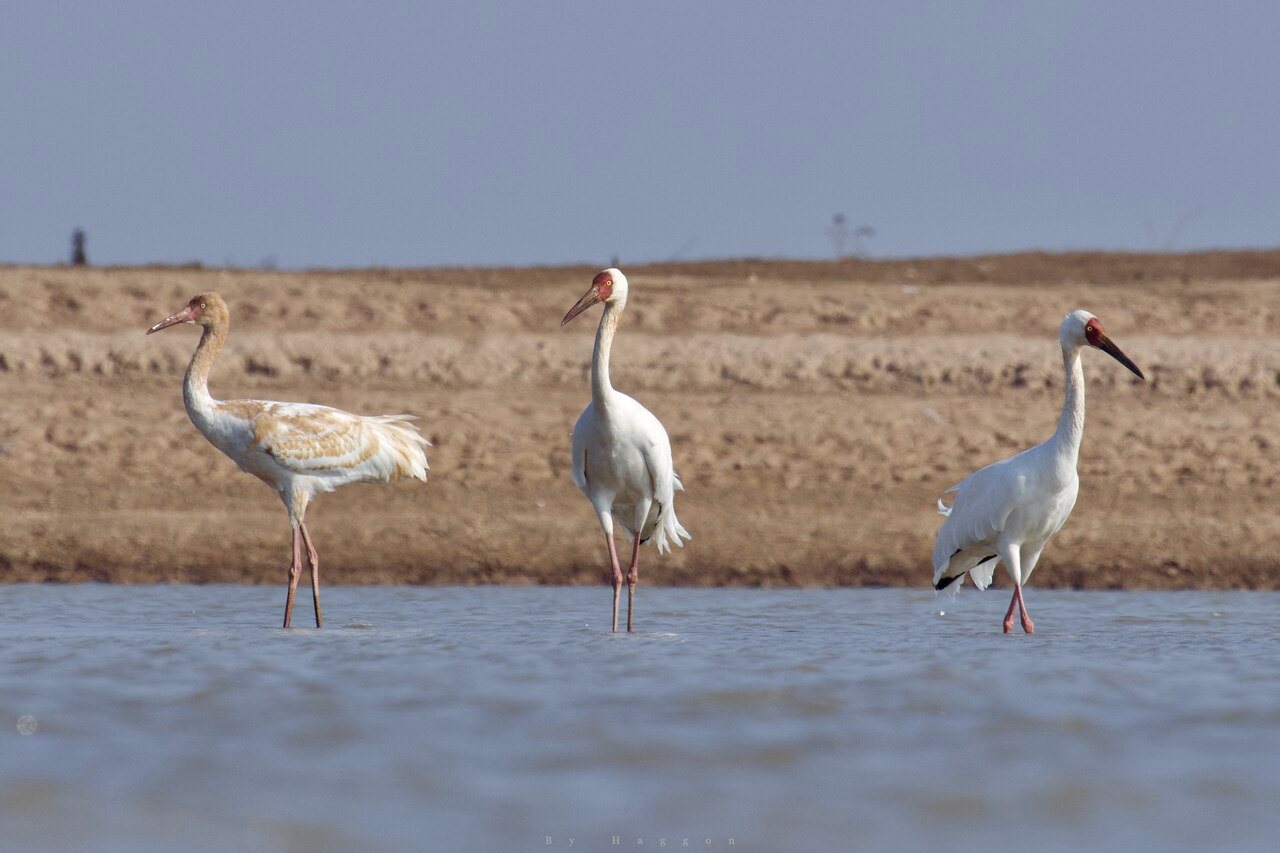
China’s best birding story does not live in a forest or a mountain. It lives in a lake that empties. Poyang, the largest freshwater lake in the country, is seasonal: in winter the water drops away, the mudflats open, and the exposed beds of tubers, snails and submerged plant roots become the winter table for the world’s entire population of Siberian cranes — around 5,800 birds in the 2025–26 count, more than 80% of the species on one lake.
A dry lake is a working lake.
The low water looks like a drought story and is actually the opposite. In 2025 the lake’s Xingzi gauge fell below the 12-metre low-water line on 8 August — eighty-seven days earlier than average — and below the 8-metre extreme-low line on 14 December; the lake spent 217 days of the year below the low-water mark. That is a hard year for the lake, and a rich one for the birds: roughly 102 seasonal sub-lakes larger than a square kilometre, holding more than 800 square kilometres between them, keep shallow water at the right depth while the main lake drains. Six tenths of the wintering birds sit in those basins.
And the cranes have added a modern twist: since around 2012 they increasingly leave the lake altogether and feed in flooded lotus and rice fields on the shore, where the tubers are easier. When one such field near Nanchang was about to be ploughed in 2017, five hundred bird photographers crowdfunded the rent to keep it flooded. That field is now the Five Star Siberian Crane protection area — the closest thing to a guaranteed crane in China.
The winter, by numbers.
The calendar runs on the water. Cranes arrive from late October; the peak sits in the weeks after the water bottoms out — realistically mid-December to the end of January. At Five Star, about thirty kilometres from Nanchang, a two-storey hide looks over flooded fields where birds sometimes feed a few dozen metres away, free of charge. The Nanji wetland, a national reserve on the south shore, holds around 141,000 wintering waterbirds and watchtowers over four sub-lakes — also free. Wucheng, the built-up option on the Yongxiu shore, clusters free viewpoints with mounted telescopes; only its four indoor museums sell tickets, roughly ¥29–78 a combination, and none of them is required to see a crane.
Three grounds, two mornings.
The honest rule of the lake is that it moves. Which flat is holding birds changes with every week of the drawdown, and mid-morning fog is common enough to wipe out a whole session — which is why the plan we build runs two mornings at each of the three grounds rather than one. A guide who was out scouting that morning is worth more than any fixed itinerary; the schedule is allowed to move because the birds move first.
The rules of the flats.
The reserve runs its own drone patrols against poisoning and netting, and private flights over the wintering birds are both prohibited and counterproductive. No call playback, no flash at dawn, and no walking out onto a flat to get closer — the guide’s working distance is a condition of the trip, not a suggestion. Bring binoculars first and a long lens second: 400 mm is a sensible minimum for frame-filling crane portraits, and the birds are wild and unbaited, so the photograph is a function of patience and distance. And pack for the cold — wetland mornings sit near freezing with a wind that goes through layers, and January fog is the season’s signature.
Planning the winter.
The trip we build from all this is a five-day private route in and out of Nanchang — the Poyang crane tour — with hide mornings, watchtower mornings and one fog-insurance session in hand. The species-guide page for Poyang Lake and its cranes carries the groundwork, and the behaviour rules it follows are the same ones set out in watching without disturbing. Poyang pairs naturally with a Jiangxi or Anhui add-on; it is one of the easiest wildlife add-ons in the country, and in December and January it is the single best birding window in East Asia.
Plan the winter?
The Poyang crane tour: five days, three grounds
Poyang Lake: the species guide
Watching wildlife without disturbing it
The season calendar, for the other China
The other crane winter: black-necked cranes on the plateau