Tiger Leaping Gorge
The famous crossing: from Qiaotou up the Twenty-Four Bends to the Naxi's Tea Horse Guesthouse, the halfway ledge, and the descent to the gorge floor where the river narrows to its leaping width.
 Start your enquiry
Destinations / Yunnan / The Tibetan northwest
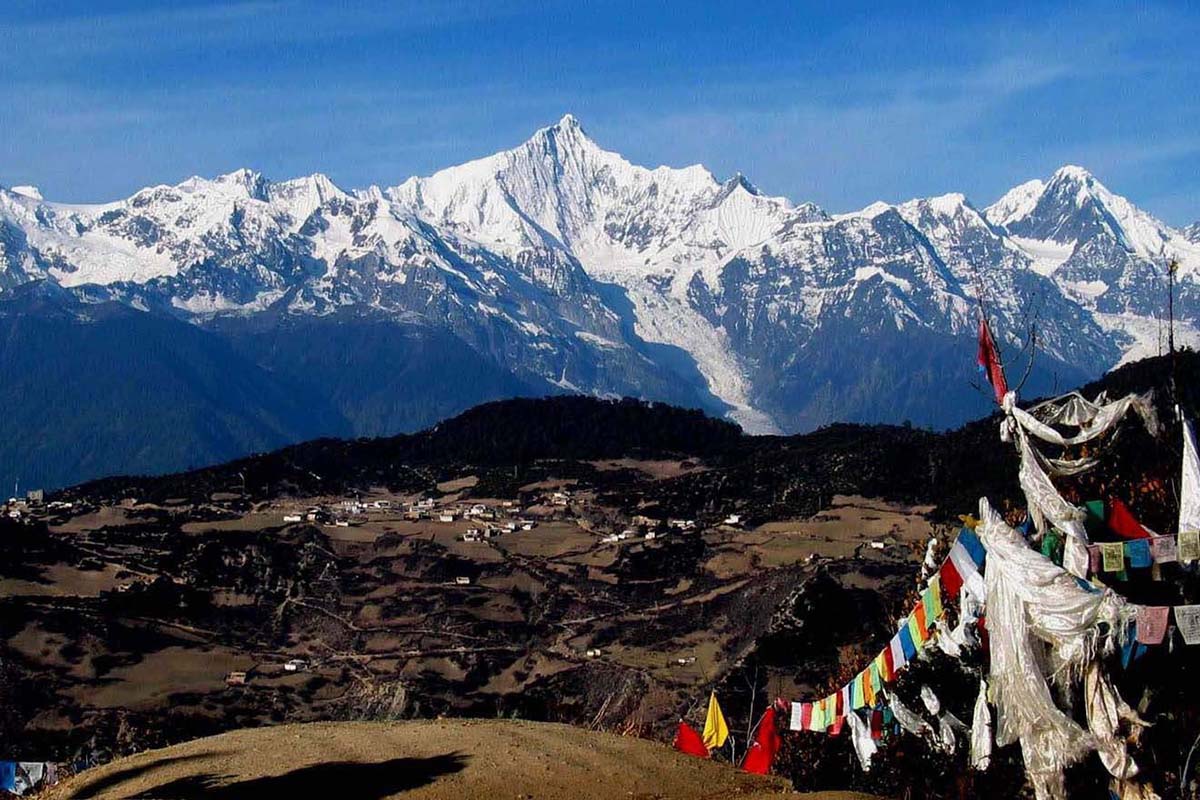
China's staircase goes vertical here: a gorge deeper than the Grand Canyon, a monastery city at 3,300 metres, and the great ice wall of the Meili range that no one has climbed and no one will.
Explore the guide ↓Diqing Tibetan Autonomous Prefecture · Lijiang
The northwest is where Yunnan stops being gentle. Three great rivers — the Jinsha (Yangtze), the Lancang (Mekong) and the Nu (Salween) — run parallel south through parallel mountain walls, and the road lines between them climb and fall through four vertical kilometres. Lijiang sits at 2,400 metres in the shadow of the Jade Dragon Snow Mountain; Tiger Leaping Gorge drops two kilometres to the river below; Shangri-La spreads across a 3,300-metre plateau of barley and prayer flags; and the road west ends at Deqin, under the thirteen peaks of the Meili range led by Kawagebo at 6,740 metres.
This is Tibetan China: the Diqing prefecture holds monasteries, kora paths and villages of white-walled farmhouses, and the pilgrim traffic under the Meili range has run for centuries. It is also where Yunnan's minorities meet its mountains — Naxi old towns below, Yi and Lisu villages on the slopes, Tibetan culture on the plateau. A northwest journey moves through all of them on one line.
Season decides the texture. Winter is cold but crystalline — the terraces of the southeast flood at exactly this time, and the mountain views are at their annual best. Late spring brings the rhododendrons and the greenest barley. Autumn is the professional's choice: clear air, golden harvest, and the first snows on the thirteen peaks.
The region's essential landscapes, and the journeys that work them.
The famous crossing: from Qiaotou up the Twenty-Four Bends to the Naxi's Tea Horse Guesthouse, the halfway ledge, and the descent to the gorge floor where the river narrows to its leaping width.
The village with no road in — reached on foot or horseback over a 3,700-metre pass — walks to the holy waterfall and the glacier lake, and dawn on the ice wall of Kawagebo.
The friendly giant: a two-day climb from a Hani village base through forest, meadow and scree to a summit that looks down the whole gorge country. The classic first 5,000er.
The Yunnan snub-nosed monkey — the "children of the snow" — live in fir forests above 3,000 metres; ranger-led mornings in the Baima reserve are the way to meet them.
Shangri-La's 300-year-old Gelug monastery, home to hundreds of monks — walk the kora circuit at dawn, then the halls with a resident guide.
The white-walled Tibetan old town — rebuilt with care after the 2014 fire — its prayer-wheel hall, rooftop squares and yak-butter tea houses.
Four different northwests, by season.
The professional's window: stable high pressure, golden barley and harvest, the Meili range snow-loaded and visible. Book early — this is when everyone wants the mountain.
Cold nights, still, bright days, and the year's best mountain visibility. The gorge walks run all winter; Yubeng runs with snow flexibility. Pairs perfectly with the flooded terraces of the southeast.
Rhododendrons across the Cangshan and the high slopes, young barley around Shangri-La, waterfalls at full voice. Rain builds late in the window.
July–August: green, dramatic, wet. Tiger Leaping runs with rain plans; mountain views are a lottery. We run it honestly with flex days — or send you to the terraces instead.
The staircase has a rhythm — plan altitude first, distance second.
Lijiang is the practical gateway: high-speed rail from Kunming (about 3.5 hours) and a busy airport. Shangri-La has its own airport and the line now runs close behind. Most journeys start Lijiang, climb west, and fly or rail back.
2,400 → 3,300 m in two steps. Our itineraries hold a Lijiang night, a gorge night, then Shangri-La — the climb is gradual by design. Anyone heading to Yubeng adds the 3,700-metre pass on day three or later.
Lijiang guesthouses in the old town, gorge guesthouses on the ledge (book the view side), Shangri-La's Tibetan-run lodges, and Yubeng's village guesthouses — simple, warm, and the only way to see the dawn.
Naxi, Bai, Yi and Tibetan lifeways on one line.
Circumambulate clockwise, always. The paths under the Meili are pilgrimage routes first — walk them as guests, greet the pilgrims, and never treat the prayer flags as photo props.
Lijiang's old town is a living Naxi town — the Dongba script, the last pictographic writing system in use, and the traditional music societies are worth an evening.
Yak meat, butter tea, tsampa and the plateau's mushrooms; in Lijiang, the Naxi baked cheese (rubing) and the trout streams of the gorge. Food climbs with altitude — the northwest eats for warmth.
The details worth discussing when shaping your trip.
Kawagebo is unclimbed by agreement since 2001 — the ban is honoured by the climbing community and treated as settled by the region. Journeys here are walking journeys, and we describe them exactly that way.
Even in the clear season, nights run below freezing above 3,000 metres. Layers, a real shell and spare batteries; the guide's call governs early starts in ice.
The Deqin road and the gorge road are engineered marvels with real exposure. We use experienced drivers, daylight-only schedules, and never promise a view the weather has not confirmed.
Tell us your altitude comfort and your walking appetite. The northwest rewards the patient — a line built gorge → plateau → ice wall, at the right season's pace.
Start my journey brief ↗