Qiaotou to the bends
The first kilometres climb steadily through farmland above the valley road — the legs should know before the bends announce it.
 Start your enquiry
Trekking / Tiger Leaping Gorge · The high trail
Tiger Leaping Gorge is the deepest river canyon on earth that carries a walking trail — and the high route through it is two days of ledge, bend and balcony above the Jinsha.
Start this route briefYunnan · The high route above the Jinsha River
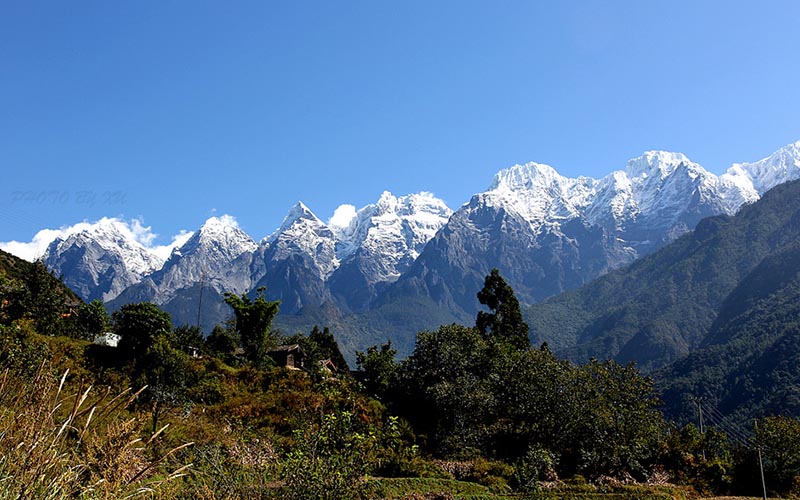
from the river to the Jade Dragon summits — the gorge the trail balconies above is one of the deepest on earth
the famous staircase of switchbacks that lifts the trail from the valley road to the high ledge at about 2,670 m
of walking from Qiaotou to Tina's guesthouse on the classic two-day schedule, mostly on contour paths built by farmers
Jade Dragon Snow Mountain on the south bank; Haba, 5,396 m, on the north — the trail looks at both
Every gorge in China has a road; Tiger Leaping Gorge has two. The low road carries buses to the river and the famous leaping rock. The high road — the one the Naxi and Yi villagers built and still walk — rides a ledge 1,500 metres above the water, past farm terraces, waterfall caves and guesthouses that exist solely because hikers need somewhere to sleep.
The two-day schedule is the classic for good reason: it puts the twenty-eight bends early, the great balcony traverse in the afternoon light, and the night at Halfway guesthouse, whose terrace toilet has the most photographed view in Chinese trekking. The second day walks the finest ledge section to Tina's, then drops — optionally — to the river itself for the Middle Rapids.
This page unpacks the route stage by stage. The overview lives on the gorge's main page; the practicalities — buses, tickets, seasons — are there too. Here it is just the line, walked in order.
Eleven hours of walking split into a rhythm of climbs, ledges and tea stops.
The first kilometres climb steadily through farmland above the valley road — the legs should know before the bends announce it.
Two hours of switchbacks to the high point near 2,670 m. Slow and steady wins; the view at the top closes the argument.
The contour path rides out along the gorge wall, farms and pines below, Haba's wall across the river. The finest walking of the trip.
The night stop, plastered to the cliff with its famous terrace. Sunset fills the gorge with shadow while the peaks stay lit.
Morning contour walking past the waterfall cave and the Fourteen-Mile ledge — the wildest, quietest stretch of the trail.
From Tina's, a steep side path drops to the Middle Rapids and the leaping rock — 600 metres down, and worth every returning step.
Start from the town at the gorge mouth after the morning bus from Lijiang. The path climbs through rice terraces and a bamboo grove; the river disappears below and the scale of the walls arrives gradually.
The twenty-eight bends are the trip's gymnasium: two hours of switchbacks through pine shade. Water bottles can be refilled at the hut at the top.
The contour begins. This stretch is the reason the high trail exists — level walking, enormous air, the gorge opening and closing like a slow door.
An easy afternoon leg that arrives early on purpose: Halfway's terrace is the place to sit out the sunset, and beds are limited.
The longest morning: the ledges past the waterfall cave, the slight descent through the pines, and the sudden arrival of the gorge's narrowest section.
Drop to the Middle Rapids if the knees agree — a hour down to the roaring narrows and the leaping rock — then climb back and take the vehicle out via the low road.
The high trail is not technical, but it is exposed in places: ledges with real drops, sections that can be slippery after rain, and a middle day with almost no shade. Sturdy shoes and a sensible head for heights are the only equipment that matters.
Start early on both days. The bends are cooler in the morning, the guesthouse beds reward early arrivals, and afternoon thunderstorms build over the Jade Dragon wall in summer — walking the traverse in rain is nobody's memory.
And take the gorge at the gorge's pace: the farmers who built these ledges did it for porters carrying tea and salt, and the paths are safest when walked the way they were built — unhurried, watching feet, looking up at the walls only when standing still.
April to June and September to November give the clearest ledges; summer walks well but the afternoon storms are real.
Halfway and Tea Horse exist for hikers and book out on weekends — supported trips reserve beds before the season does.
Every stage passes a tea house; carry a litre and buy the rest. The guesthouse dinners are better than they have any right to be.
Tina's connects to the low road and the Shangri-La buses; the exit logistics are the easiest part if planned ahead.
The gorge supplies the rest.
There is a moment at Halfway guesthouse that explains the whole gorge. The terrace is a plank bolted over a kilometre of air; the gorge narrows ahead; and as the sun drops, the shadows climb the north wall while Haba's summit stays lit like a lamp. Nobody talks much.
The toilet is famous for the same view, which tells you everything about the guesthouse's priorities. The food is Naxi farmhouse cooking; the beds are hard; the morning arrives with the wall across the river turning gold from the top down.
Then the second day's ledges — the waterfall cave, the quiet pines — and the descent to the river, where the gorge compresses into a roar you feel in the handrails. Two days, twenty-two kilometres, and the deepest argument in Chinese trekking.
The road the buses take sees the gorge. The road the farmers built walks inside it.
We run the high trail as a supported two-day module — beds at Halfway reserved, transfers at both ends, and a guide who knows which ledge to linger on — or folded into a wider Yunnan line with Lijiang, Shangri-La and the Meili country.
The full gorge guide · The NW Yunnan hub · The Yubeng pilgrimage loop
Start a route brief