Deqin station forecasts
The county's own forecasts read the ridge better than generic apps; a falling snow line with rising pressure behind it is the classic clear-spell signature.
 Start your enquiry
Destinations / Yunnan / News / Meili outlook
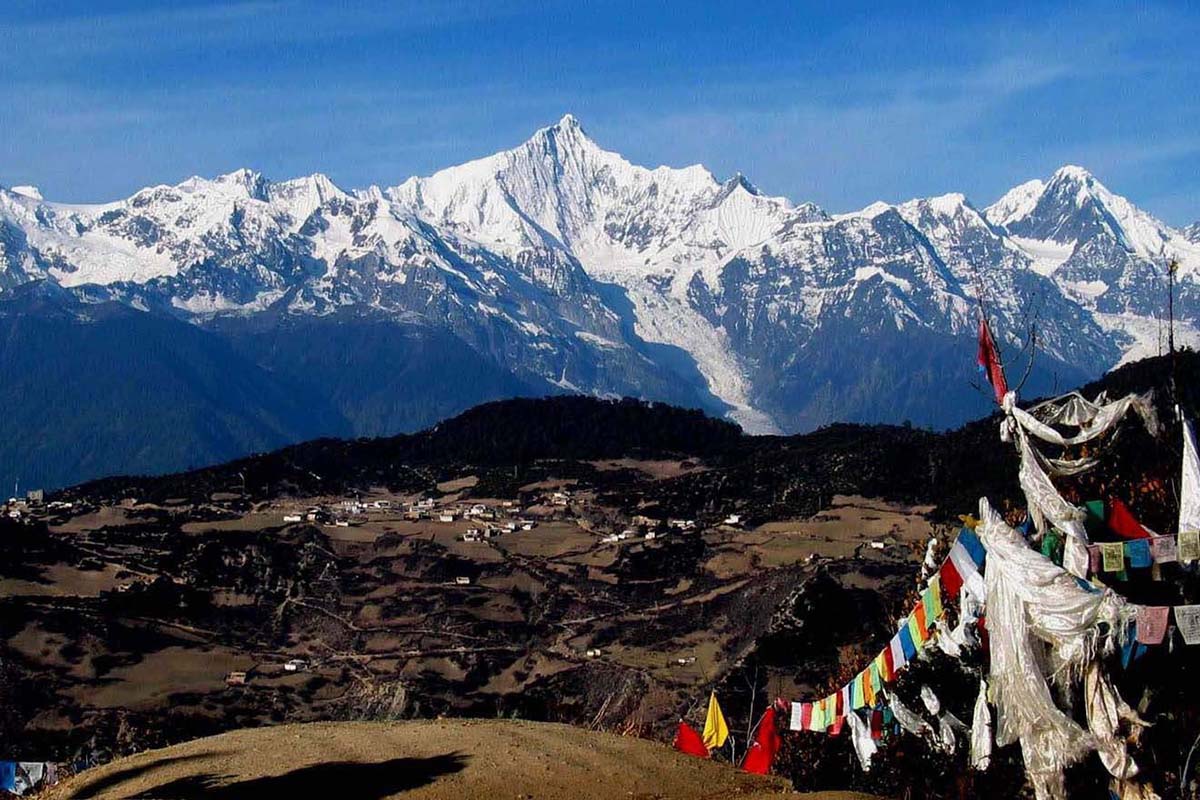
The thirteen peaks are the reason travellers come to Deqin — and the mountain decides who sees them. Here is how the visibility season actually works, and how the journey is built to wait it out.
Explore the guide ↓Deqin · the Meili range
The Meili range sits on the edge of the Tibetan plateau's winter high pressure: cold, dry and stable for most of November to March, with short-lived storms sliding along the ridge every few days. The practical rhythm is 1–3 days of cloud and snowfall, then 2–4 days of crystalline clear — and the dawns in the clear spells are among the finest mountain light in Asia, the ice wall of Kawagebo catching first pink while the valley still holds its fog.
The statistical best runs November to February. March stays good but warms; October can be excellent in the right year; the monsoon months of July–August are a lottery we decline to sell. Within any given week the weather, not the calendar, decides — which is why every journey holds slack rather than promises.
In order of usefulness.
The county's own forecasts read the ridge better than generic apps; a falling snow line with rising pressure behind it is the classic clear-spell signature.
The viewing-platform reports and photos are the fastest honest signal of where the ridge sits — clearer than any forecast.
Guides coming off the overland feed observations straight into the schedule — if the pattern says wait a day, the journey waits a day.
The Shangri-La and Meili overland books two nights at the Feilai viewpoint for one reason: two dawn attempts. If the first dawns clear, the second becomes the Yubeng side-valley walk or the Mingyong glacier road; if the ridge is loading, the second dawn is the insurance. Nobody boards a flight out of Deqin before the mountain has had both chances.
That is the whole method — buy the mountain two mornings, sleep high, and let the storm cycle decide which morning it pays. It almost always pays one of them.