Terraces & canola loop
The two light shows at dawn pace: three mornings in the Yuanyang mirrors, the canola sea and karst of Luoping, and the stone villages between.
 Start your enquiry
Destinations / Yunnan / The red southeast
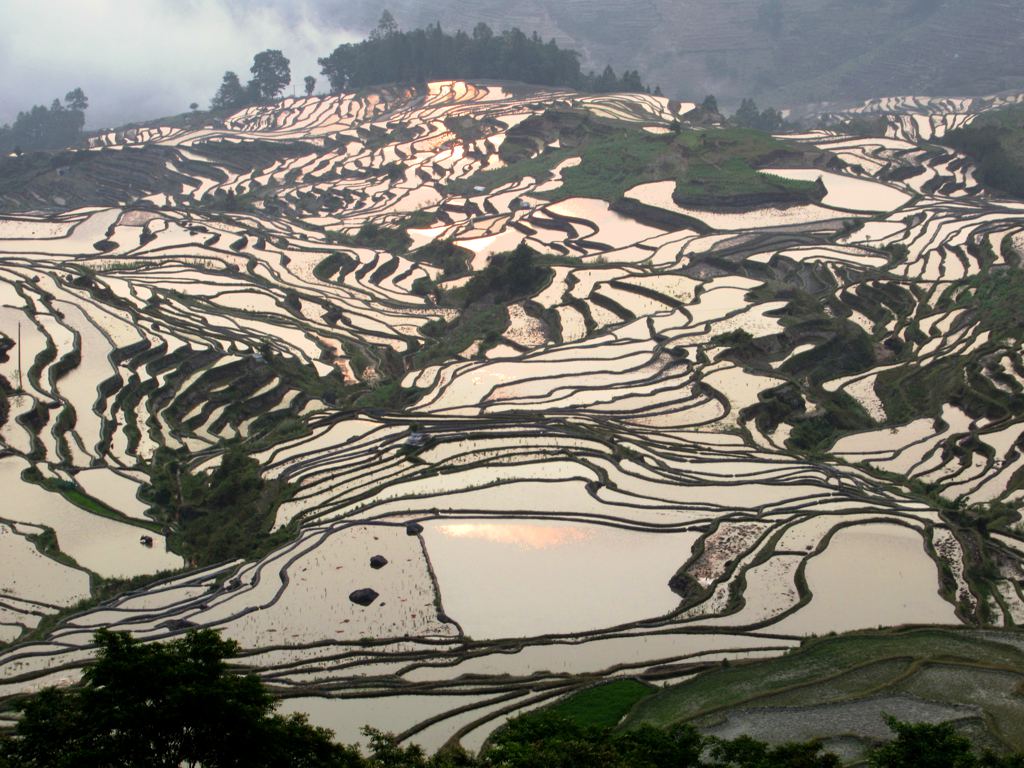
The earth, sculpted and painted: terraces that mirror the sky for five months, a canola sea each February, and red fields ploughed into palettes — the southeast is winter's best argument.
Explore the guide ↓Honghe · Qujing · Kunming east
The southeast is where Yunnan's earth becomes art without stopping being agriculture. The Hani terraces of Yuanyang — 1,400 years old, inscribed by UNESCO in 2013 — stack from the valley rivers up to 2,000 metres, and every winter the farmers flood them: thousands of mirrors catching dawn, cloud sea and sunset in the same hour. This is not a viewpoint landscape; it is a living system of channels, forests and villages that still feeds the families who farm it.
East of it, the karst country around Luoping runs to a different calendar: each February and March the canola bloom turns the hillsides and the carbonate pinnacles yellow at once, and the village of Duoyihe fills with photographers who know the two-week window. North toward Kunming, the Dongchuan red land ploughs its iron-rich soil into shifting palettes of red, gold and green — the fields that made a generation of colour photographs.
Between them sit stone villages, the Jianshui Confucian quarter, the old tin capital of Gejiu and the karst lakes of Puzhehei — the southeast rewards the road line, and almost no one travels it slowly. We do.
The region's essential landscapes, and the journeys that work them.
The two light shows at dawn pace: three mornings in the Yuanyang mirrors, the canola sea and karst of Luoping, and the stone villages between.
The terraces on foot between villages — Duoyishu, Bada and Laohuzui from the paths the farmers use, not the car parks.
The painter's fields at working pace: Luoxia gully, the thousand-year dragon trees and the seven-colour slopes, from a lodge that watches the dawn.
The gold fortnight: canola to the horizon around the karst cones of Jinjifeng and the Duo Yi river — timed to the bloom, not the calendar.
Limestone towers rising from connected lakes south of Yuanyang — boat country in summer, lotus season in July, and quieter than Guilin ever was.
A 600-year-old Confucian temple, the Zhu family garden, and China's most charming narrow-gauge railway — the southeast's cultured half-day.
The southeast is the winter destination.
The terraces flood after harvest and hold water to spring: mirrors, cloud sea and dawn colour at their fullest. Cold mornings, warm light, the year's best photography.
Luoping's canola sets the karst alight — the bloom peaks for about two weeks, usually late February into March, moving with the winter. The Yuanyang mirrors are still on: the two pair perfectly.
The terraces turn yellow-green-gold before the flood: the harvest landscape, village life at its busiest, and the year's second-best light.
July–August the terraces are green and Puzhehei is in lotus — fine travelling, but not the landscape the photographs promise. We will tell you plainly.
The southeast is a road line — build it as one.
Kunming is the gateway and the anchor. Yuanyang is a 5–6 hour road day south (or rail to Jianshui + road); Luoping is 3.5 hours east by rail or road; Dongchuan is 3 hours north. Our loops run Kunming → terraces → karst → Kunming without repeating a kilometre.
The mirror dawns need you inside the terrace zone before first light: stay in Xinjie town or the Duoyishu village guesthouses, not the county city. The red land needs a mountain lodge, not a Kunming hotel. We book accordingly.
Terrace-view village guesthouses, Jianshui's courtyard hotels, and the red-land lodges — simpler than the cities, and correctly placed for the light.
Hani water law, Yi markets and the southern table.
The terraces run on a village-managed water system — channels, forest headwaters and a rotation older than the Ming. Walk it with a local guide; the engineering is the story.
The Yi, Hani and Miao villages rotate weekly market days — livestock, embroidery, tobacco and the best street food of the trip. Ask us which market falls on which day of your journey.
Crossing-the-bridge noodles were born here (Mengzi, next door to Jianshui); add Jianshui steam-pot chicken, Gejiu's tin-pot grill and the terraces' red-rice dishes — the most distinctive food line in the province.
The details worth discussing when shaping your trip.
Canola timing shifts with each winter — the loop is planned around mid-window dates with flex, and we confirm the outlook before flights. Same honesty applies to the first frost that starts the flood.
The whole southeast is a dawn destination: three 5:30 starts in a week is normal, and the lodge placement is the difference between the shot and the story about the shot.
The southeast pairs naturally with the tea south (one line south from Kunming) or makes a winter journey of its own while the northwest sleeps under frost.
Tell us your window — mirrors, gold or red — and we will build the loop around the light, with lodge positions and dawn times that respect the landscape.
Start my journey brief ↗