
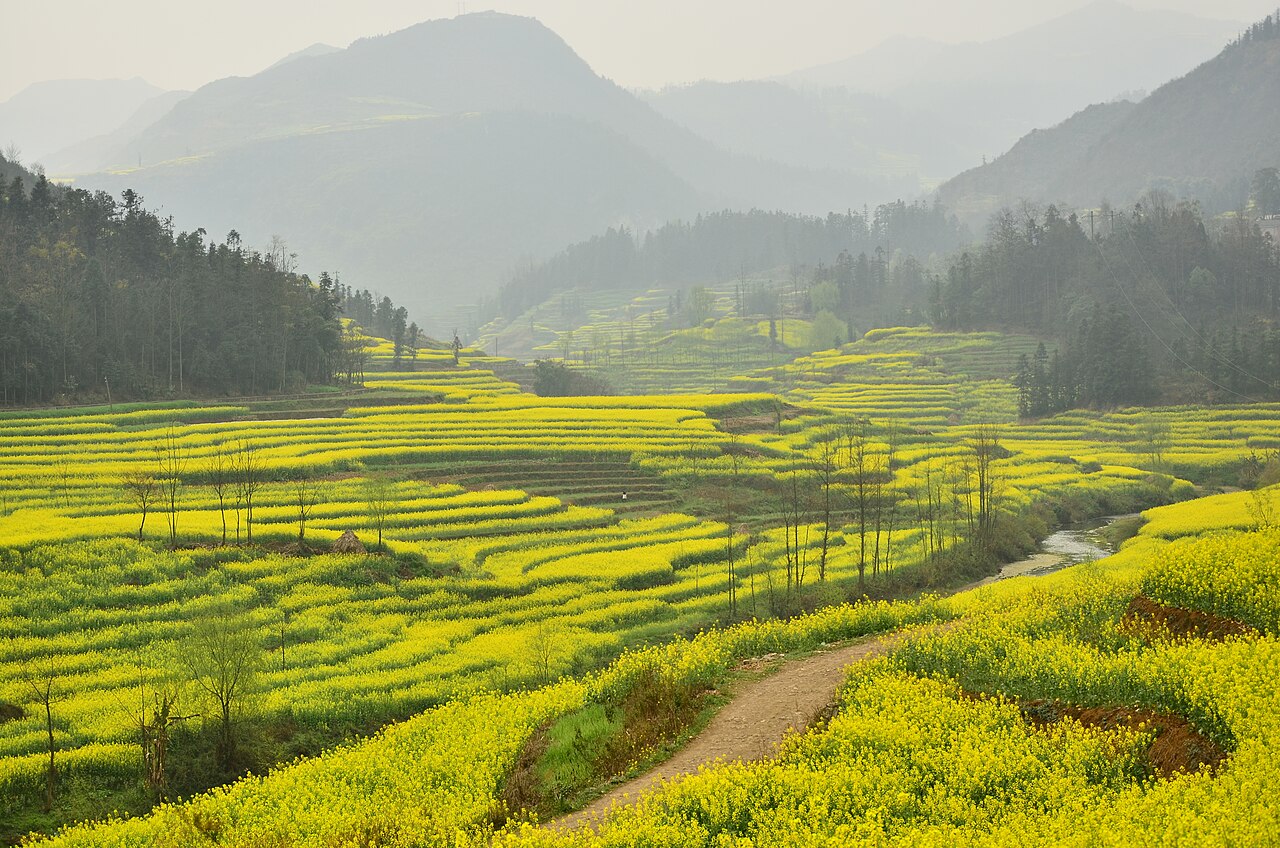
The bloom.
The canola of Luoping is agriculture on an astronomical scale: the county's winter crop flowers in late February and early March, and for its fortnight the fields run yellow to the horizon under big clouds. The timing moves with each winter — the warmth of January decides whether the peak lands in the last week of February or the first of March — which is why the journeys book the window with flex days and confirm the outlook before flights are bought.
The cones.
What makes the bloom a phenomenon rather than a crop report is the karst: limestone cones and pinnacles rising from the yellow sea, with the cluster above Jinjifeng the classic composition. Work it at first light, from the ridge positions, before the coaches; the cones come out of the mist one at a time, and the colour under dawn light is deeper than any postcard manages.
The falls.
The region's second act is water: the Nine Dragon falls step down a karst amphitheatre with spring volume, and the Duoyi river's villages — waterwheels, dye vats, rafts — thread the valley south. The canola fortnight books out the county town; the falls and the villages are where the crowds thin. A week in the window gives you both: the gold, and the water that grows it.
Keep reading
The water keepers
Luoxia gully
The water season