
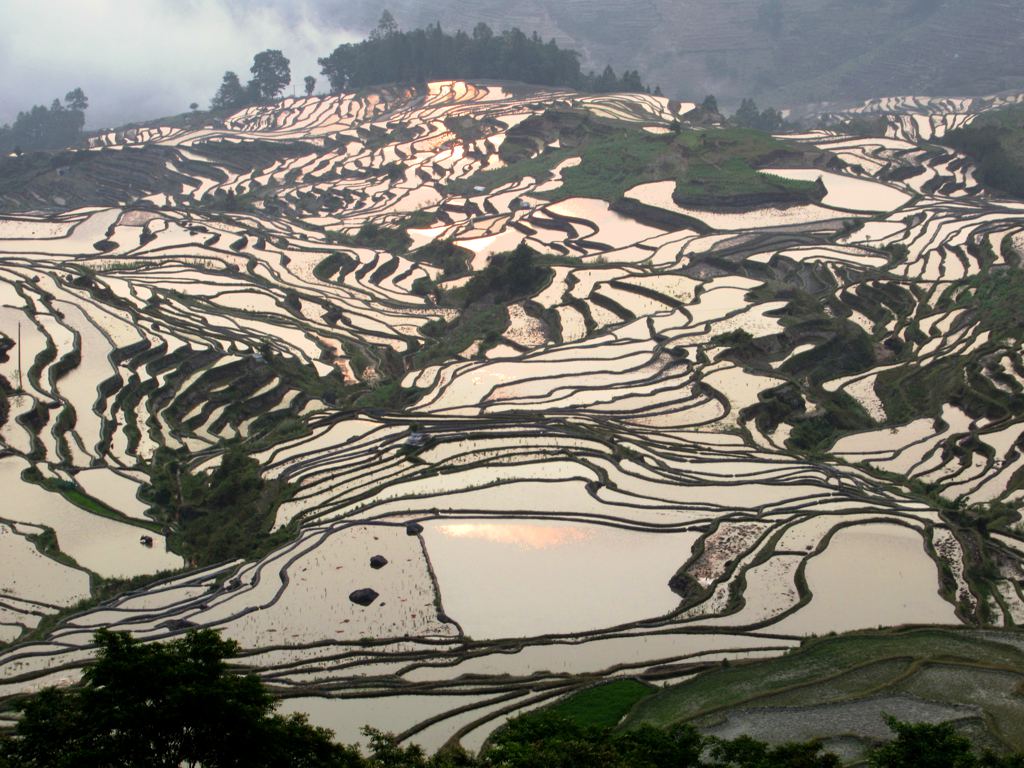
The photographs that sell China's rice terraces are taken in a window of a few weeks, and the rest of the year the same hillsides are brown. This is not a secret the industry hides so much as one it does not mention: a terrace is a farm, and what you see depends on where the farmers are in the annual cycle, not on a maintenance schedule.
There are two terraces worth building a trip around, and their calendars are almost opposite. Longji, north of Guilin in Guangxi, floods in late May. Yuanyang, in southern Yunnan, floods in November and keeps water until April.
Two calendars, and why they differ.
Both are working rice terraces, planted once a year, and both are spectacular when the paddies are full of water and the surface reflects the sky. What differs is altitude and latitude. Longji sits at 300 to 1,100 metres in a subtropical valley that warms early; planting happens in late May and June. Yuanyang's Hani terraces climb between roughly 1,400 and 2,000 metres, where the growing season starts later and the fields are kept flooded through the dry winter months.
So the practical question is not "when are the terraces best" but "which terrace fits the month I can travel". If you have a fixed week in February, Longji is bare and Yuanyang is at its best. In June it is the other way round.
Longji: the window is about twenty days.
Longji — the Dragon's Backbone — is three separate terrace areas inside one scenic zone: Ping'an, Jinkeng above Dazhai, and Longji Ancient Zhuang Village. One ticket covers all three and it is checked at each entrance, so keep it. Expect ¥80–100 depending on the channel and year, with the Dazhai cable car around ¥100–120 return and local shuttles ¥20–50.
The mirror period runs from roughly 25 May to 10 June. In that window the terraces are flooded and unplanted, the water is still and the reflection is near-perfect. From about 10 to 20 June the rice goes in, field by field, from the lower terraces upward — so the mirror disappears in patches rather than all at once. After about 20 June the hillside is green and stays green until the rice ripens.
The second window is the harvest: late September into mid-October, when the rice turns gold and is cut somewhere around 10–25 October. This is the more comfortable trip and the more crowded one. Between late October and late April the fields are bare earth, and from December to February there is a chance of snow — which is beautiful, and rare.
Which of the three areas you choose matters as much as the month. Ping'an is the most developed and can be done in half a day; Dazhai's Jinkeng terraces are the largest and the only ones with a cable car, and are where photographers stay overnight; the Ancient Zhuang Village is the quietest. There is no direct road between Ping'an and Dazhai — a car takes about fifty minutes, and walking takes four to five hours.
Yuanyang: the water stays all winter.
Yuanyang is the larger and older landscape — Hani terraces cut into the slopes over some 1,300 years, listed by UNESCO in 2013 — and its water season runs from November through April, with December to March the strongest. A three-day pass costs ¥70 and covers the main viewpoints: Duoyishu for sunrise, Bada for sunset, Laohuzui for the wide V-shaped panorama, and Qingkou village.
This is the more forgiving trip. You are not chasing a three-week window; you are choosing among four months, and the odds of a clear dawn are better in the dry season than in the Guilin spring. Sunrise in the water season is around 07:00, which means a 06:00 start rather than a 04:00 one, and the viewpoints are twenty to forty minutes apart by road.
Two things to know. Mornings are cold — below 10°C in winter, at 1,800 metres — and the terraces are best photographed in the twenty minutes before sunrise and the twenty after, not at midday. And Laohuzui was rebuilt on two levels after a landslide in 2018, so older photographs of the viewpoint no longer match what you will stand on.
Getting there is the cost. Yuanyang is four and a half to five hours by bus from Kunming (¥180–220), or about the same by private van for ¥1,500–2,000, and the road climbs continuously. This is not a place to visit for an afternoon.
The months, compared.
| Month | Longji (Guangxi) | Yuanyang (Yunnan) |
|---|---|---|
| January | Bare; occasional snow | Water — strong |
| February | Bare | Water — strongest |
| March | Bare; rapeseed in the valleys below | Water — strong |
| April | Bare; water from late April | Water, then planting |
| May | Water from about 25 May — mirror | Green |
| June | Mirror to about 10 June, then transplanting | Green |
| July | Green | Green |
| August | Green | Green |
| September | Green, turning gold late in the month | Green |
| October | Gold; harvested roughly 10–25 October | Gold |
| November | Bare | Water from late November |
| December | Bare | Water — strong |
The months nobody warns you about.
Late October to late April at Longji is bare brown earth with stubble. It is not ugly — the shape of the terraces is still there, the villages are quiet, and hotel rates halve — but it is not the photograph that made you book, and a five-hour round trip from Guilin to look at it is a poor trade.
The same logic applies in reverse at Yuanyang: May to September is green, humid and often in cloud. Green terraces are handsome, but the layered mirror effect that defines the place is gone.
If your dates are fixed and fall outside both windows, the honest advice is to leave the terraces off the itinerary rather than visit them as a tick. Both are long detours from anywhere else, and both reward a night on the mountain rather than a day trip. A half day gets you to the first tier above the car park, which is not what you came for.
Planning around it.
If the mirror is the point: Longji in the last week of May or the first ten days of June, with a spare day for weather; or Yuanyang any time from mid-December to the end of February, which is the easier and more reliable of the two.
If you want the colour: Longji in the first half of October, before the harvest finishes. Yuanyang in October, when the terraces turn gold before the winter flooding.
Both places are working farmland, and the paths between fields are the farmers' routes. Walk on the stone, do not cut across a planted terrace, and ask before photographing anyone close up. The Yao women at Longji who pose for photographs expect a small fee, and it is fair to pay it.
Windows, prices and access checked 3 November 2026 against operator and official scenic-area information. Planting and harvest dates shift by one to three weeks with the weather each year; ask your guide or hotel what the fields are doing in the week you plan to arrive.
Building a route around the water?
See the Longji terrace walks →