Wolong
The original panda reserve, in the Qionglai range west of Chengdu. Heavily damaged by the 2008 earthquake and rebuilt; the valley is open, the deep forest is not.
 Start your enquiry
Destinations / Sichuan / The reserves
The reserve system that saved the giant panda, spread across the Qionglai and Minshan ranges: Wolong, Wanglang, Tangjiahe, Labahe and four more, all within a half-day of Chengdu and all closed to independent travel.
Explore the guide ↓Qionglai & Minshan ranges · UNESCO 2006
The giant panda survives in a set of mountain reserves across western Sichuan and southern Shaanxi, and the Sichuan group was inscribed by UNESCO in 2006 as the Sichuan Giant Panda Sanctuaries. Wolong, the best known, was established in 1963, expanded to about 200,000 hectares in 1975 and joined UNESCO’s Man and the Biosphere network in 1979. Around it sit Wanglang, Tangjiahe, Labahe, Baihe, Wawushan, Fengtongzhai and the Anzihe reserve.
These are not zoos. They are forest reserves at 2,000–5,000 metres, administered for conservation, with a small number of permits for research and low-volume tourism. That is precisely why they are worth the trouble: a morning in Tangjiahe or Wanglang is the closest most travellers get to the actual habitat, and the species list is not limited to pandas.
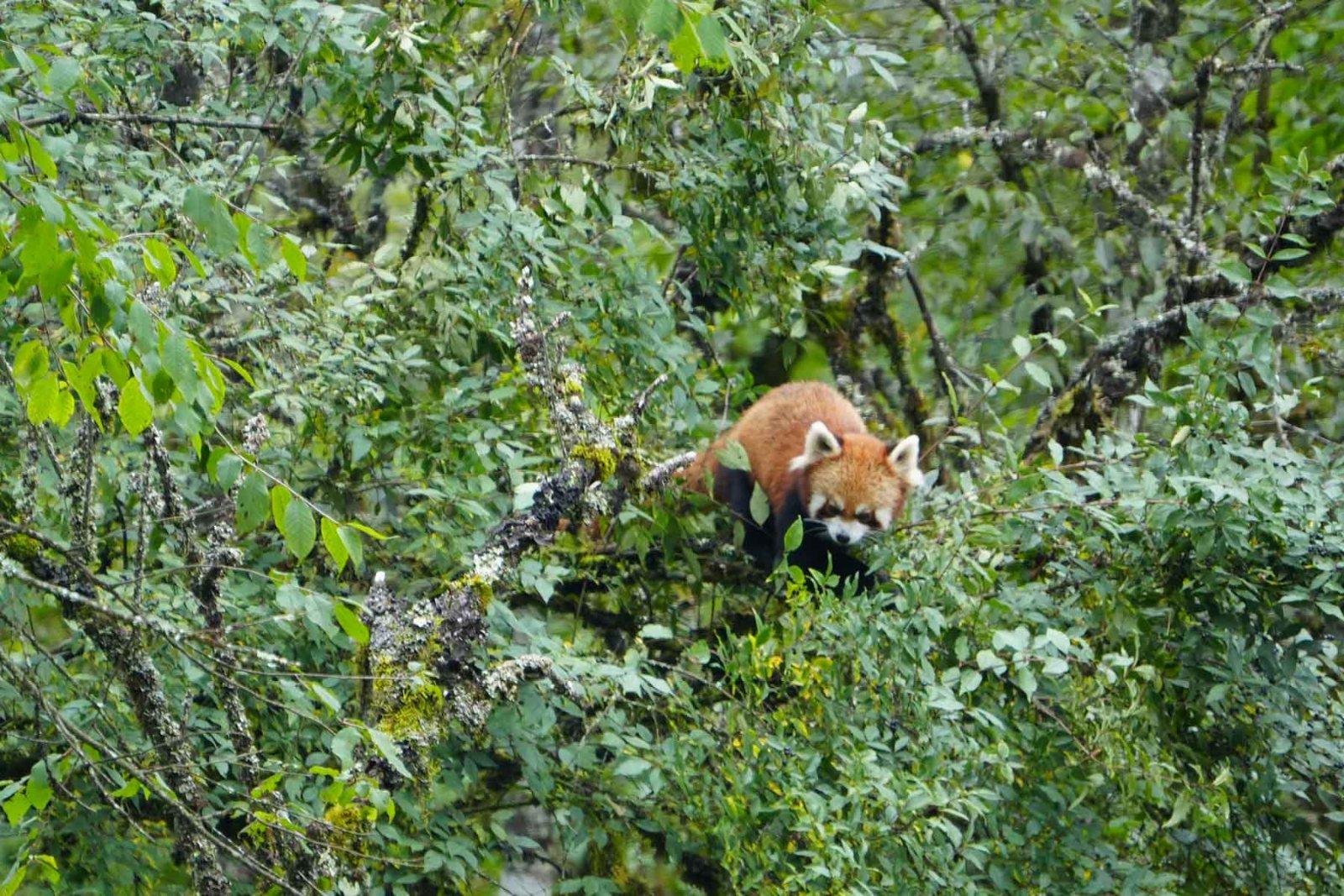
The practical difficulty is access. Permits are limited, some reserves are closed entirely to foreign visitors, and the ones that are open require a guide and a vehicle. The reward is a forest that has not been logged since the 1960s and a genuine, if modest, chance of seeing takin, golden snub-nosed monkey, red panda and serow in a day.
Four that take visitors, and what each is actually for.
The original panda reserve, in the Qionglai range west of Chengdu. Heavily damaged by the 2008 earthquake and rebuilt; the valley is open, the deep forest is not.
A reserve on the Minshan range at 2,400–4,980 m, mostly dark conifer forest on glacial valley floors. The best place in Sichuan to walk forest that has never been cut.
A river valley reserve in Qingchuan, in the far north, known for takin, goral and a very high density of large mammals along the road at dawn.
A reserve in Tianquan, south of Wolong, with a habituated red panda population and forest tracks that are walkable in a morning.
Spring and autumn, and the bamboo.
Spring: bamboo shoots, animals moving after winter, and the forest at its most visible before the leaves close. The best all-round window.
The monsoon. Green and dense, with the forest closed in and the animals harder to see. Leeches in the lower valleys.
The other good window: clear, dry, and the autumn colour in the birches and maples. Cold at night at altitude.
Winter. Snow at altitude, some tracks closed, and the animals concentrated in the valleys — good for tracking, hard for access.
Three hours from Chengdu, with a permit.
Wolong is about 130 km and three hours from Chengdu, on the road to Siguniang. Tangjiahe is five to six hours north, near Qingchuan. Labahe is four hours west.
All of these need a vehicle and a guide, and the reserves set their own daily limits. Nothing here works as a self-drive stop.
Wolong town and the reserve guesthouses for the Qionglai reserves; Qingchuan for Tangjiahe. Two nights per reserve is the minimum for a chance of a good sighting.
How to behave in a reserve.
The reserves exist to protect habitat, and the permits are conditional on staying on the track. Bamboo understory is fragile and trampling it removes the panda’s food.
Recording calls or leaving food changes behaviour and is prohibited in every reserve we use. The wildlife here is wild, and the point is that it stays that way.
A panda sighting in the wild is rare, even in Wolong. Takin, red panda, golden monkey and serow are realistic; a panda is not, and any operator promising one is selling you something.
Permits, altitude and cold mornings.
Reserve permits are issued per group and per date, and some require a research or conservation justification. We apply four to six weeks ahead.
Access rules for foreign travellers change without notice. We confirm the current status of each reserve in the week before a trip rather than assuming last year’s rules.
Valley floors sit at 2,600 m and mornings are near freezing even in May. Waterproof boots, layers and a headtorch are the whole kit list.
Tell us which species matter and how many dawns you will give them. The reserves reward patience and punish itineraries.
Start my journey brief ↗