Dafeng, 5,025 m
Base camp at 4,200–4,300 m, a snow slope of roughly 700 metres and no technical ground in good conditions. Two days up and down, and the standard first summit in China.
 Start your enquiry
Destinations / Sichuan / Siguniang
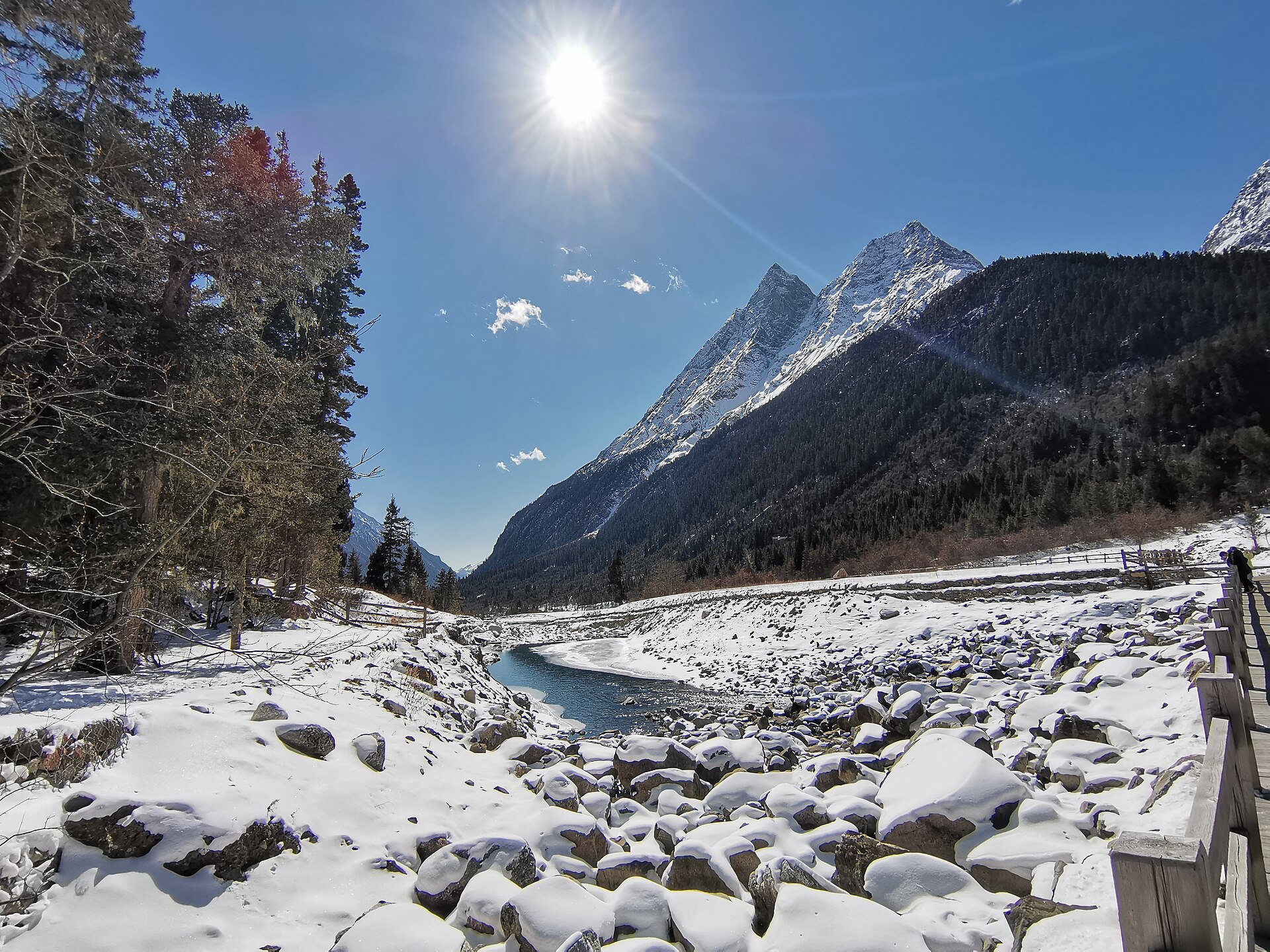
Four peaks on one ridge, the highest at 6,250 metres, and a valley below them with more than a hundred ice falls. The closest real mountain to Chengdu, and the best place in China to learn to climb one.
Explore the guide ↓Qionglai range · 3,200 m
Siguniang — “four girls” — is a ridge of four summits in the Qionglai range, about 220 kilometres west of Chengdu. Yaomei Feng, the youngest and highest, is 6,250 metres; Sanfeng is 5,355, Erfeng 5,276 and Dafeng 5,025. The reserve around them contains sixty-one peaks above 5,000 metres, which is why it has become the standard training ground for Chinese alpinism.
Three valleys run east from the ridge. Shuangqiao is the longest at 34.8 kilometres, with a road to the end and a floor that rises from about 3,000 metres at the gate to 3,840 at the last stop. Changping is the walking valley, and the traverse from Changping over the pass into Bipenggou is one of the classic two-day routes in Sichuan. Haizi is the shortest and steepest, and the usual approach for Dafeng and Erfeng.
The practical appeal is that everything is close together. You can sleep at 3,200 metres in the town, be at 3,840 an hour later, and stand on a 5,025-metre summit the day after that with no glacier travel and no technical climbing. Nowhere else in China compresses that sequence into four days.
One easy summit, one long valley, one wall of ice.
Base camp at 4,200–4,300 m, a snow slope of roughly 700 metres and no technical ground in good conditions. Two days up and down, and the standard first summit in China.
A glacial valley with a shuttle to the top and boardwalks at the stops. The scenery is the point: 3,840 m at the head, with the massif above and conifer forest the whole way.
More than a hundred falls form on the valley walls each winter, of which about thirty are used as climbable routes. The January festival has been running since 2010.
The long valley walk to the head of Changping, a camp, and a pass into the neighbouring valley in Lixian. Non-technical, high, and weather-dependent.
Two good windows and a winter that exists for ice.
Spring: snow on the peaks, green in the valleys, and the clearest combination of the year for Dafeng. May is the single best month.
The monsoon. Green and warm in the valleys, but the summits are usually in cloud and the trails are mud. Not the season for a first 5,000er.
The most reliable clear weather, with the larches turning in late October. Cold at night, and the best light of the year on the ridge.
Winter: the ice season, with the falls forming from mid-December. Daytime temperatures of −5 to 5 °C, and the valley is quiet apart from climbers.
Four hours from Chengdu, over one pass.
About 220 km and four to five hours by road from Chengdu, via Yingxiu, Wolong and over Balang Pass, which tops 4,400 m; the tunnel bypasses the worst of it. Private vehicle or a shared van from Chengdu.
The three valleys are separate and each has its own gate and shuttle. Shuangqiao is a bus to the top and walks back down; Changping and Haizi are on foot or horseback.
Siguniang town, at about 3,200 m, has the hotels and the acclimatisation. Base camps are for summit nights only. Three nights in town is the minimum for a summit.
Why this one valley became the country’s climbing school.
Shuangqiao is a Quaternary glacial valley, so the walls are steep, the rock is fractured and the water runs off in long, clean ribbons. That is exactly the shape a waterfall needs to freeze into something climbable.
Falls form at every altitude in the valley, which means a beginner can climb at 3,400 m in the morning and a strong team can be on a harder line at 3,800 m in the afternoon. Very few valleys in the world offer that range from one road.
The Siguniang ice festival runs over the New Year holiday and has been held since 2010, with competitions, instruction and a lot of people standing around in down suits. It fills the valley; book around it or join it deliberately.
Altitude, cold and one long pass.
The town is at 3,200 m and the valley head at 3,840. Two nights in town before any summit attempt is not caution, it is the difference between enjoying the mountain and being carried off it.
Balang Pass is 4,400 m and the road can close in snow between November and March. In winter, check the road status the morning you travel, not the week before.
Boots, crampons, tools and harness come with the climbing products. Bring your own boots if you have them; rented boots are the usual reason a day ends early.
Tell us whether this is a first 5,000er, a week of ice, or a valley walk with a camera. Those are three different trips out of the same town.
Start my journey brief ↗