The Hubei Provincial Museum
Sixty-five bronze bells cast around 433 BC, dug out of a tomb at Suizhou in 1978, still playable, and displayed with the lacquerware and bronze that came out with them. The best single room in the province.
 Start your enquiry
Destinations / Hubei / Wuhan
The junction. Every line in the province meets here, the first bridge across the Yangtze stands here, and the river is clean enough again for porpoises to be counted inside the city.
Explore the guide ↓Eastern Hubei · the middle Yangtze
Wuhan is what happens where the Han meets the Yangtze: three historic cities — Hankou, Hanyang and Wuchang — that grew into one, divided by two rivers and joined by bridges. For the traveller it is the province’s front door: the airport, the high-speed lines to Yichang, Shiyan and Enshi, and the point where almost every Hubei itinerary begins or ends.
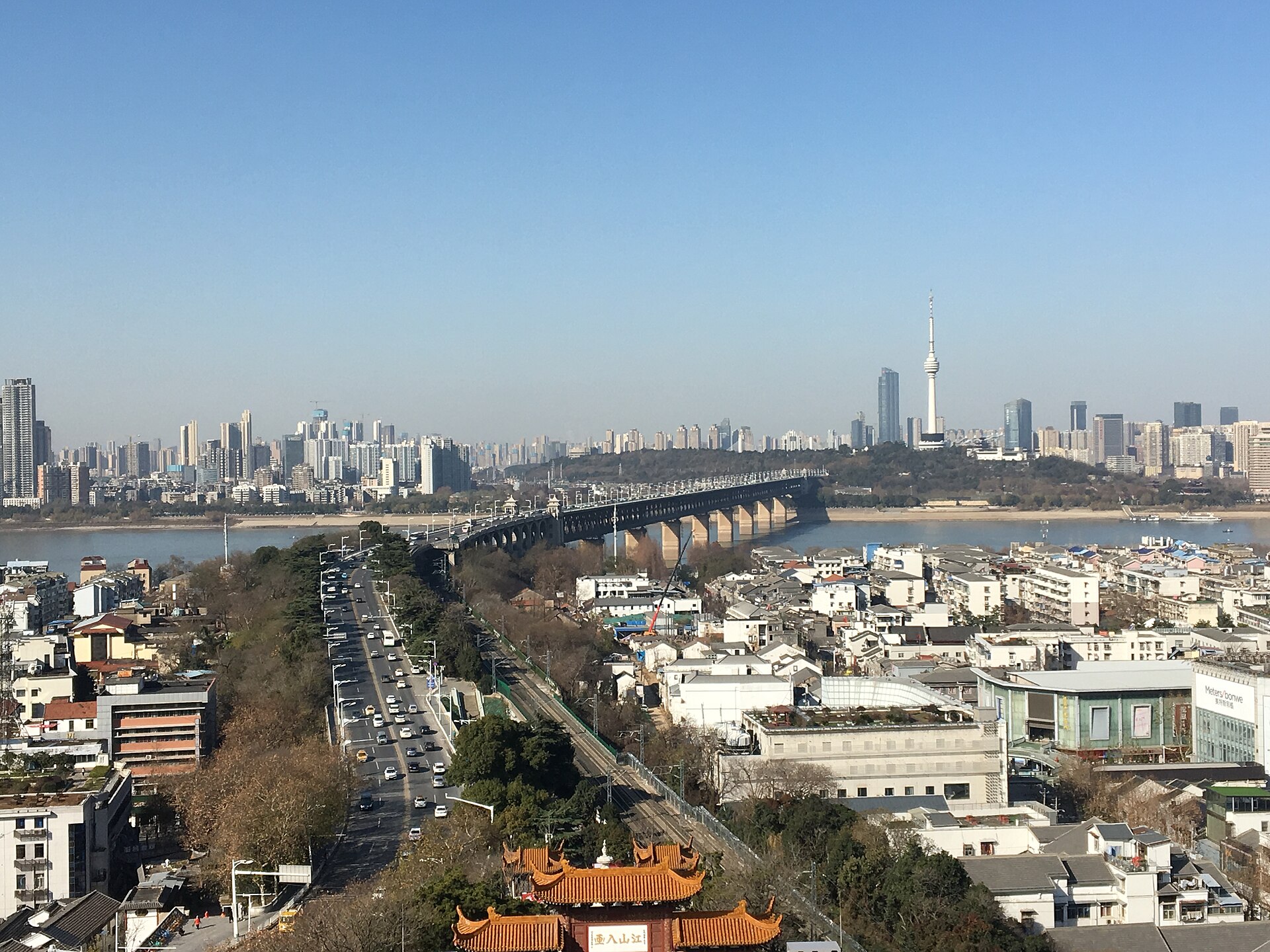
It is also a river city in the literal sense. The First Yangtze Bridge, finished in 1957, was the first bridge to carry a railway across the Yangtze anywhere on its course, and it is still the best place in the city to understand the scale of the river: 1,670 metres of steel truss, with the water below it a kilometre and a half wide. Walk it at dusk, when the traffic is heavy and the fishermen are out.
The reason to give Wuhan a day rather than a change of trains is the water quality story. The Yangtze finless porpoise — the only freshwater porpoise left — was down to about a thousand animals nationally a decade ago. The 2022 survey counted 1,249, and animals are now recorded in the Wuhan section for the first time in years. Twenty to thirty live in or near the city. You will probably not see one; knowing they are there changes the walk along the bund.
A museum, a lake, a bridge and the riverbank.
Sixty-five bronze bells cast around 433 BC, dug out of a tomb at Suizhou in 1978, still playable, and displayed with the lacquerware and bronze that came out with them. The best single room in the province.
A lake in the city with a causeway, a botanic garden and a shoreline of paths. The place Wuhan goes at weekends, and the easiest half-day if the weather is good.
Cross on foot from Wuchang to Hanyang, then walk the Hankou bund at dusk: the old customs house, the colonial banks, and the ferries still running.
The city runs patrols and a rescue base for stranded animals, and the riverbank at the bridge is the usual place to look. Ask before promising a sighting; they are wild and few.
Two furnaces and a short spring.
Cherry blossom at Wuhan University and on the East Lake causeway, mild temperatures, and the best two months to walk the city.
Hot and humid, one of the hottest cities in China, with the plum rain in June and July. Do the museum at midday and the river at night.
The best autumn window: dry, clear, and comfortable. The reeds on the riverbanks turn and the light is good.
Cold, damp and grey, with occasional snow. The city is quiet, the museum is empty, and the river is at its most atmospheric.
An airport, three stations and one bridge.
Wuhan has three main stations: Hankou for the north-west line to Shiyan and Wudang, Wuchang for the conventional lines and the south, and Wuhan station for the Beijing–Guangzhou high-speed line. Check which one your ticket uses.
Tianhe is 25 kilometres north of the city, connected by metro line 2. Allow an hour to Hankou, more at rush hour.
A day is enough for the museum, the bridge and one lake. Two days lets you add the old Hankou streets and a ferry crossing at sunset.
What came out of the tomb at Suizhou.
The set is tuned to a five-octave range, cast in a single piece per bell with two distinct pitches depending on where it is struck. It is the reason the museum exists in its current form.
Hubei was the heart of Chu, and the Chu aesthetic — lacquer red and black, antlered bronze, flying figures — is unlike anything else in Chinese Bronze Age art. The museum’s Chu galleries are the place to see it.
The Wuchang uprising that ended the imperial system started here in October 1911. The site is a red-brick compound near the river, and it explains a lot about how the city sees itself.
Heat, bridges and museum bookings.
The Hubei Provincial Museum is free but requires a timed reservation, and the bells gallery fills first. Book two or three days ahead in season.
In July and August the city routinely runs above 35 degrees with high humidity. Plan indoor mornings and river evenings, and do not schedule a long walk for 14:00.
Once by bridge and once by ferry. The ferry costs a few yuan, takes ten minutes, and is the only way to see the two banks as one city.
Tell us whether you are arriving, leaving or both, and how long you have between trains. Wuhan works as a day if the day is built around the museum.
Start my journey brief ↗