Seventy-two peaks arranged around one summit, and two hundred Ming buildings arranged around the roads that climb to it. The mountain the Yongle emperor built to legitimise himself.
Wudang is a block of metamorphic rock with a single quartzite summit, Tianzhu Peak, at 1,612 metres, and 72 lesser peaks arranged around it in a pattern that Chinese geomancy read as ministers facing an emperor. The name of the effect is 万山来朝 — ten thousand mountains coming to court — and once you have stood on the summit at dawn you stop thinking of it as a metaphor.
What makes the mountain a World Heritage site is not the rock. In 1412 the Yongle emperor — who had taken the throne from his nephew and needed a mandate — declared Zhenwu, the Perfected Warrior, his protector, and sent 300,000 soldiers and labourers to build on the mountain where Zhenwu was said to have attained immortality. Over eleven years they put up nine palaces, eight abbeys, 36 hermitages and 72 cliff shrines, strung along 70 kilometres of pilgrim road. Two hundred structures survive, with 50,000 square metres of building on a site of roughly a square kilometre of consecrated ground.
The result is unusual among Chinese mountains: a landscape where the architecture is the reason to come and the walking is how you see it. The summit complex, the cliff-hung Nanyan palace and the valley floor Zixiao palace are all Ming, all in use, and all reached on foot or by a combination of shuttle bus, cable car and stairs.
What to explore.
Four pieces of one pilgrimage, from the valley to the summit.
The Golden Summit
1,612 m · the hall of 1416
A small gilded bronze hall on the very top of Tianzhu Peak, cast in 1416 and the largest of its kind in China, with the bronze statues inside it cast by the lost-wax method. The last climb is a steep stone stair through three gates.
Nanyan Palace
The cliff · 1,000 m
A temple built into an overhanging cliff face, with a beam that projects over the drop and a stone dragon head beyond it. The most dramatic single building on the mountain, and the one most photographed.
Zixiao Palace
The valley · the working centre
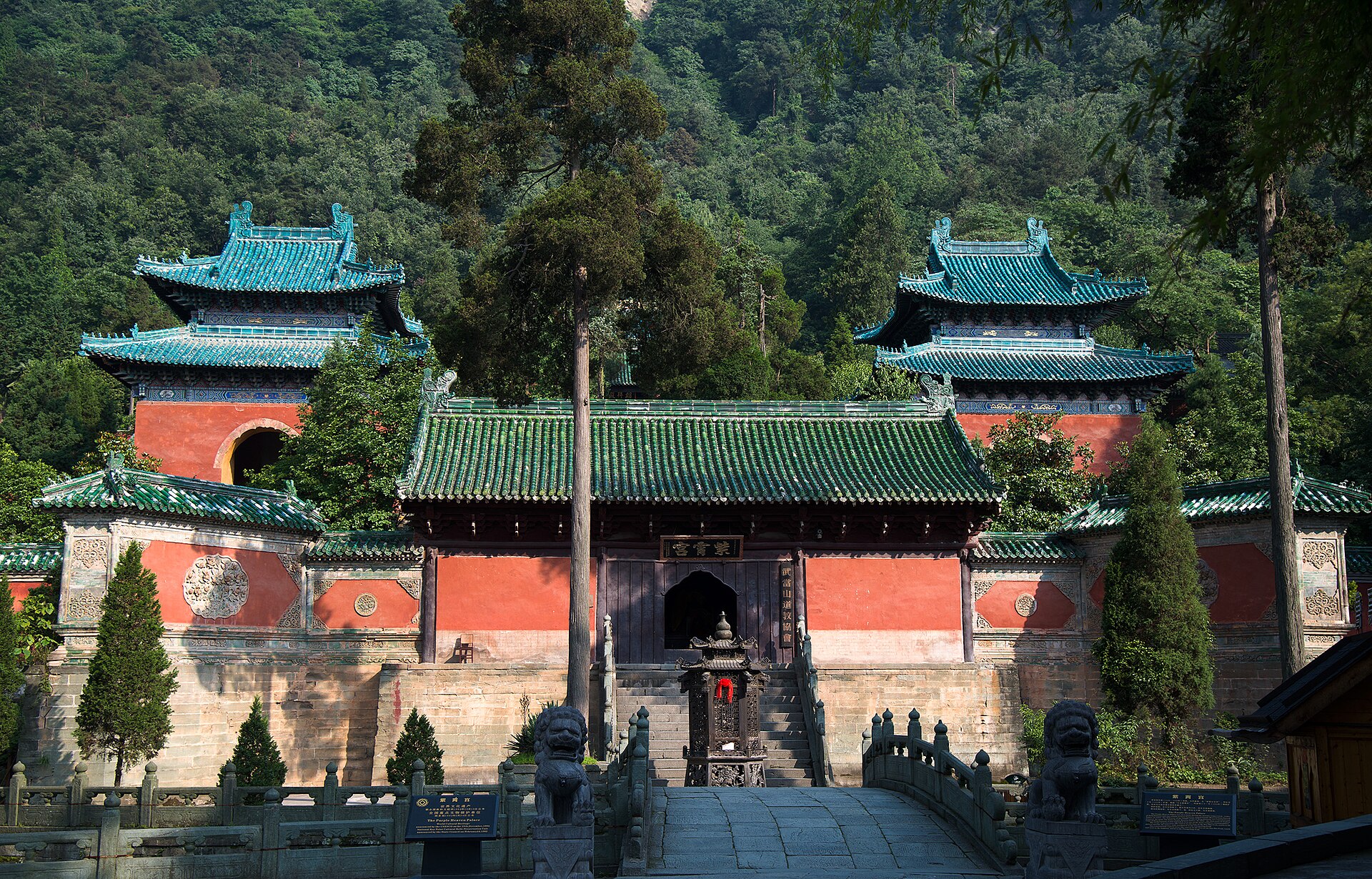
The largest surviving palace, on the valley floor in a bowl of forested cliffs: green tiles, red walls, two pavilions flanking the gate. This is where the Daoist community and the morning rites are.
Taizi Slope & the Yuxu ruins
The lower road
Fuzhen temple on the slope where Zhenwu is said to have begun his training, and the vast, roofless platform of Yuxu Palace — a Ming palace reduced to a base, a gate and a very large silence.
When to go.
Spring and autumn for the walking, winter for the mountain itself.
March – May
The best walking weather: cool, green, and the pilgrim season building. The climb to the summit is comfortable and the valley is at its best.
June – August
Hot and wet, with the heaviest visitor numbers, because Wudang doubles as a summer resort for the plain. Early mornings are the only quiet hours.
September – November
Clear, dry and the second-best window, with colour on the lower slopes in late October. The Daoist festivals cluster in this period.
December – February
Snow on the summit and ice on the upper stairs, few visitors, and the mountain at its most austere. The cable car can close in wind; the stairway stays open.
Plan the journey.
A high-speed station, one gate, and three ways up.
Getting there
Wudangshan West station opened with the Wuhan–Shiyan high-speed line in November 2019: about two hours from Wuhan, half an hour from Shiyan. The gate and the town are a short taxi from the station.
The gate and the buses
Private cars stop at the gate. Green shuttle buses run from there to the two cable car bases and to Nanyan, on a loop that takes most of an hour end to end.
Three ways to the summit
The cable car from Qiongtai, the cable car from the other side, or the pilgrim stairs from Nanyan through the three gates. Most people go up one way and down another; the stairs are the reason to come.
Zhenwu and tai chi.
Why this mountain is the one the martial arts claim.
The god
Zhenwu, the Dark Warrior of the north, is said to have cultivated here for forty-two years. The Ming state made his cult official, and the mountain’s architecture is laid out as a narrative of his progress up it.
The martial art
Wudang is the traditional home of the internal schools, attributed to Zhang Sanfeng, a semi-legendary figure of the late Yuan and early Ming. Whether or not he taught here, the mountain has been the brand name of Chinese internal martial arts for six centuries.
The music
Wudang Daoist music is on the national intangible heritage list, and the morning rites at Zixiao are sung rather than chanted. It is worth timing a visit around them.
Before you go.
Steps, queues and the cold at the top.
It is a stair mountain
The pilgrim route from Nanyan to the summit is several thousand steps, in sections that are steep and narrow. Knees decide more itineraries here than fitness does.
Cable car queues
Between 09:00 and 11:00 in high season the queue at the main cable car can cost an hour and a half. Go up on the first bus or walk up and ride down.
The summit is cold and exposed
At 1,612 metres with wind, the top is 6 to 8 degrees colder than the valley. In winter the stairs ice over and the cable car stops in high wind.
Tell us whether you want to walk the pilgrim stairs or ride, and whether the summit night matters. That decides which side of the mountain you sleep on.