
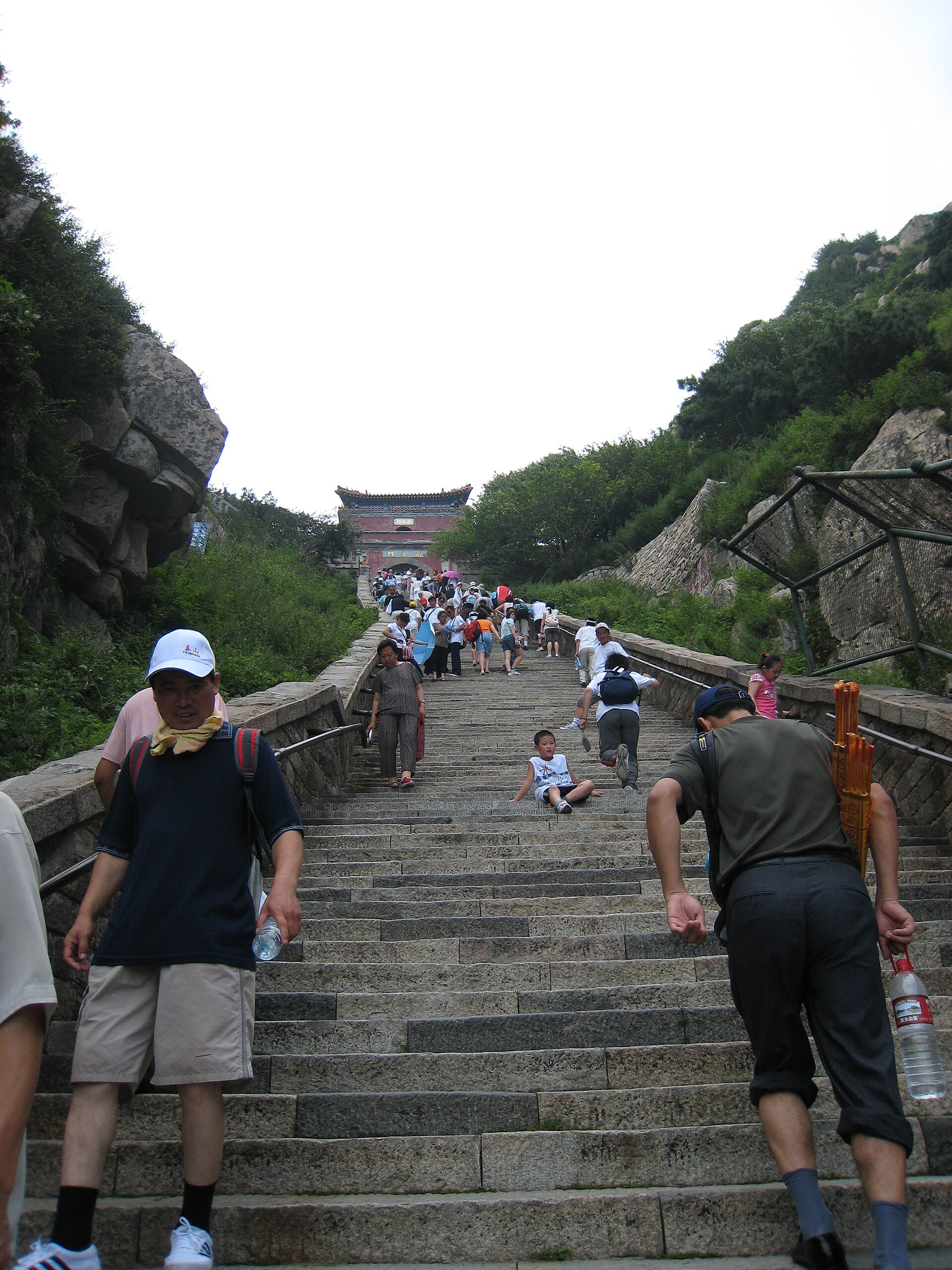
Every civilisation that has mountains eventually makes some of them holy. China made a system of it: five "Great Mountains" appointed by imperial decree, four Buddhist sacred peaks, four Daoist ones, and a supporting cast of hundreds — all of them climbed, most of them for millennia, and every one of them reached by stairs. To hike in China is to walk in the footsteps of emperors, pilgrims and poets, usually on stone they laid.
The Five Great Mountains
The system is old — the Five were formalised two thousand years ago, one for each cardinal direction plus the centre. Taishan in the east is the most august, the mountain where emperors came to report their reigns to heaven. Huashan in the west is the most dramatic, a blade of granite. Hengshan in the north (Shanxi) is the cold, hanging-temple one; Hengshan in the south (Hunan) is the Daoist pilgrim mountain of 72 peaks; Songshan in the centre is Shaolin’s mountain. None of them is the highest mountain you will ever climb. All of them are among the most significant.
Taishan, the stairway
Taishan is a stair with a mountain attached: some seven thousand stone steps from the red gate at the foot to the temples on the summit, carved through 1,545 metres of history. The classic way to climb it is at night, joining the stream of pilgrims who have always climbed in the dark to reach the summit for sunrise — the itinerary takes a weekend, and the sunrise takes the pain away. Read the full guide: night up Mount Tai.
Huashan, the blade
Huashan is the opposite temperament: five granite peaks, ridges so narrow that "the road" is sometimes a plank bolted to a cliff. It is the most physically dramatic climb of the Five, and its fame predates the cable cars by two thousand years — the old saying goes that there was one road up Hua since the beginning of roads. Our guide to the Five Peaks ridge walk explains what the planks and chains are actually like.
The Buddhist and Daoist peaks
Beyond the imperial five, the religious mountains offer their own kind of walking: Emei Shan in Sichuan, its summit monkeys and golden Buddha above three thousand metres of forest; Wutai in Shanxi, the high plateau of five flat terraces; Putuoshan, the sea-island mountain; Jiuhua in Anhui. The Daoist quartet — Wudang among them — trades incense for architecture. And then there are the mountains outside the system entirely, like Wuyi Shan with its river gorge and tea cliffs, sacred in a quieter way: the boundary ridge guide.
Choosing your mountain
The honest rule: choose by temperament, not altitude. Taishan is history and crowd communion — climb it for the ritual. Huashan is exposure and adrenaline — climb it for the fear, managed. Emei and Wutai are pilgrimages — climb them for the days, not the sunrise. And Wugongshan, not sacred at all, is the meadow ridge that answers a different question entirely. Whichever you choose, the stairs are older than every country in the West. That is the feeling that stays.
Where this leads
Night up Mount Tai
Hua, the vertical mountain
Wuyi Shan, the boundary ridge