
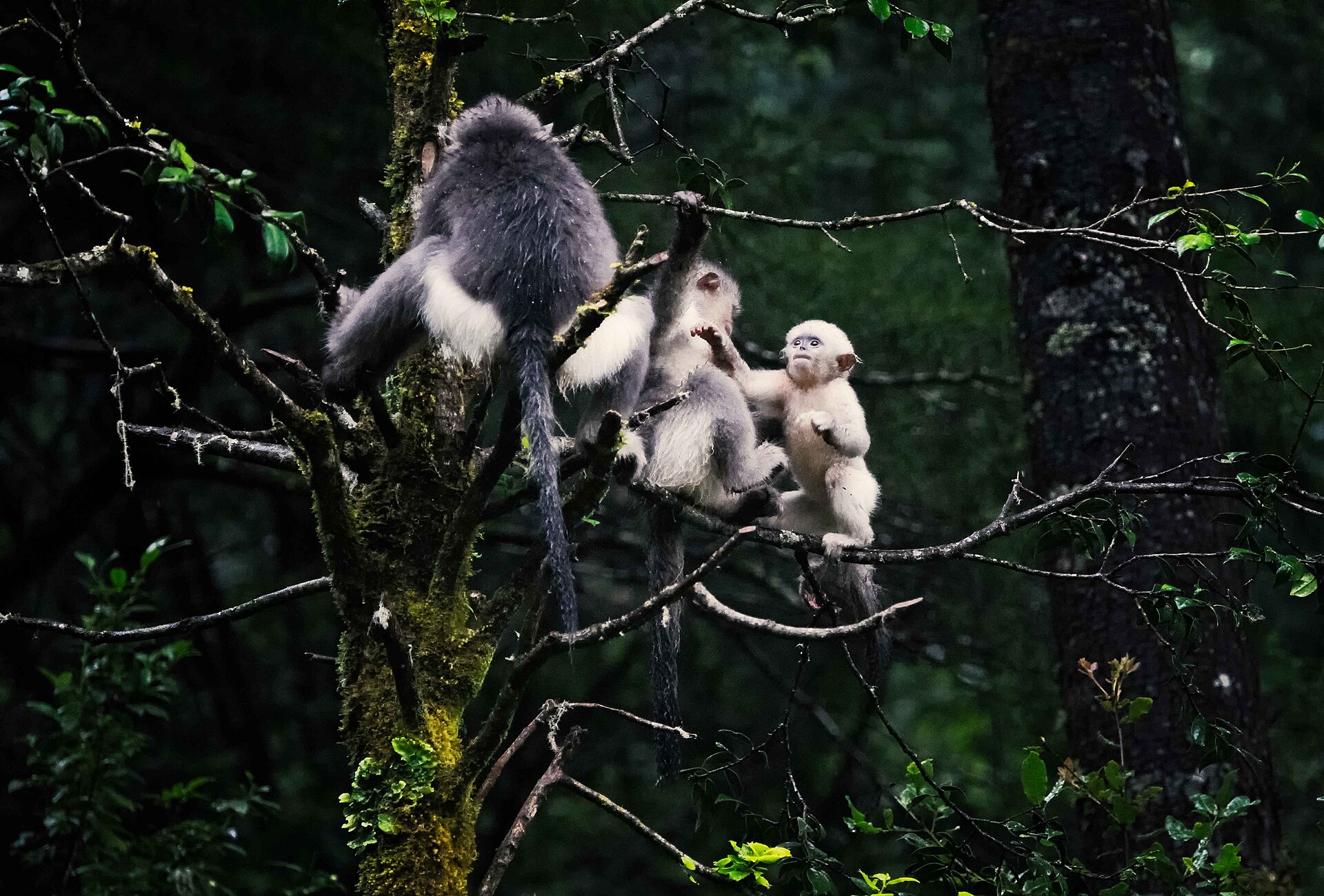
China has five snub-nosed monkeys. Travellers will realistically meet two, and they could hardly be more different animals — which is exactly why the pair makes such a good trip. The golden snub-nosed monkey is the celebrity of the Sichuan mountains, blue-faced and gold-shouldered, living in big multi-layered troops through panda country. The Yunnan snub-nosed monkey is its obscure, endangered cousin: black and white, bearded, pink-lipped, and committed to a life higher in the firs than any other non-human primate on earth.
One genus, two lives
Both belong to the genus Rhinopithecus, the snub-nosed monkeys — cold-adapted primates whose flat faces are an adaptation to freezing air, and whose diets lean heavily on lichen and conifer. The golden species ranges across the Sichuan, Shaanxi, Gansu and Hubei mountains, with perhaps twenty thousand animals across its fragmented range; it is Vulnerable, and its strongholds — Tangjiahe, Wanglang, Baihe — are reserves a traveller can visit. The Yunnan species, R. bieti, is a single Chinese endemic confined to a corridor between the Yangtze and Mekong in far north-west Yunnan and adjacent Tibet. Roughly three thousand survive. It is Endangered, and more than seventy percent of the world population lives inside one reserve: Baima Snow Mountain.
The golden: Sichuan’s showman
Golden monkeys are the easier watch and the bigger spectacle. In the right valleys — Xiapingdi at Baihe above all — troops numbering well over a hundred animals move through the canopy around visitors, and a morning produces the classic images: blue faces in the firs, golden mantles in motion, juveniles tumbling. The species shares its forest with pandas, takin and red pandas, which is why a Sichuan monkey trip is usually a mammal trip with the monkeys as the headline act.
The Yunnan: the high-living specialist
The Yunnan monkey lives at 3,200 to 4,600 metres — higher than any other non-human primate — and spends much of the year out of sight in cloud forest. Its entire world is lichen: the pale usnea hanging from the firs, which gives the species both its food and its local nickname, since a face half-covered in the stuff looks bearded. Only one valley offers a reliable window: Xiangguqing near Tacheng, where ranger teams have spent decades earning a wild troop’s tolerance. Between nine and eleven each morning, from an open meadow at about 3,000 metres, the troop’s families come down through the firs. Sixty-nine animals, nine to eleven family units, metres away — a wild encounter that feels impossible and is entirely real.
Watching both, honestly
The two watches differ in texture. The golden watch is abundance: a hundred animals in the canopy, constant motion, easy light. The Yunnan watch is intimacy: fewer animals, closer, slower, and framed by the knowledge of exactly how rare what you are looking at is. They also differ in logistics — Sichuan’s sites sit on a compact circuit east of the plateau; Tacheng requires the high road from Lijiang or Shangri-La. But they chain: Chengdu to the Sichuan reserves, across to Shangri-La, down to Tacheng, and the two monkeys — and two mountain worlds — in one overland journey.
Where these lead
The golden snub-nosed monkey guide
The Yunnan snub-nosed monkey guide
The Tacheng monkey tour