Sanhuangzhai
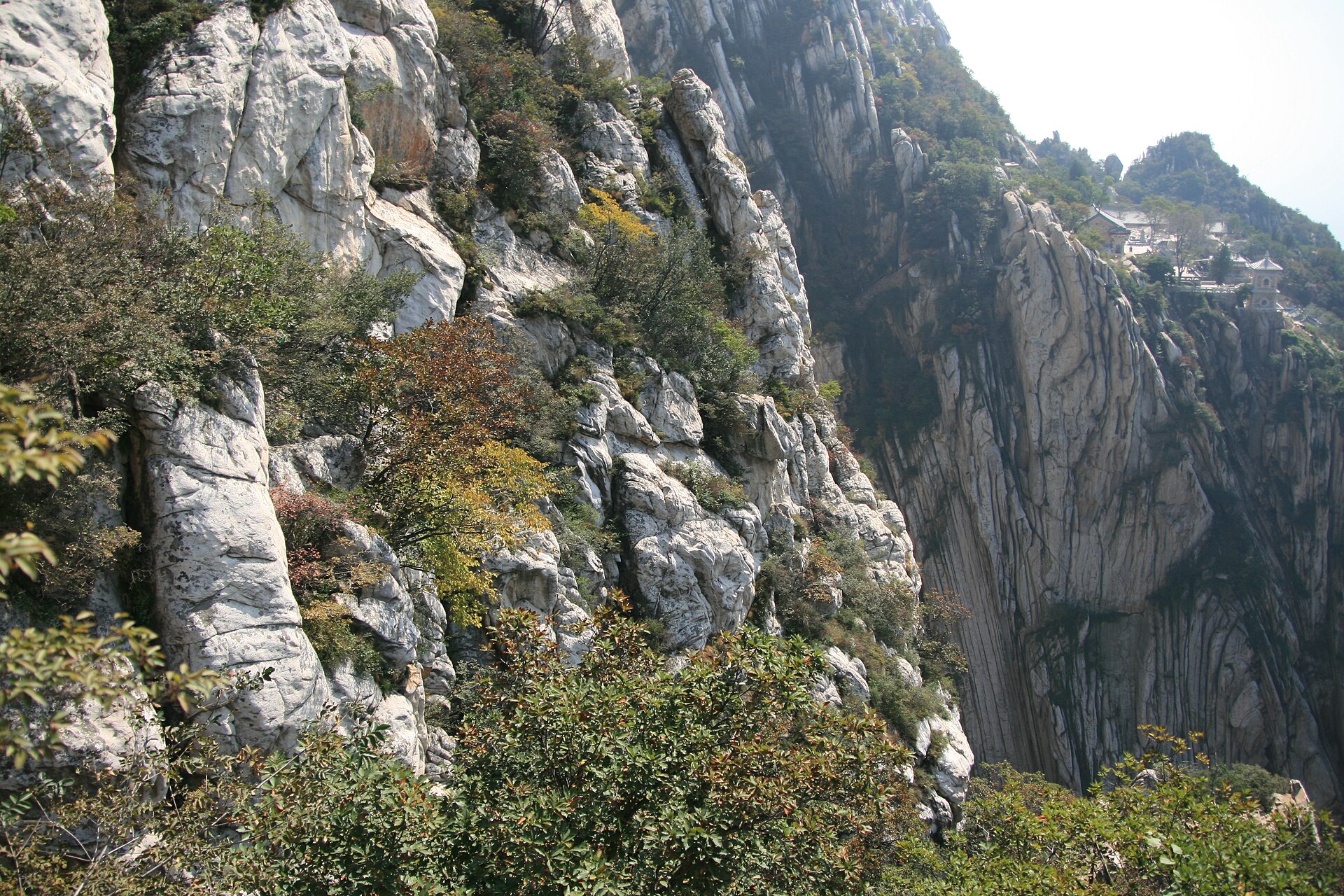
The western cliffs of Shaoshi: a walkway pinned to a vertical wall, with the “book pages” — a stack of thin quartzite slabs standing on edge — above it and the valley below. The best half-day of walking on the mountain.
 Start your enquiry
Destinations / Henan / Songshan
The mountain in the middle: 1,491.7 metres above a plain that has been the centre of Chinese politics for three thousand years, with a plank road on its western cliffs and eight clusters of buildings UNESCO listed in 2010.
Explore the guide ↓Central Henan · Dengfeng · 1,491.7 m
Songshan is two massifs, not one. Taishi to the east carries the main summit, Junji Peak, at 1,491.7 metres. Shaoshi to the west is slightly higher at 1,512 on Liantian Peak, and much steeper: a wall of quartzite towers above the Shaolin valley, with a plank road pinned to its face. Between them is a pass, and the county town of Dengfeng sits under it.
The geology is the reason it is a geopark. The rock here records an unusually complete sequence from the Archaean to the Cenozoic — five eras stacked in one place, which Chinese geologists call “five generations under one roof”. The quartzite towers of Shaoshi are the visible part of it: near-horizontal beds lifted and fractured into blocks that stand as vertical fins, which is why the plank road can be bolted to a wall that runs for kilometres.
But what Songshan is famous for is not the rock. It is the position: the Central Mountain of the five sacred peaks, the one that stands in the middle of the plain where the dynasties were, and the place where Buddhism, Daoism and Confucian scholarship ended up on the same mountain without killing each other. In 2010 UNESCO listed eight clusters of buildings around it — the “Centre of Heaven and Earth” — which is the most compact summary of Chinese cosmology available as a walking route.
The cliff, the summit, the academy and the observatory.
The western cliffs of Shaoshi: a walkway pinned to a vertical wall, with the “book pages” — a stack of thin quartzite slabs standing on edge — above it and the valley below. The best half-day of walking on the mountain.
The main summit, climbed from Songyang Academy by a long stone stair through pine. The top is a platform with a view over the whole plain, and a small shrine that has been there for a very long time.
A Northern Song academy where Cheng Hao and Cheng Yi taught, and where the Cheng-Zhu school of neo-Confucianism was formulated. Two cypresses in the courtyard are said to have been named by Emperor Wu of Han.
The Gaocheng observatory, built in 1276 for Guo Shoujing’s calendar reform, is the oldest surviving astronomical platform in China. Zhongyue Temple below the mountain is the largest of the five sacred-peak temples.
A hot plain, a cool rim, and a short autumn.
The best walking window: cool, green, and the peony season in nearby Luoyang from mid-April. The stairs are at their most comfortable.
Hot and humid on the plain, with thunderstorms on the summit in July. Start at first light; the rock holds the heat until dark.
The best month: dry, clear, and the deciduous cover on Shaoshi turning. The plank road is at its best in October light.
Cold, dry and often hazy below. Snow on the summit is rare but ice on the north-facing stairs is not. Quiet, and the temples are at their most atmospheric.
Two mountains, two gates, one county town.
Dengfeng is about 1.5 hours from Zhengzhou by road and an hour from Luoyang. There is no station in the town itself; the high-speed stops are at Zhengzhou East and Luoyang Longmen.
Taishi and Shaoshi have different gates, different tickets and no through path. Songyang Academy and Junji Peak are on one; Shaolin, Sanhuangzhai and the plank road are on the other.
One day for Shaoshi — the monastery, the pagoda forest and the plank road — and one for Taishi, the academy and the summit. Trying to do both in a day means a cable car and no walking.
Why this mountain got to be the middle one.
The sacred mountains of China are arranged as a diagram of the state: east, south, west, north and centre. The centre is the one that legitimises the others, and Songshan has held that position since at least the Zhou.
The only woman to reign as emperor performed the feng and shan sacrifices here rather than at Taishan, and renamed the county Dengfeng — “ascending to perform the sacrifice”. The name has stayed for thirteen centuries.
A Buddhist monastery, a Daoist temple and a Confucian academy within a few kilometres of each other, all still working. The usual Chinese phrase for it is that the three teach the same thing by different routes; the buildings suggest they simply agreed to share the mountain.
Stairs, heat and which mountain you are on.
The commonest wasted morning in Dengfeng is arriving at the wrong mountain. Shaolin and the plank road are south-west of town; the academy and the summit are north.
Sanhuangzhai is a real walkway on a real wall, with drops of a hundred metres and handrails that are sometimes a cable. It is not via ferrata and it is not a stroll; both directions are stairs.
May Day and the first week of October turn the plank road into a queue. The mountain is big enough that this is tolerable, but the cable car is not.
Tell us whether you want the plank road or the summit, and whether the temples are the point or the excuse. Songshan rewards two days and punishes one.
Start my journey brief ↗