The Changzhu Yuan
The monastery itself: the gate, the Hall of Heavenly Kings, the Mahavira Hall, the library, the abbot’s room, the Standing in Snow pavilion and the Hall of a Thousand Buddhas with its 300 square metres of Ming murals.
 Start your enquiry
Destinations / Henan / Shaolin
A monastery founded in 495, a forest of 240 brick stupas behind it, and the most famous martial art in the world invented outside its gate.
Explore the guide ↓Central Henan · Dengfeng · under Shaoshi
Shaolin was built in 495 by the Northern Wei emperor Xiaowen for an Indian monk called Batuo, on the north slope of Shaoshi, with a stream in front and a cliff behind. For the next fifteen centuries it was a working monastery with a violent history: sacked, burned, rebuilt, and patronised by emperors who wanted its fighting monks as much as its prayers.
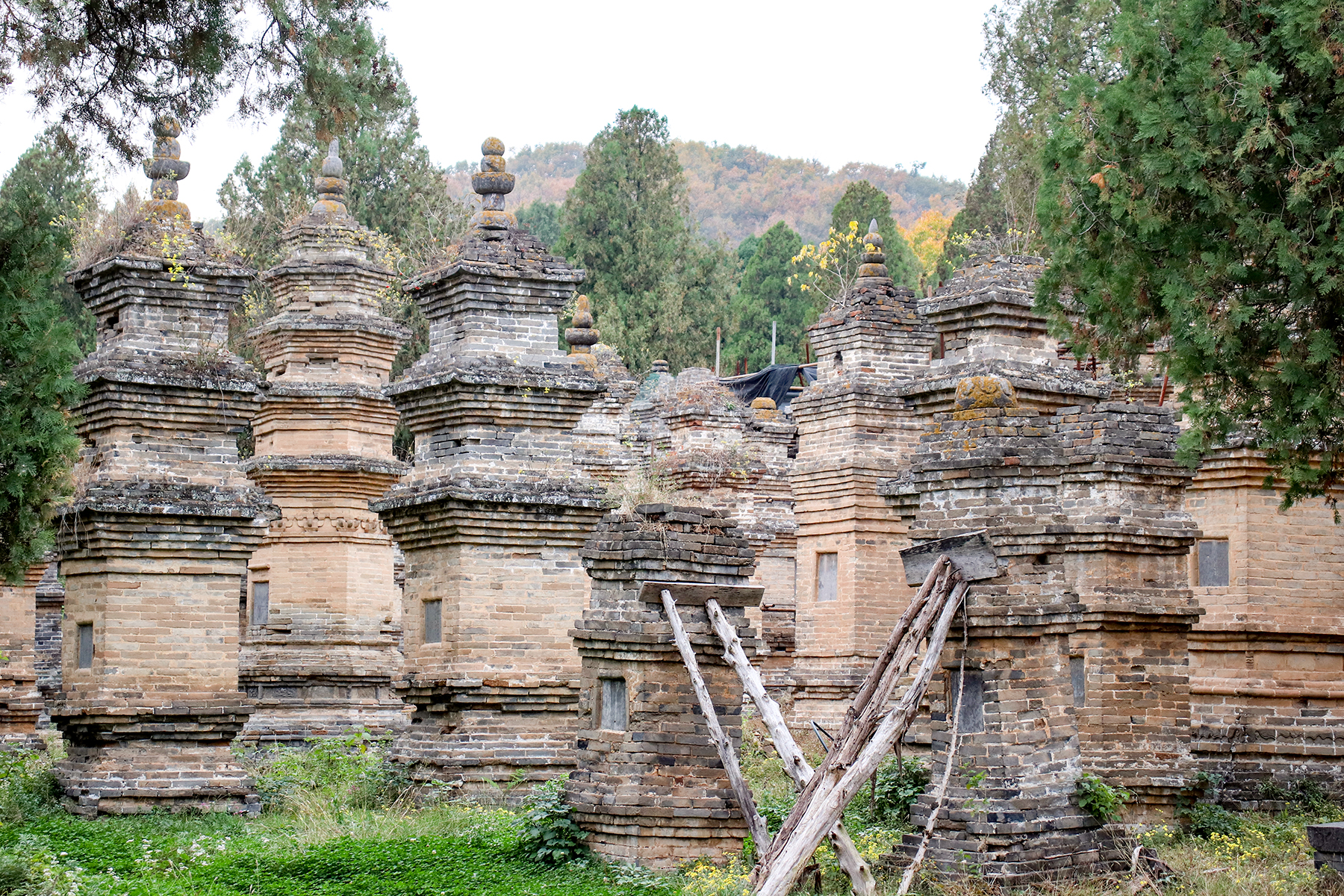
What survives is the compound and the cemetery. The Changzhu Yuan is 300 metres deep and 120 wide, seven halls on a rising axis with 22.6 metres of climb from gate to the Hall of a Thousand Buddhas, and a set of Ming and Qing halls that still function as a monastery. Behind it, across the stream, the pagoda forest holds more than 240 brick stupas built between the Tang and the Qing: the largest and most complete such group in China, and effectively a stone archive of who taught here and when.
The thing to be clear about before you go is that the kung fu is not in the monastery. The martial art is real, it is taught in the schools in the valley around Dengfeng, and the connection to the monastery is historical rather than operational. Inside the walls you get the halls, the stupas, the incense and a demonstration for tourists. Outside you get several thousand teenagers running uphill at six in the morning. Both are worth seeing, and they are not the same experience.
The halls, the stupas, the cave and the schools.
The monastery itself: the gate, the Hall of Heavenly Kings, the Mahavira Hall, the library, the abbot’s room, the Standing in Snow pavilion and the Hall of a Thousand Buddhas with its 300 square metres of Ming murals.
The burial ground behind the monastery, with stupas from the Tang to the Qing in brick and stone, each recording a name, a date and a sect. The best hour of the visit, and usually the quietest.
The cave on the cliff above where Bodhidharma is said to have sat facing the wall for nine years, reached by 300 steps. Below it, the First Patriarch Nunnery holds the oldest timber building on the mountain.
Dozens of academies around Dengfeng teach full-time students, some of them boarding from childhood. The morning runs and the training yards are visible from the road, and are the honest version of the thing the monastery sells.
Any month, but not any hour.
The best weather for the compound and the cliff: cool, green, and the peonies in Luoyang an hour away from mid-April.
Hot and humid, with the valley full of summer camps and the demonstration hall packed. Go at opening, at seven, and be out by ten.
The best month for the pagoda forest, which is at its most photogenic under autumn light. October is busy but the site absorbs it.
Cold and quiet. Snow on the stupas is the best version of the place, and the halls are almost empty on weekday mornings.
One valley, one ticket, and a cable car to the cliffs.
Dengfeng is 1.5 hours from Zhengzhou by road and an hour from Luoyang. The Shaolin gate is 13 kilometres west of the town, with buses and taxis from the centre.
One ticket covers the compound, the pagoda forest and the shuttle up the valley. The cable car to Sanhuangzhai and the plank road is separate, and is the reason to give the valley a full day.
Short kung fu demonstrations run several times a day in a hall beside the compound, included in the ticket and over in twenty minutes. They fill early; take a seat ten minutes before.
Two things that grew in the same place and then separated.
The semi-legendary Indian monk who brought Chan Buddhism to China and is said to have sat in a cave here for nine years. The wall-facing meditation is the origin story of the school; the fighting is a later accretion.
The story that thirteen Shaolin monks saved the future Tang emperor Li Shimin in the seventh century is the founding myth of the monastery’s martial reputation. It is carved, painted and filmed; the historicity is thinner than the iconography.
Dengfeng’s economy is martial arts. The schools take students from across the country, teach wushu as a sport and a curriculum, and produce the performers who tour the world. Watching a training session is more informative than watching a show.
Crowds, cameras and the commercial strip.
The gate opens at seven in season and the tour buses land at nine. Two hours of relative quiet is the difference between a monastery and a theme park.
No photographs of the Buddha images or the murals, and no flash anywhere. The pagoda forest has no such rule, which is where most people end up taking pictures.
Between the car park and the gate is a kilometre of shops, noodle stands and martial-arts souvenir stalls. It is the least interesting part of the valley; walk it quickly.
Tell us whether the monastery or the martial arts matter more, and whether you want the cliff above it. That decides whether you need a morning or a day.
Start my journey brief ↗