Longmen Grottoes
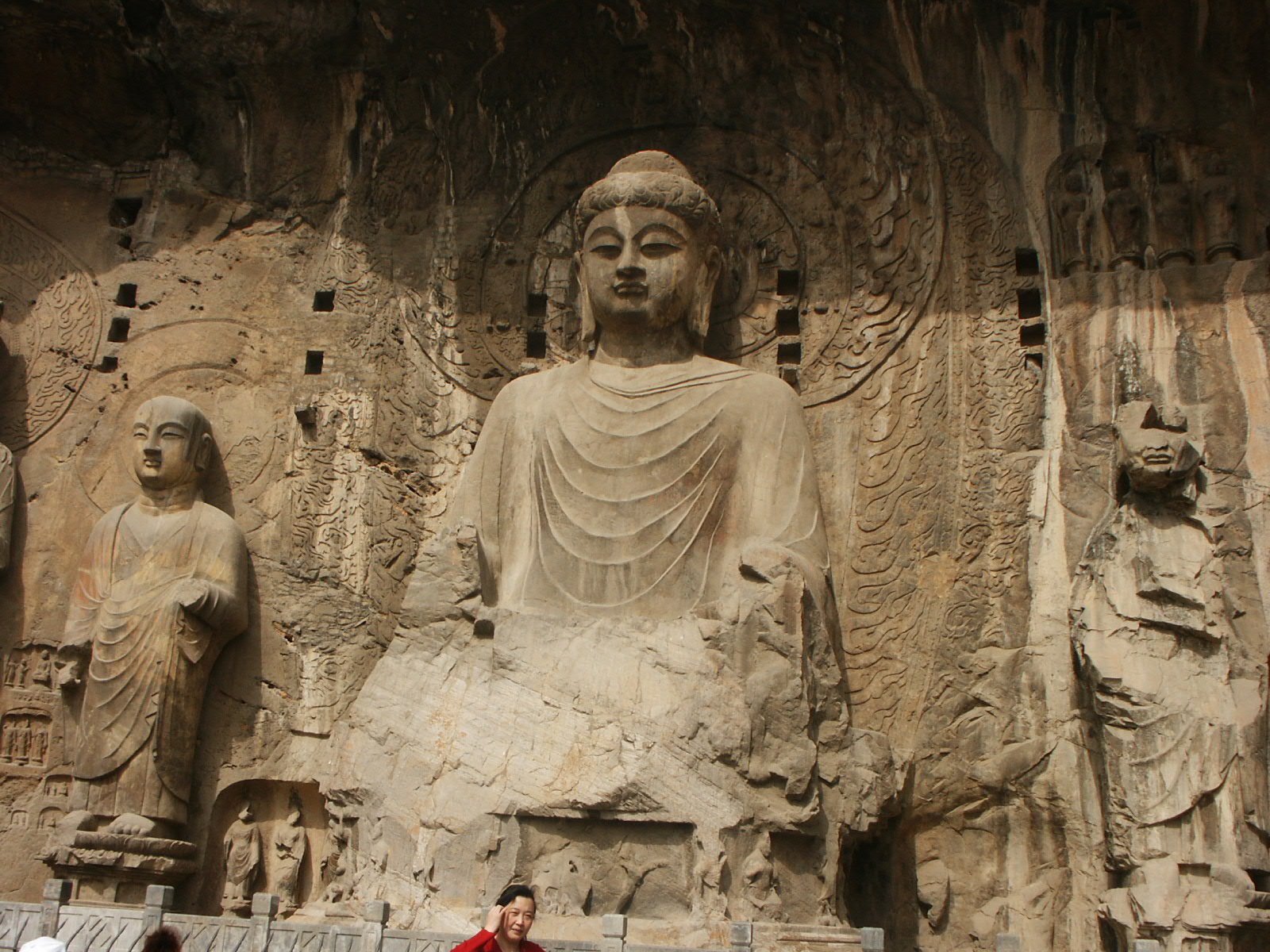
Two river-facing cliffs of caves, best entered at opening time. The night lighting on weekends changes the site completely — ask us which version suits.
 Start your enquiry
Destinations / Henan
Four ancient capitals, the Yellow River’s middle plain and the birthplaces of kung fu, porcelain and Chinese writing. Henan is where the long story starts.
Explore the guide ↓Central China
Henan holds four of China’s great ancient capitals — Luoyang, Kaifeng, Anyang and Zhengzhou — and the ruins of Yin, where oracle-bone writing first appears in the record. This middle plain of the Yellow River is the textbook cradle of Chinese civilisation.
Luoyang’s Longmen Grottoes, UNESCO-listed in 2000, carry some 100,000 Buddhist figures cut into limestone cliffs along the Yi river from the fifth century on; the Fengxian temple’s Vairocana alone stands 17 m.
South of the river rises Songshan, the Central Sacred Mountain, with the Shaolin temple and its pagoda forest at its foot. The mountain-and-monastery ensemble is UNESCO-listed as a historic monument set, and the kung fu training here is real, not a show.
The line from Luoyang through Dengfeng and beyond.
Two river-facing cliffs of caves, best entered at opening time. The night lighting on weekends changes the site completely — ask us which version suits.
The monastery, the 240-stupa forest behind it, and the training courtyards of the martial schools around Dengfeng.
Trail systems on Shaoshi and Taishi mountains, with the Sanhuangzhai plank road and the Songyang academy, one of China’s four great academies, below.
The White Horse Temple — China’s first Buddhist establishment, traditionally 68 CE — and the Luoyang museum’s Tang figures.
Northern Song capital pleasure-grounds and the Yin ruins with their oracle bones. Both extend the line east when the trip has room.
A four-season plain; spring has one famous spectacle.
Luoyang’s peony festival is centuries old and the city fills for it. Book beds weeks ahead; the flowers repay it.
Dry, warm and practical: the best walking window on Songshan’s trails.
Hot and showery on the plain; the caves and forest walks stay workable with early starts.
Connections, bases and the practical details that hold a good route together.
Zhengzhou is the national rail crossroads: Luoyang 40 minutes, Dengfeng under an hour by road, Kaifeng half an hour east.
Xi’an → Luoyang → Dengfeng → Zhengzhou (or reverse) is the classic corridor. It chains cleanly into our Shaanxi and Shanxi routes.
Luoyang city hotels, Dengfeng guesthouses under the mountain, and a Zhengzhou night before the fast train onward.
Make room for local life, food and cultural encounters.
Shaolin’s schools train thousands of students daily. A morning training session and the pagoda forest beat the staged show for most travellers.
Hui mian braised noodles, Luoyang’s water banquet, Kaifeng soup dumplings poured from a ladle. Plain, hot and excellent.
Ru-ware kilns, Shang bronzes, Tang sancai camels — the museum collections here are national-grade and rarely crowded.
Useful details to discuss when shaping your trip.
Longmen and Shaolin use timed entries in season. We book around the festival weeks, not into them.
Henan pairs naturally with Xi’an (1.5 h by rail) or with Shandong’s Mount Tai. Tell us which direction pulls.
Tell us what draws you — caves, kung fu, the sacred peaks — and we will draw the corridor line that connects them.
Start my journey brief ↗