The Ten-Li Gallery
The granite ridge path through the leaning towers, with boardwalks and stairs, and the best geology in the province. Do it on the way up rather than the way down.
 Start your enquiry
Destinations / Henan / Laojun Mountain
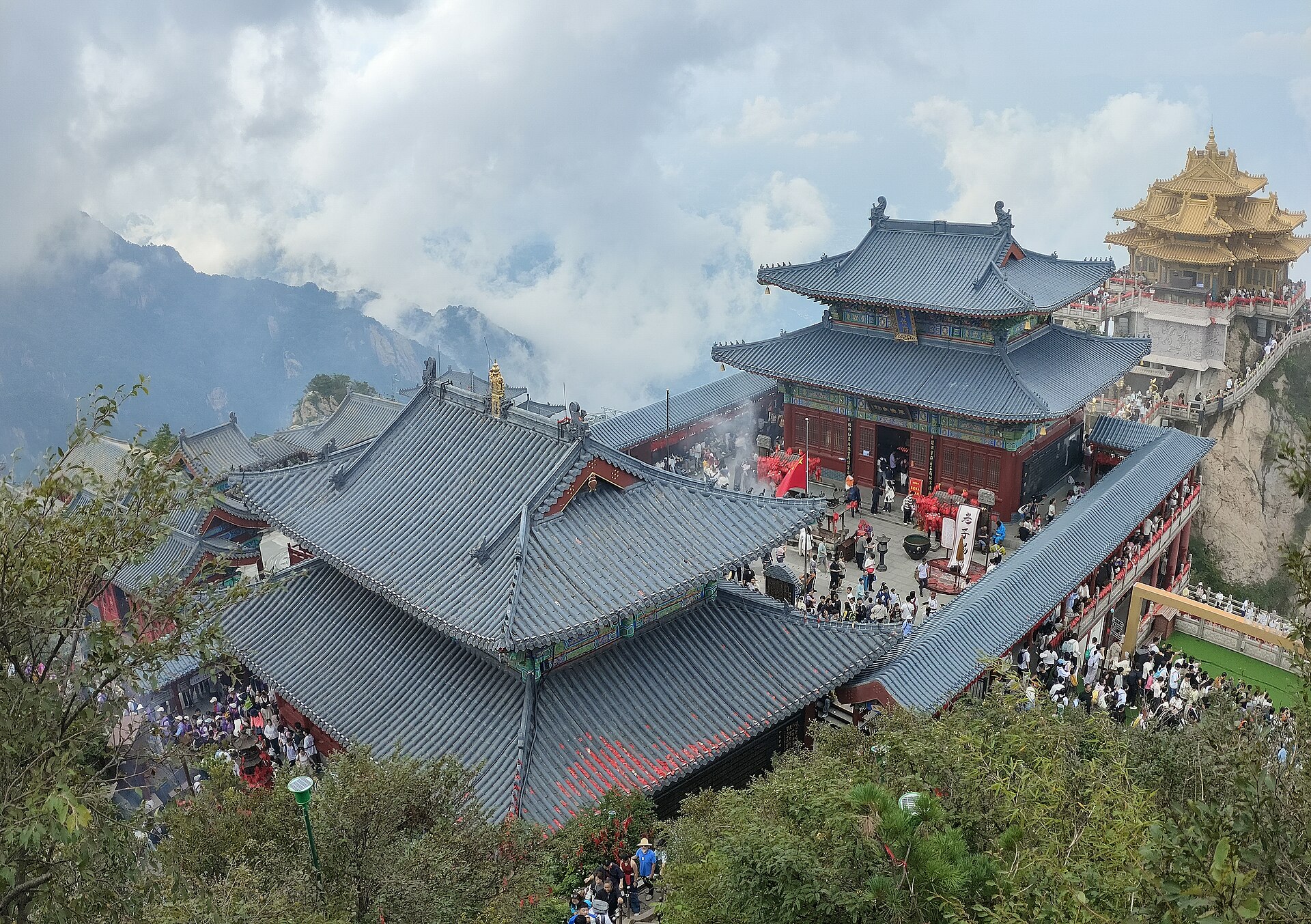
The highest peak of the Funiu range at 2,217 metres, with a forest of granite towers that leans downhill and a group of gold-roofed temples on the summit.
Explore the guide ↓Western Henan · Luanchuan · 2,217 m
Laojun Mountain is the main peak of the Funiu, the range that runs across western Henan and divides the Yellow River basin from the Huai and the Yangtze. The summit is 2,217 metres, and the rock is granite intruded around 100 million years ago and then lifted by the same tectonic pressure that raised the range.
What makes the peak forest unusual is that it is tilted. The granite here was pushed from south to north by a thrust fault, so the towers and fins of the summit ridge lean as a group — geologists describe them as detached slabs that slid and settled rather than as the vertical pillars of Huangshan or the sandstone spires of Zhangjiajie. The three-kilometre ridge walk called the Ten-Li Gallery runs through the middle of it, and it is the reason the mountain is famous.
On top is a walled group of temples, built in the Ming and Qing imperial style, with three gold-roofed pavilions placed on separate points above 2,000 metres: the Laozi hall, the Liangbao terrace and the Jade Emperor peak. The climb is done in two stages by cable car and then by stairs, which is worth knowing before you judge the crowds: this is a summit most visitors reach without walking more than an hour.
The ridge, the summit, the two side valleys.
The granite ridge path through the leaning towers, with boardwalks and stairs, and the best geology in the province. Do it on the way up rather than the way down.
The walled temple group on the top: the Laozi hall, the Liangbao terrace and the Jade Emperor peak, in gold tile and red column, above the cloud on a good morning.
The western valley below the summit, with waterfalls and a much thinner crowd than the cable-car route. A half-day on foot, and the best walking on the mountain.
The scarp above the summit that records the collapse which shaped the peak forest. A short, steep add-on with the clearest view of the tilted strata.
Cloud in June, colour in October, rime in January.
Green, cool and relatively quiet, with the ridges clear more often than in summer. The best walking months on the Ten-Li Gallery.
The cloud season: warm moist air from the south hits the range and produces the sea of cloud the mountain is photographed for. Also the wettest and busiest months.
The best light and the most reliable visibility, with colour on the granite from mid-October. October is the peak month for domestic visitors.
Cold, with rime and snow on the summit and ice on the stairs. The temples above the cloud in winter are the best version of the place, if you can take −10.
Luoyang in, Luanchuan through, two cable cars up.
Luoyang Longmen is the nearest high-speed station. Luanchuan is about two hours south by road, and the park gate twenty minutes beyond the town.
A first cable car from the gate to the middle station, then either a second cable car or the Ten-Li Gallery on foot to the summit ridge. Most people ride both ways; the mountain rewards one of the two on foot.
A full day from Luoyang, or two nights in Luanchuan if you want the summit at sunrise and the valley walk as well.
A philosopher, a religion and a name.
The mountain was called Jingshi Shan until the Tang. It was renamed for Laozi — the Old Master, the traditional founder of Daoism — who is said to have withdrawn here to cultivate. A temple was built on the summit in the Northern Wei, and rebuilt under Tang Taizong in 637.
The summit complex is Ming and Qing imperial style rather than monastic vernacular: yellow tile, red columns, dougong brackets, arranged on three separate rock points. The effect at dawn, above cloud, is the reason the photographs work.
Laojun is a deity as well as a philosopher, and the summit is a pilgrimage destination as much as a scenic one. On the ninth day of the first lunar month and at the mid-autumn festival the stairs are full of people carrying incense.
Cable cars, crowds and no night climbing.
The park has repeatedly banned night ascents and states that it runs no night-climbing programme. Do not plan a pre-dawn walk to the summit; plan a bed near the top or the first cable car.
Two cable cars and a short stair put the temples within reach of everyone, and on a summer weekend the summit platform is genuinely full. Weekdays, or the first car, are the answer.
The summit runs 8 to 12 degrees colder than Luoyang, with wind, and the stairs ice in winter. Even in June the top is a jacket.
Tell us whether you want the summit at dawn and whether you will walk the Ten-Li Gallery. Both answers are about timing, and this mountain is a timing problem.
Start my journey brief ↗