Laoyao Chanau · 2,413.8 m
The province’s highest point, in the Xiaoqinling reserve west of Lingbao, near the Shaanxi border. Forest road, no facilities, and no view on a hazy day.
 Start your enquiry
Destinations / Henan / Altitude
The province runs from 23 metres on the Huai River to 2,414 in the Xiaoqinling. Nothing here needs acclimatisation, and almost everything needs knees.
Explore the guide ↓Central China · 23 m to 2,414 m
Henan’s altitude story is a story about edges. The province is 55 per cent plain, and the plain sits between 23 and 100 metres. All the height is in a half-ring along the northern, western and southern borders: the Taihang in the north, the Funiu and Xiaoqinling in the west, the Tongbai and Dabie in the south.
The highest ground is not where most visitors go. Laoyao Chanau in the Xiaoqinling, west of Lingbao, reaches 2,413.8 metres and is the province’s roof; it is a forest reserve rather than a scenic area, and almost nobody climbs it. The highest mountain with a road, a cable car and a temple on top is Laojun Mountain at 2,217.
That ceiling matters. Two thousand two hundred metres is high enough for rime, cloud and a ten-degree temperature difference, and low enough that altitude sickness is not a factor anywhere in this guide. What replaces it, as in Hubei, is vertical effort on stairs — and in Henan the stairs are usually cut rather than built, which makes them steeper and less even.
Every elevation worth knowing, in one list.
The province’s highest point, in the Xiaoqinling reserve west of Lingbao, near the Shaanxi border. Forest road, no facilities, and no view on a hazy day.
The main peak of the Funiu, reached by two cable cars and a stair. The highest summit in the province with visitor infrastructure.
The Yuhuang summit in Songxian, the second of the Funiu peaks and the highest road-accessible point in the range.
The highest point of the Taihang inside Henan, above Jiyuan. The rest of the Henan Taihang rim sits between 1,500 and 1,739.
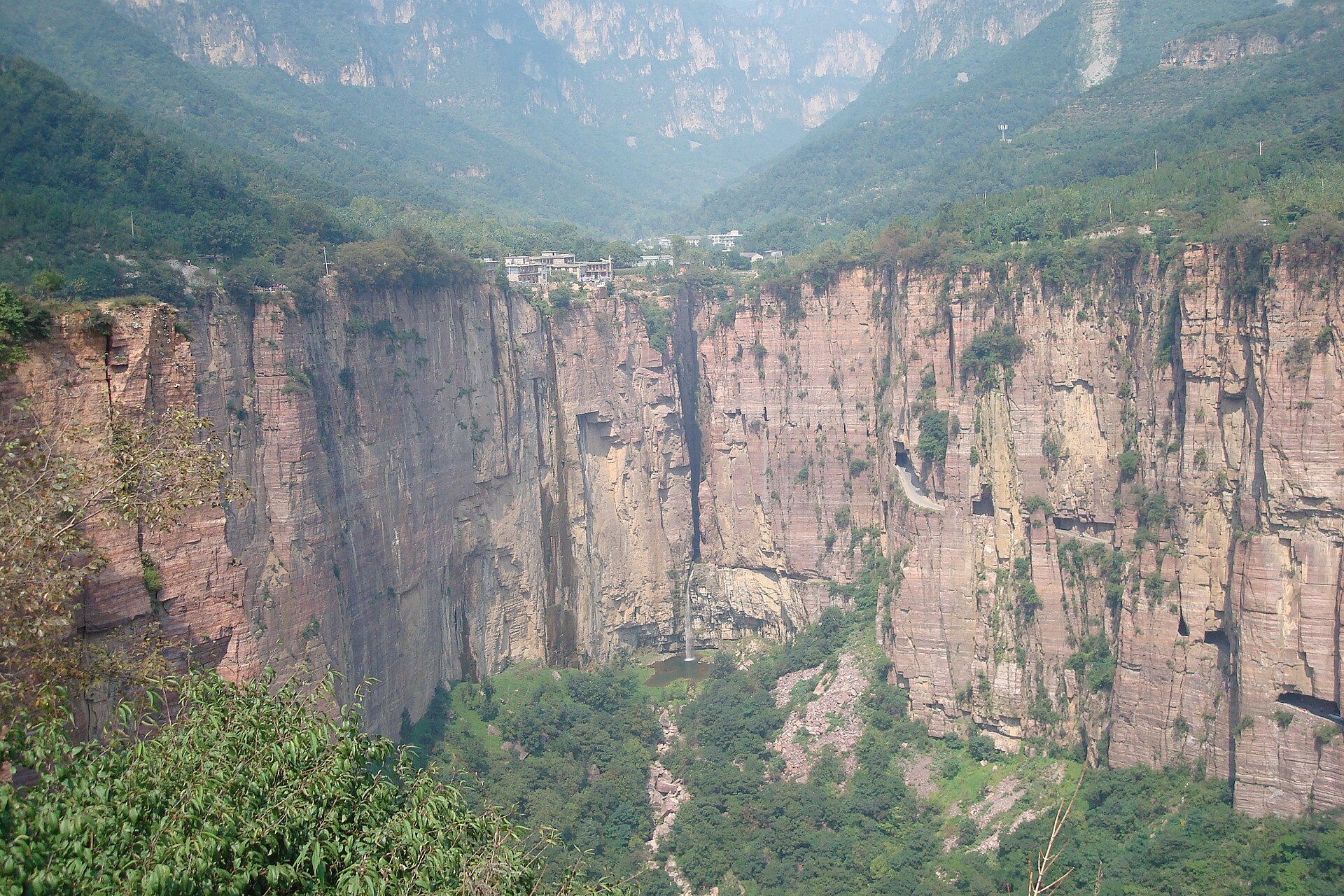
The top of the south Taihang escarpment, with the canyon floor at 800 — a thousand metres of relief in a kilometre and a half of horizontal distance.
The village on the cliff top, with the tunnel cut at about 1,100 and the valley floor at 600.
Junji Peak on Taishi. Shaoshi’s Liantian Peak is slightly higher at 1,512, and steeper.
Juzhu Peak, the summit of the massif, with the red gorge floor at about 600.
Zhengzhou at about 100 metres, Kaifeng lower, and the lowest point of the province at 23.2 metres where the Huai leaves for Anhui.
Steps, exposure and heat.
Sanhuangzhai is three to four hours of stairs; the Songshan summit four to five; Laojun’s summit stair is short but steep; the Wangxiang ladder at Linzhou is 88 metres vertical in one pitch.
The older routes here are cut into rock rather than laid as blocks: uneven, narrow, and often without a handrail on the outside edge. Poles help more than boots.
Several of the classic walks — the Guoliang gallery, the Sanhuangzhai plank road, the Wangxiang ladder — are on vertical faces with real drops. If that is a problem, say so early; there are alternatives for every one of them.
Where the difference is.
The Taihang rim, the Songshan summit and Laojun Mountain all run 8 to 12 degrees colder than the plain, with wind. Snow from December, rime into March.
Red Stone Gorge and the Taohua valley stay cool and damp all year because they are deep and shaded. A wet gorge at 30 degrees outside is still a wet gorge.
Cold, dry and hazy, with temperatures near freezing and occasional snow that shuts the motorways rather than the mountains.
Tell us how many stairs a good day contains and whether exposed walkways are a pleasure or a problem. In Henan those two answers design the trip.
Start my journey brief ↗