The cliff gallery
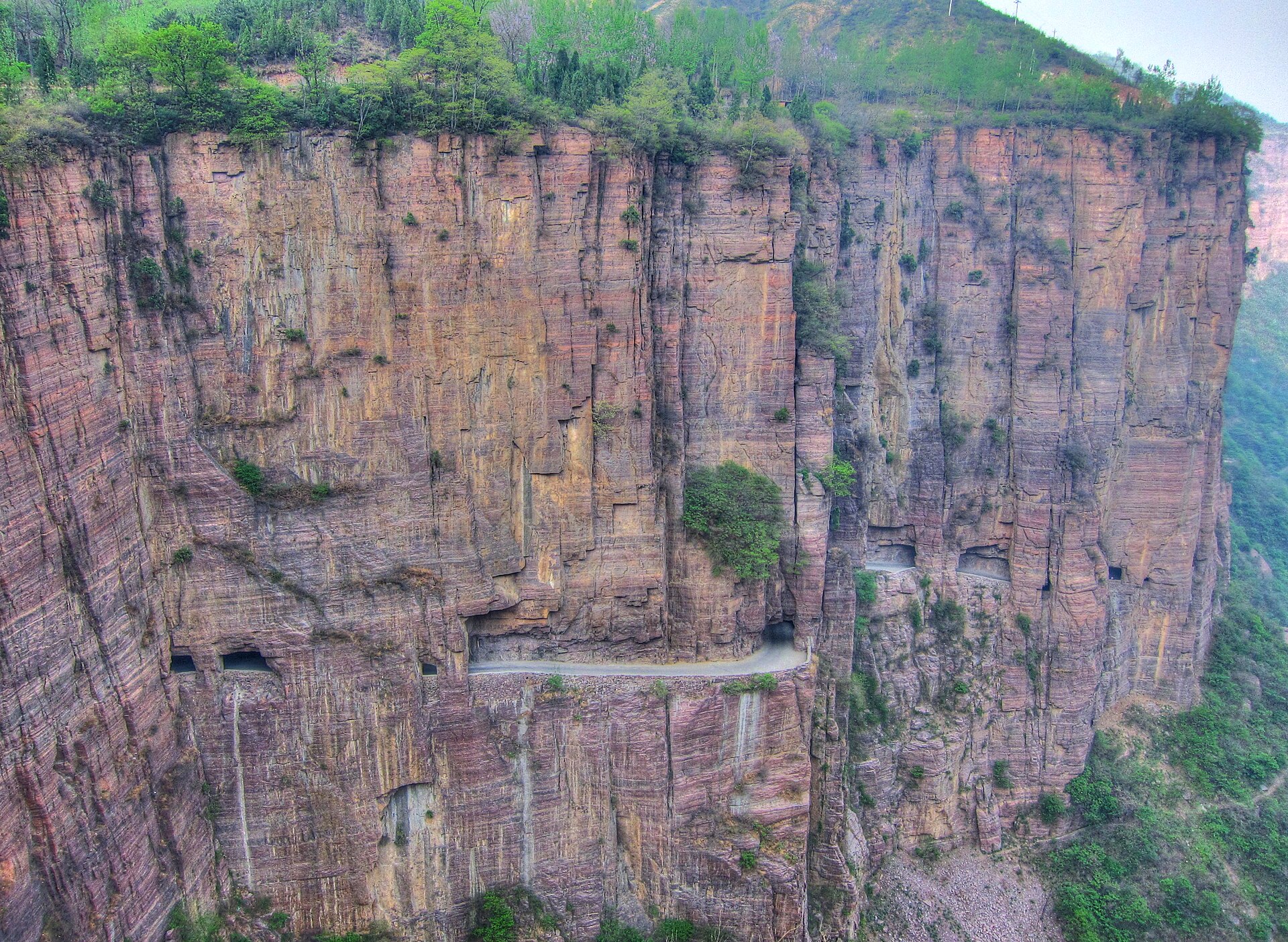
The road itself: cut as a gallery with one open side, so the whole traverse is a series of windows onto the valley. Walk it if it is closed to vehicles, drive it if it is not, and stop at the numbered openings.
 Start your enquiry
Destinations / Henan / Guoliang
A village on top of a cliff, and the 1,250-metre tunnel that thirteen men cut through the rock to reach it. Five years of hammering, thirty-five windows, and one lane.
Explore the guide ↓Northern Henan · Huixian · 1,700 m
Until 1977 the only way into Guoliang was a staircase cut into the cliff: 720 steps, unwinding up a vertical face, forty centimetres wide at the narrowest point and with nothing between the walker and the drop. Salt, oil, a pig, a marriage — everything came up those steps on somebody’s back. It took two hours to reach the valley floor.
In March 1972 the village party secretary, Shen Mingxin, started the alternative. Thirteen men began cutting a gallery through the cliff from both ends, with hammers, steel drills and home-made explosives, lowered on ropes against the face. There was no machinery, no electricity and no survey. They got through five years and two months later: 1,250 metres of tunnel, five high and four wide, with 35 openings blasted out for light and for tipping the spoil. Four thousand hammers were worn out, twelve tonnes of drill steel were ground away, and twenty thousand cubic metres of rock came out of the wall. The first vehicle drove in on 1 May 1977.
The road is still the village’s only access, and it is still one lane. What has changed is the traffic: 105 households, most of them now running beds or food, sixty-odd films and television series shot here, and a car park at the bottom of the cliff. The tunnel is the reason they came, and the tunnel is genuinely worth the trip — not as a curiosity but as a piece of engineering that a village did to itself.
The gallery, the village above it, the old stair and the wider massif.
The road itself: cut as a gallery with one open side, so the whole traverse is a series of windows onto the valley. Walk it if it is closed to vehicles, drive it if it is not, and stop at the numbered openings.
The cliff-top settlement: stone houses, narrow lanes, and the viewing platforms on the rim that look straight down onto the tunnel’s windows. The reason to sleep up here rather than below.
The path the village used for centuries, still there, still narrow, and now a walk rather than a necessity. Steep, exposed in places, and the best way to understand what the tunnel replaced.
The massif around the village, with two other valleys — Nanping and Luojiazhai — and a ridge of red towers above them. Adds a day if the tunnel alone feels thin.
Ice closes the gallery; October fills it.
The best window. Green on the cliff, the road dry, and the village not yet full. Mornings are often clear and afternoons build cloud.
The rains, and the risk of rockfall on the face. The valley below runs with water and the cloud sits in the gorge, which is atmospheric but can close the road.
The best light and the biggest crowds, particularly the first week of October. Book beds at the top; day-trippers arrive at ten and leave at four.
Cold and quiet, with ice in the tunnel where water seeps through the roof. Some winter closures after snow, and the best chance of having the gallery to yourself.
Xinxiang in, Huixian through, and up.
Xinxiang East is the nearest high-speed station, about 25 minutes from Zhengzhou. Huixian is forty minutes west, and the park gate another hour. Most people come by car or on a small-group tour from Xinxiang.
Private cars are stopped at the gate in season; park buses run up to the tunnel and through it. The last bus down leaves in the late afternoon, which is the argument for staying the night at the top.
The village has perhaps thirty guesthouses, all family-run, most with rooms looking over the drop. Simple, cheap, and the only way to see the place at dawn and after the buses leave.
A road with names attached to it.
The village secretary who proposed the tunnel and led the work. The decision was his, and so was the risk: the village had no money and no permission to spend what it did not have.
Thirteen men in the cutting team, with the rest of the village carrying spoil, making rope and growing the food. The figures usually quoted — 4,000 hammers, 12 tonnes of steel, 20,000 cubic metres of rock — are the village’s own accounting, repeated in every account since.
More than sixty films and television series have been shot here since the 1990s, which is why the village looks familiar even if you have never been. It also explains the guesthouse economy and the props still standing in the lanes.
One lane, exposed edges and the way down.
The gallery carries vehicles, and in season that means buses. Walking it is possible when it is closed to traffic and inadvisable when it is not. Ask at the gate which it is today.
The face sheds rock after freeze-thaw and heavy rain, and the road closes when it does. That is a normal operating condition here rather than a disaster, but it can cost you the day.
The best view of the tunnel is not from inside it but from the rim above the village, looking down at the line of windows in the wall. Allow an hour for that and go at sunrise.
Tell us whether you will sleep at the top and whether you want the old stair as well as the tunnel. The village after the buses leave is a different place.
Start my journey brief ↗